HECTIC READING. STARTING ALL OVER AGAIN (3)
It’s happening again: I’m reading hectically. I’m filling up. Little in the way of rhyme or reason at this stage, just following the imagination’s peccadilloes. I finish a book and within minutes I’m reaching for a new one. Every few days I stop long enough to write notes, prompted by my jottings in the back of each book and the wanderings of a mind set free. The jottings and the notes sometimes bear no relation to anything that has gone before, but more often they feed the new novel that is slowing forming, or, not so much the novel as a whole, but the characters who will carry the story.
Here are the current volumes.
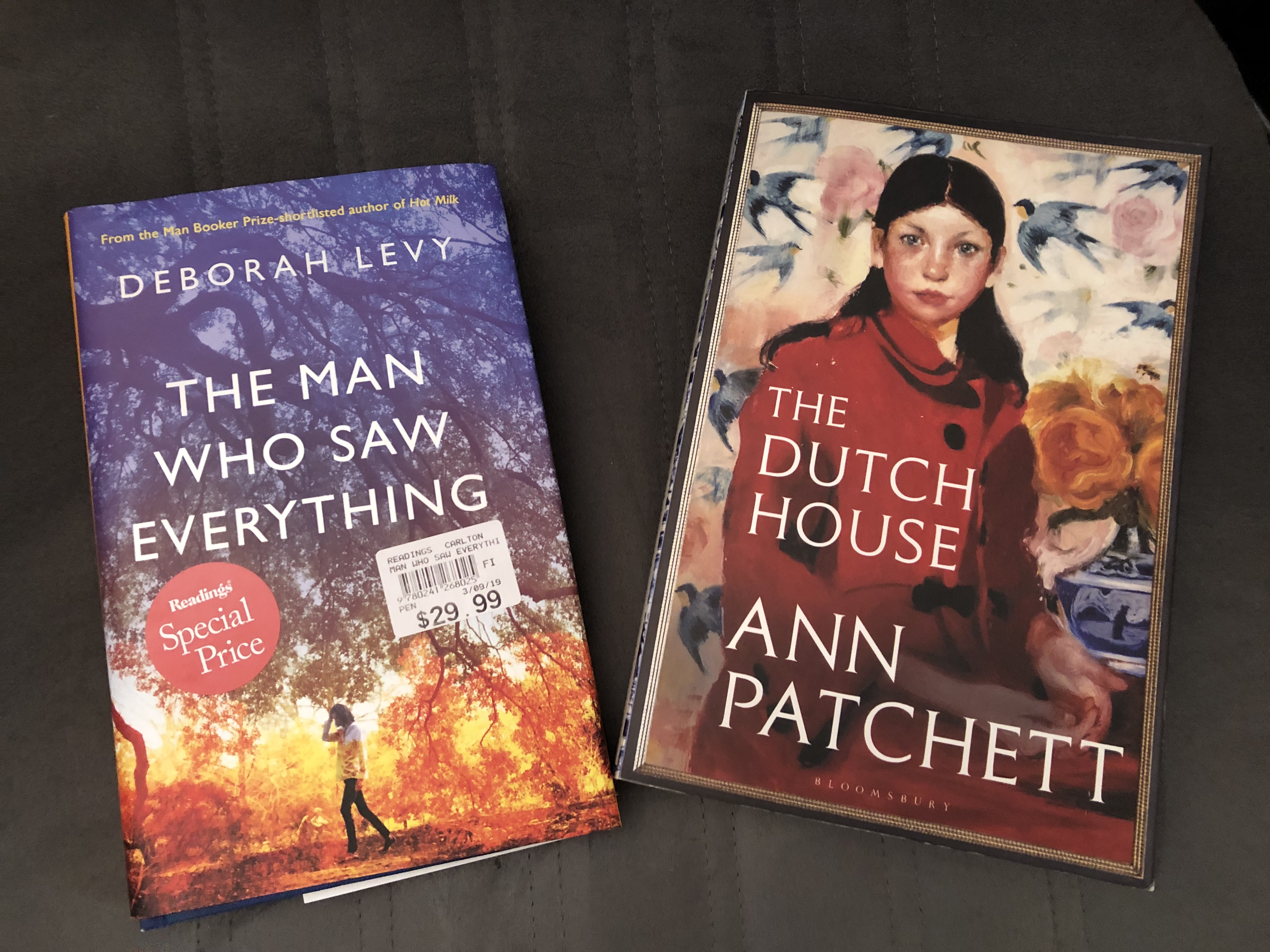
- Deborah Levy. The Man Who Saw Everything. I’m reading this book because of Ann Patchett’s new novel, The Dutch House. I went to Readings Bookstore in Carlton to buy the Patchett, and there, in the new releases was Deborah Levy’s new one, a novel that traverses the 1980s to the present day, character-based and ideas-driven, and written in Levy’s lucid rich prose. I am 1/3 the way through and Levy’s characters are provoking some surprising thoughts about my own very different characters. (Incidentally, Patchett has returned to form with The Dutch House. Such a subtle, yet intricate portrayal of family relations.)

- David Biale. Gershom Scholem. Master of the Kabbalah. Mention of this book was made in a recent article in the NYRB. It occurred to me that while Scholem’s name was very familiar to
 me, I knew nothing about him, nor the Kabbalah. Biale’s book is part of the excellent Yale Jewish Lives Series – a recommendation in itself.
Jewishness in any of its manifestations is not a theme in my new novel, but suddenly it seemed essential, and urgent, too, that I learn about Scholem. I read the book over two days. Scholem was a great scholar and there are some wonderful quotes in Biale’s book about the power of writing, of language, of story. One quote from Goethe’s Faust particularly struck: ‘Parchment – is that the secret fount/ from which you drink, to still your thirst forever?’ And from Scholem himself: ‘the desiccation of the language has dried out our hearts.’
One of the characters in my new novel, Adrian, is grappling with the problems of meaning, and, in particular, the nature of meaning without language. I put my books aside and listen to Mahler’s ‘Das Lied von der Erde’, a piece of music that has a profound effect on Adrian early on in the new novel, an effect that, wordman as he is, he simply does not understand. I let the music lift me out of the quotidian into the imagination’s swirl. The music plays, the voice lures, and I travel without will, without any monitoring whatsoever, through memory, musings, ideas, images that are not in the least essayist, but more like a Kandinsky painting.
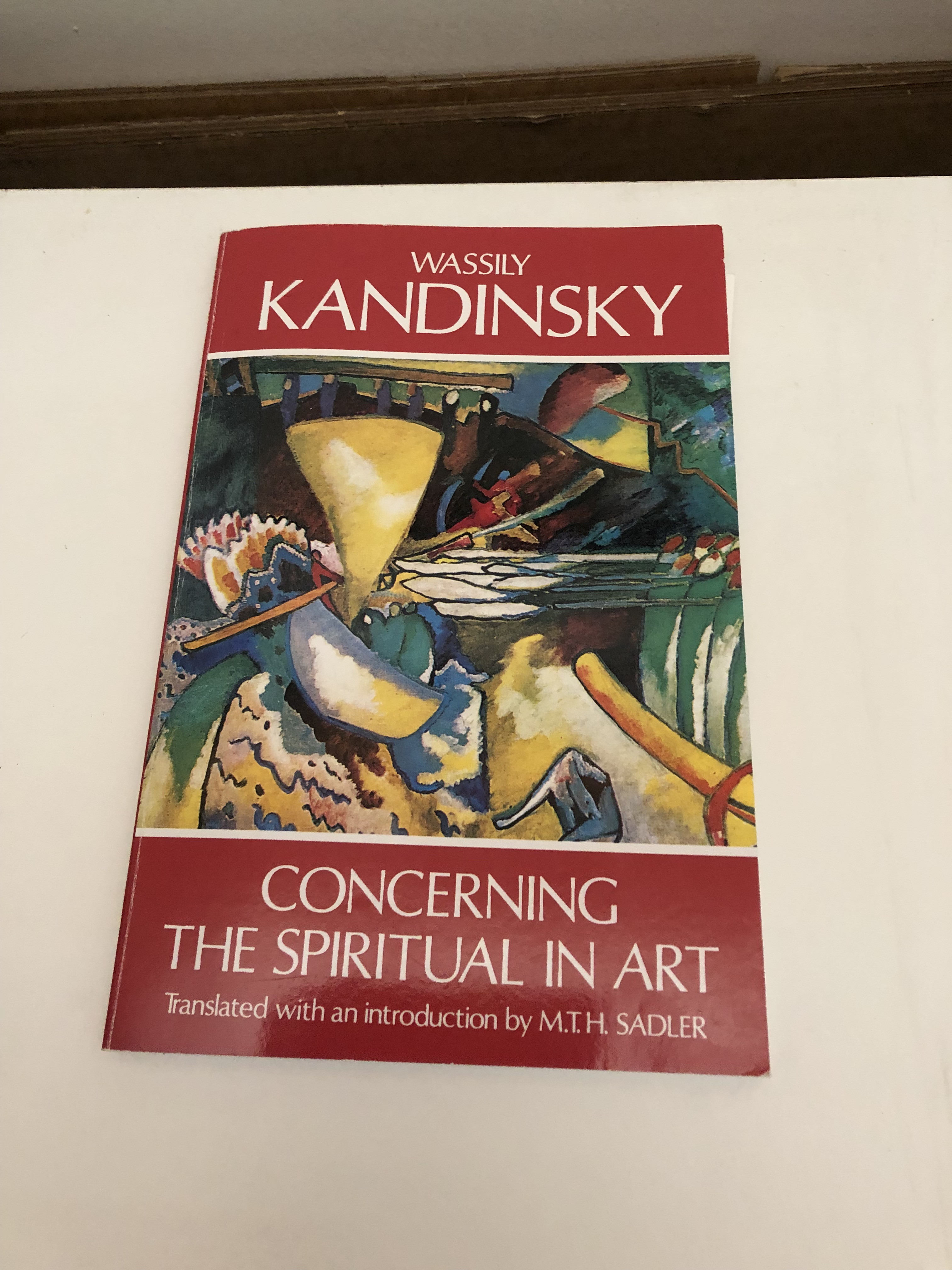
- Wassily Kandinsky. Concerning the Spiritual in Art
 In this book, Kandinsky explains his theory and understanding of art, music, and the numinous. In the years 1911-1914, Kandinsky produced a number of large lyrical paintings. I’ve always loved these paintings, but it was only this past November, when I saw some of them again at Munich’s Lenbachhaus, that I realised the connection these paintings have to music and, more generally to a meaning that seems to circumvent language (Rothko’s work has the same effect). As I read Kandinsky’s book – it’s a slender book, but it demands a careful reading – some of the struggles and insights that beset my character, Adrian, sharpen and, at the same time, acquire a firmer foundation. Rather than the usual fragments that characterise this early stage of a novel, I actually reach for a proper notebook and write several pages.
- While I was in Germany I read Marjorie Perloff’s Edge of Ironyin which she, like others before her, visits the Hungarian intellectuals of the mid-twentieth century, an extraordinary group that included the mathematician John von Neuman, Arthur Koestler and Robert Capa, my favourite physicist Leo Szilard, and Elias Canetti – although Canetti could be said to have come from several places including Bulgaria and Vienna. Anyway Canetti was mentioned by Perloff, and I realised I had not read his three-volume autobiography. I’d always assumed I had, it being one of the books I OUGHT to have read.
I’ve read the first volume now, The Tongue Set Free, and am 2/3 the way through the second  volume, The Torch in My Ear,the volume that charts his late teens through his twenties.
Books find you at the right time, and this is clearly my time for the Canetti autobiography. This morning I read a section in which Canetti may or may not be in love with a Russian chemist, Eva, who works in the same laboratory as he does. I think of the ramifications of not knowingif you love someone, and I’m not thinking of Canetti and the Russian chemist, I’m thinking of another of my characters, Claire, caught in a marriage that she regards as deep and meaningful and everyone else sees as cruel and destructive. I make some jottings and read on. Several pages later, Canetti writes of a specific type of hearing, a rare type of hearing that ‘was impossible unless you exclude your own feelings.’ My character Claire thinks about the common intrusion of this ‘I’. What people usually hear is first sieved through a mesh of their own desires and disappointments. And Claire starts to wonder about her own husband, what actually drives him in his relationship with her. I reach for the notebook.
- And poetry. I’m still dipping into Ted Hughes’ Crow— my character Adrian is an expert on death – and I’m about to pull down Goethe’s Prometheusfrom the shelf (it was mentioned in the Canetti autobiography), and I’ve not long finished The Death of Empedocles, both Hölderin’s and Matthew Arnold’s versions.

So this is just the current reading. If I glance down my lists for the last months of 2019 there are a lot of books, and very diverse. And what emerges from all this reading? An imagination that is ranging far and wide (definitely without a roadmap), new thoughts, new ideas, nascent characters who are gaining in flesh and sensibility, interesting scenes and curious events (most of which won’t survive the first draft), and three roughish chapters.
And so it goes. At the end of it all one hopes there’ll be a new novel. Ihope there will be. But it couldn’t happen without reading. Indeed,lifecouldn’t happen without reading.
.





 Andrea Goldsmith