Tag Archives: Randa Abdel-Fattah

AFTER BONDI 2

AFTER BONDI 2

A note before I begin:

This post has been prompted by the responses to the previous post, so I would suggest that post be read first. Also, I meant to add a link to the Australian Book Review in which 5 Jewish Australians respond to the Bondi massacre. It is an excellent overview from 5 progressive writers – politically, religiously and culturally.

Here the link:
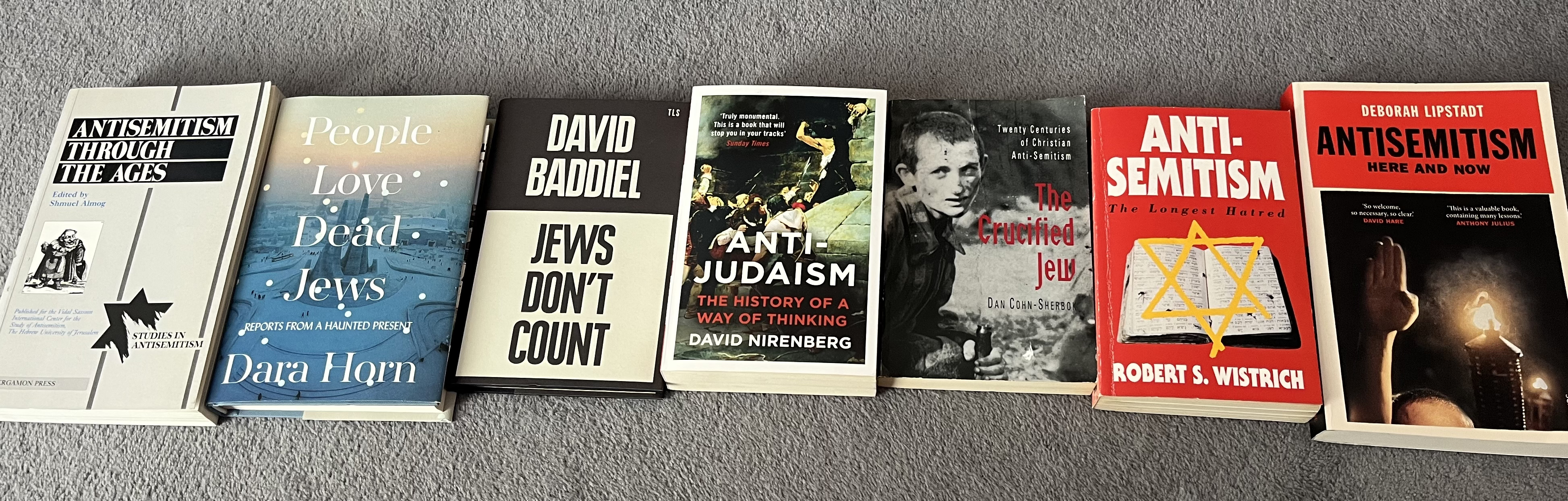
From my library.

I have been shocked at the level of antisemitism, how it has become normalised among certain groups. When people shout ‘Gas the Jews’, do they know what they are saying? Do they know about the historical reference? Do they want to kill Jews? Or do they want others to do the killing for them?

It is antisemitism that prompted the previous post: specifically, how people have used the actions of the Israeli government and military in Gaza to vent their hatred of Jews. People have also used the actions of the Israeli government and military to call for the elimination of Israel as a country. They argue that Israel should never have been brought into existence. This is what anti-Zionism means: that Israel has no right to exist. In contrast, a Zionist, as Lisa Hill points out, simply means someone who recognises and accepts Israel as a legitimate state, a country. 

As I wrote in my earlier piece, if not for the widespread hatred of Jews in the 19th century, the Zionist movement might never have been founded. And if not for the virulent antisemitism in Nazi Germany, 6 million European Jews would not have been murdered (while the allies did next-to-nothing to stop the slaughter). And if not for the murder of 6 million Jews (a number approximately the same as the combined populations of greater Melbourne and greater Geelong) there may not have been a guilty rush to give Jews a sanctuary/country of their own.

I define my own Jewishness in terms of family, history, culture and as a Jewish Australian. (Years ago, I wrote a long essay, ‘Only Connect: Musings of an Australian Jew’. I’ll post it under published essays in the next day or so.) While I do not feel a connection to Israel in the same way as other Jews do, I support the country of Israel, its right to exist, I support its legitimacy. But that does not stop me from being critical of the actions of the current government. I would like to think that this same view is held by Christians, Hindus, Muslims, Buddhists, and people of no religion at all.

And I support the right of Palestinians to have their own state. Both peoples have historical claims to the land, and, indeed, there have been periods in the past when Jews and Muslims have lived in peace alongside each other (as indeed many of the 1200 Jews killed by Hamas on October 7th had lived closely and peacefully with their Palestinian neighbours). Both groups have not been served well by their current leaders.

I abhor this recent trend in identity politics that would prevent non-Jews talking about Jewish issues, or non-Muslims speaking of Muslim issues. I hate the one-dimensionality of identity politics. So, of course I welcome the responses of Lisa and Tim. Indeed, after the Hamas killings on October 7th 2023, and following the Bondi Murders, I drew huge consolation from the many non-Jewish friends and acquaintances who reached out to me. They understood, they were speaking out, and I thank them for it.

I finished the earlier post with a comment about AWW’s disinviting of Dr Randa Abdel-Fattah to this year’s festival. I disagree with most of what Abdel-Fattah believes. She is aggressively anti-Zionist and has uttered offensive statements that can be easily interpreted as antisemitic. But I do not support her being banned.

Her banning is not, in my opinion, a free speech issue. Removing her from a public cutural forum like AWW will not silence her. Indeed, in these times there are so many on-line outlets where she, and others like her can say whatever they like without being called to account. A cultural forum is exactly where she should be allowed to speak, in real time, and subject to dialogue with people who can challenge her views. There’s not much in the way of dialogue nor opportunity for opposing views in the on-line silos. Bring her resentments and accusations out in the open, in the real world, where her views can be subject to scrutiny and challenged.

You are so right, Lisa, about the dirth of public support from literary and cultural institutions for Jewish creatives since October 7th. It’s been disheartening to say the least. I think the withdrawal of so many writers from the AWW, though, is not so much in support of Abdel-Fattah but rather resulting from what these writers believe a public cultural forum should provide. (As an aside, my good friend Dennis Altman and I, both of us with new books published since the last AWW, were rather miffed we didn’t crack an invitation to this year’s festival. How relieved we now are to be so neglected.) 

Tim – I really appreciate your drawing on the moral underpinnings of free speech and its dangers (coincidentally I’m reading about Elizabeth Anscombe at the moment), and I agree that speech that incites violence should be stopped. But at the same time there’s the distinction to be made between opinion/beliefs expressed in hate speech and propaganda/lies. There’s an element of coercion in propaganda, and it’s sinister as well: you’re being screwed and you don’t know you are. This is harmful. Hate speech can be hurtful, but at least it’s clear and unambiguous: you know what you must oppose. And at a public cultural forum, the speaker, one would hope, would be required to defend her position. (I should add, at this point, that I don’t know what sessions were planned for Abdel-Fattah, and with the AWW website now cleared, I cannot check.)

I held these same views when the English-speaking world’s most infamous antisemite and Holocaust denier, David Irving, was banned from entering Australia. Let him speak, I said. Let him be forced to defend what I consider an indefensible position.

AFTER THE BONDI MASSACRE

It is the oldest, most enduring form of racism, and the oldest, continuous expression of hatred. I refer to antisemitism, though I am reluctant to use the term, it is too polite, too cool, a euphemism of sorts for the far blunter (and some would consider unsayable) ‘Jew hatred’ or ‘hatred of Jews’. The term, antisemitic (antisemitisch), was coined by a German journalist, Wilhelm Marr in the 1870s. But hatred of Jews can be traced back to well before the Christian era.

While hatred of Jews and Zionism are often erroneously conflated in the contemporary period, historically they are connected. Zionism as a movement emerged not long after Marr’s neologism. Theodor Herzl (1860-1904), an Austrian lawyer and journalist, and the man considered the father of Zionism believed, along with many other secular European Jews of his time, that assimilation of Jews was desirable. However, given how widespread anti-Jewish sentiment was, assimilation was neither realistic nor viable, thus the need for a Jewish state. The obvious location was the region where Jews had historical roots and a significant presence, namely, Palestine.[1]

While Zionism was led by a German-speaking intellectual, the movement drew most of its supporters from pre-revolutionary Russia (which included present-day Poland and Ukraine) where pogroms, i.e. massacres of Jews, were common. Indeed, without the prevalence of Jew hatred one could hypothesise there might have been no Zionist movement. 

Since October 7th, 2023, there have been mass rallies in Australian cities. The sloganeering around Zionism has veered from the nonsensical ( ‘Zionism is Genocide’) to the ignorant (‘Globalize the Intifada’) to the murderous (‘Oct 7, do it again’.) And there’s been a swathe of specifically anti-Zionist slogans aimed at the very existence of the country of Israel (i.e. its right to exist) as against the actions of its government, the most common being ‘from the river to the sea’.[2]

Antisemitism, hatred of Jews, never goes away. It is not, as a young friend suggested to me ‘a light sleeper’: antisemitism never sleeps. As late as the 1970s in America some apartment buildings were ‘restricted’, a euphemism for ‘no Jews’. And here in Australia, the Melbourne Club was notorious in its prohibition against Jews as members; neither was it alone, a number of sporting clubs and golf courses had similar unwritten policies that banned Jews.[3]

When I was 8 years old a girl at my school called me ‘a dirty Jew’ (clearly an insult inherited from her parents), and in the 1970s when a close friend of mine was marrying a man with a Russian surname, her parents’ first response, was to ask, and ask with horror, whether he was Jewish (though they didn’t use the word ‘Jewish’, instead choosing to use an antisemitic term). Antisemitism, hatred of Jews, rumbles along with slurs and slogans until circumstances provide it with a platform to muscle up. And it rarely misses an opportunity to do so: from the death of Jesus to the black death; from Dreyfus to communism; from the Treaty of Versailles to whatever hardships Germany suffered after the Great War these circumstances are among the many that have been used to embolden the Jew haters.

We Jews are a diverse group. From the point of view of religion, there are ultra-orthodox Jews like the members of Adass Israel synagogue in Melbourne that was burned down a year ago in an antisemitic attack; there are orthodox Jews who keep kosher and wear a kippah and who are regular targets for Jew hatred; there are relatively secular Jews who attend synagogue maybe a couple of times a year whose children have barmitzvahs and batmitzvahs, but that’s about it; there are Jews who are right wing and conservative, and there are others, like me and the family I was born into who are left-wing and progressive.[4] There are Jews whose sense of being Jewish is connected to Israel, and there are many, like me, a Jewish Australian who is fifth generation Australian through 3 of her grandparents, whose sense of being Jewish is not linked to Israel.

Hatred of Jews has gone unchecked these past 2 years since the massacre of October 7th. I was shocked and appalled at the Hamas attack, but I have also been horrified by the Israeli government’s response. It’s one thing to hunt down terrorists, but not when it means the death of tens of thousands of Palestinians and the destruction of Gaza. So, I support the right of people to protest the Israeli Government’s actions. But the protests have become a grab-bag of grievances and a hotbed for antisemitism. ‘Kill the Jews’ people shouted on the steps of the Opera House on October 8th, 2023; this was BEFORE Israel had made any response. ‘Kill the Jews’, ‘Gas the Jews’ the protesters chant, many of whom could not locate Gaza or Israel on a map. So much hatred of Jews taking advantage of these protests. Antisemitism never sleeps, it’s an opportunist, it lingers in the shadows, waiting for an opportunity to act, and there has been generous opportunity these past couple of years. We Australians commonly criticise the actions of our political leaders, we criticise Trump, we had much to say about Brexit. To criticise the Israeli government is all very well, but not as a means to vent hatred of Jews.

What happened on December 14th at Bondi was inevitable. Any Australian Jew knows this. The unchecked rise in antisemitism since October 7th eventually saw 15 people murdered and dozens more injured. 

While antisemitism is the longest hatred, Islamophobia has burgeoned in the 21st century, using 9/11, and terrorist groups like Al-Qaeda and ISIS as fuel. Islam is the second largest religion world-wide behind Christianity, with Muslims commanding approximately 25% share of the world’s population against Christianity’s 31%.[5] Jews make up a meagre 0.2% which render a good many of the antisemitic conspiracy theories ridiculous.

Muslims who have made their home outside largely Muslim countries have suffered greatly, and continue to suffer, because of the actions of a few. Jews and Muslims have more in common, so it seems to me, than what divides us. We are both semitic people, we are both Abrahamic religions, and in these troubled times we both know what it is to be hated. Silencing people like the disinviting of Dr Randa Abdel-Fattah from the 2026 Adelaide Writers’ Week is not simply unhelpful, it actually feeds the hatreds. We need dialogue, and forums for dialogue, forums that include literary festivals as well as grassroots gatherings at local coffee shops. There are many instances of dialogue between our two groups – I know, for example, that my progressive synagogue has been involved – but we need more. We cannot leave it to Netanyahu and Iran’s Ayatollah or Trump to define us.


[1] In the early twentieth century, prior to the Balfour declaration, the British offered the early Zionists a swag of land in Uganda, but Herzl and his fellow Zionists held out for Palestine. One sees an echo of this in the Nazis’ early consideration of exile for Jews (as against mass murder) and the deportation in 1939 of several thousand German Jews to a barren area of Poland, at Nisko. There was also the joint Polish and French initiative of the late 1930s to exile Jews to Madagascar. Briefly, Australia’s Kimberley was considered as a place to which European Jews could be corralled.

[2] When Gaddafi was slaughtering his people did the world call for the elimination of Iraq (established as a country in 1921)? When the Taliban kill their people, as they are doing now, do we call for the elimination of the country of Afghanistan (established inn 1919)?  And when Robert Mugabe, the first president of independent Zimbabwe (1980) turned against his people, was there a call for the re-establishment of Rhodesia? 

[3] Euphemisms were generally used. Clubs and residential buildings were ‘restricted’, although the discrimination could be blatant like Lakeside Farm, a holiday venue for ‘Christian clientele’.

[4] My father (b.1919) always voted Labor and annually donated money to Israel. He said we Jews had more to fear from the right than the left, and if the worst were to happen again, the only country that would take us in was Israel. Times have changed, and I am so pleased he is not around to witness it.

[5] Pew Research Centre Forum on Religious & Public Life. Global Religious Landscape. December 2012.