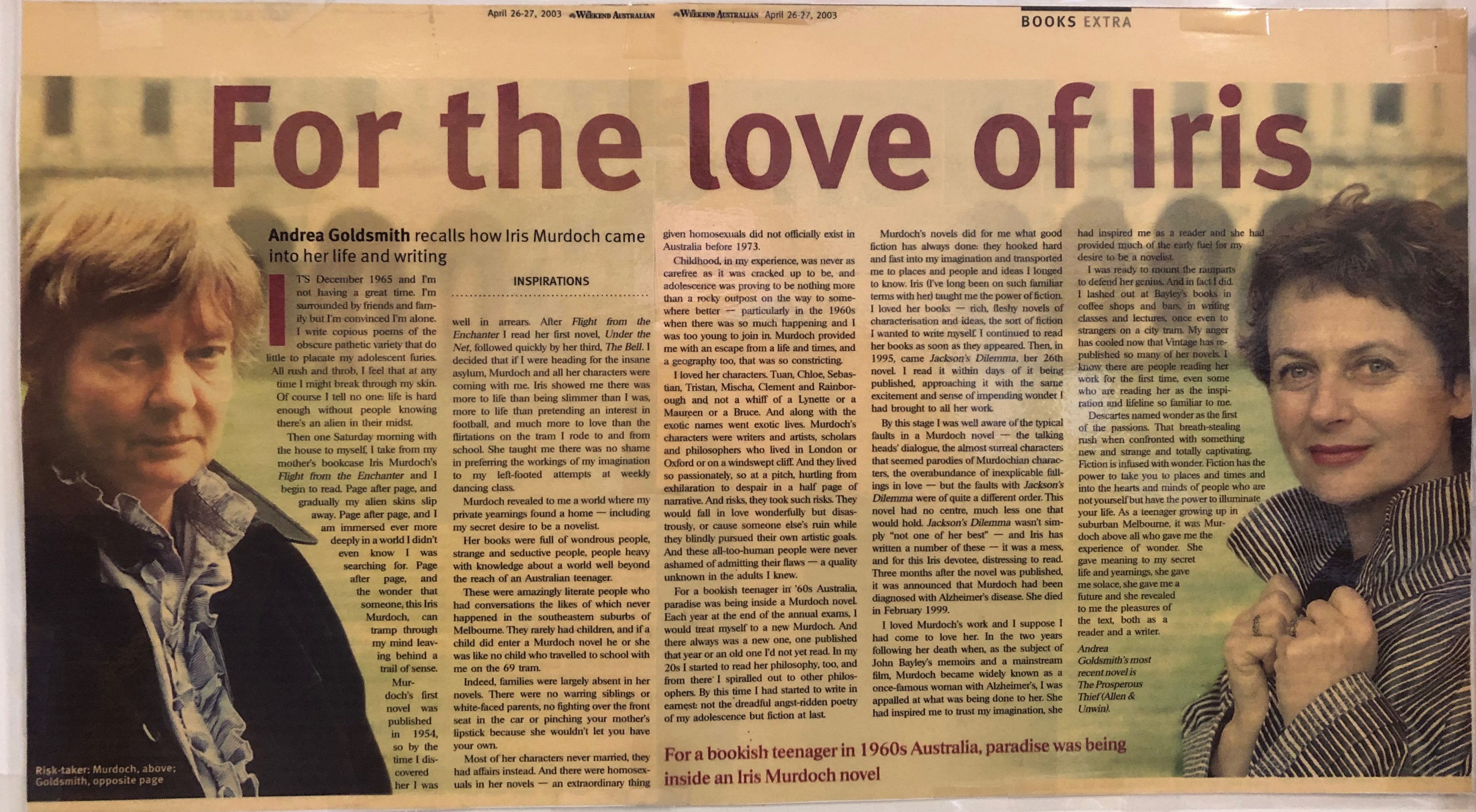
Way back in 2020, in a post titled WHEN THE LIGHTS GO DOWN: Truth, authenticity and personal allegiance in fact-based film, I mentioned a piece I had written for The Australian (April 26-27, 2003) following the death of Iris Murdoch. I recently reread the article, the first time in many years. It speaks of the passion for reading, the gifts of the imagination, and it spoke to me now in this time when attention is being pulled every which-way, it spoke to me even though I was the writer. So I decided to post it here.*
It’s December 1965 and I’m not having a great time. I’m surrounded by friends and family but I’m convinced I’m alone. I write copious poems of the obscure pathetic variety which do little to placate my adolescent furies. All rush and throb, I feel that at any time I might break through my skin. Of course I tell no one: life is hard enough without people knowing there’s an alien in their midst.
Then one Saturday morning with the house to myself, I take from my mother’s book-case Iris Murdoch’s Flight from the Enchanter and I begin to read. Page after page, and gradually my alien skins slip away. Page by page, and I am immersed ever more deeply in a world I didn’t even know I was searching for. By the halfway mark I’m struck with wonder that someone, this Iris Murdoch, can tramp through my mind leaving behind a trail of sense.
Murdoch’s first novel was published in 1954, so by the time I discovered her I was well in arrears. After Flight from the Enchanter I read her first novel, Under the Net, followed quickly by her third, The Bell. I decided that if I were heading for the insane asylum, Iris Murdoch and all her characters were coming with me. Iris showed me there was more to life than being slimmer than I was, more to life than pretending an interest in football, and much more to love than the flirtations on the tram I rode to and from school. She taught me there was no shame in preferring the workings of my imagination to my left-footed attempts at compulsory sport. Iris Murdoch revealed to me a world where my private yearnings found a home – including my secret desire to be a novelist.
Her books were full of wondrous people, strange and seductive people, people heavy with knowledge about a world well beyond the reach of an Australian teenager. These were amazingly literate people who had conversations the likes of which never happened in the south-eastern suburbs of Melbourne. They rarely had children, and if a child did enter a Murdoch novel he or she was like no child who travelled to school with me on the 69 tram. Indeed families were largely absent in her novels. There were no warring siblings or white-faced parents, no fighting over the front seat in the car or pinching your mother’s lipstick because she wouldn’t let you have your own. Most of her characters never married, they had affairs instead. And there were homosexuals in her novels – an extraordinary thing given homosexuals did not officially exist in Australia at that time.
Childhood, in my experience, was never as happy and carefree as it was supposed up to be, and adolescence was proving to be nothing more than a rocky outpost on the way to somewhere better – particularly in the 1960s when there was so much happening and I was too young to join in. Iris Murdoch provided me with an escape from a life and times, and a geography too, that was so constricting.
I loved her characters. Tuan, Chloe, Sebastian, Tristan, Mischa, Clement, Rainborough, with not a whiff of a Lynette or a Maureen or a Bruce. And along with the exotic names came exotic lives. Murdoch’s characters were writers and artists, scholars and philosophers who lived in London or Oxford or on a windswept cliff. And they lived so passionately, so at a pitch, hurtling from exhilaration to despair in a half page of narrative. And risks, they took such risks. They would fall in love wonderfully but disastrously, or cause someone else’s ruin while they blindly pursued their own artistic goals. And these all-too-human people were never ashamed of admitting their flaws – a quality unknown in the adults I knew. For a bookish teenager in 1960s Australia, paradise was being inside an Iris Murdoch novel.
Each year at the end of the final exams, I would treat myself to a new Iris Murdoch. And there always was a new one, either one published that year or an old one I’d not yet read. In my twenties I started to read her philosophy too, and from there I spiralled out to other philosophers and thinkers. By this time I had started to write in earnest: not the dreadful angst-ridden poetry of my adolescence, but fiction at last.
Iris Murdoch’s novels did for me what good fiction has always done: they hooked hard and fast into my imagination and transported me to places and people and ideas I longed to know. Iris (I’ve long been on such familiar terms with her) taught me the power of fiction. I loved her books – rich, fleshy novels of characterisation and ideas, the sort of fiction I wanted to write myself.
I continued to read her books as soon as they appeared. And then, in 1995, came Jackson’s Dilemma, her 26th novel. I read it within days of its being published, approaching it with the same excitement and sense of impending wonder I had brought to all her work. By this stage I was well aware of the typical faults in an Iris Murdoch’s novel – the talking heads’ dialogue, the almost surreal characters that seemed parodies of Murdochian characters, the over-abundance of inexplicable fallings in love – but the faults with Jackson’s Dilemma were of quite a different order. This novel had no centre, much less one that would hold. Jackson’s Dilemma wasn’t simply ‘not one of her best’ – and Iris has written a number of these – it was a mess, and for this Iris devotee, distressing to read. Three months after the novel was published, it was announced that Iris Murdoch had been diagnosed with Alzheimer’s Disease. In February 1999 she died.
I loved Iris Murdoch’s work, and I suppose I had come to love her. In the two years following her death when, as the subject of of John Bayley’s memoirs and a mainstream film, Iris Murdoch became widely known as a once-famous woman with Alzheimers, I was appalled at what was being done to her. She had inspired me to trust my imagination, she had inspired me as a reader and she had provided much of the early fuel for my desire to be a novelist. I was ready to mount the ramparts to defend her genius. And in fact I did. I lashed out at Bayley’s books in coffee shops and bars, in writing classes and lectures, once even to strangers on a city tram.
My anger has cooled now that Vintage has re-published so many of her novels. I know there are people reading her work for the first time, even some who are reading her as the inspiration and lifeline so familiar to me.
Descartes named wonder as the first of the passions. That breath-stealing rush when confronted with something new and strange and totally captivating. Fiction is infused with wonder. Fiction has the power to take you to places and times and into the hearts and minds of people who are not yourself but have the power to illuminate your life. As a teenager growing up in suburban Melbourne, it was Iris Murdoch above all who gave me the experience of wonder. She gave meaning to my secret life and yearnings, she gave me solace, she gave me a future, and she revealed to me the pleasures of the text, both as a reader and a writer.
_____________________________
There has been a long time between posts, occasioned by far too many annoying intrusions this past year – a situation I hope will not be repeated in the years to come. And…I have a newly renovated study, so splendid I expect I’ll want to spend most of my life in here.
Talk given via Zoom, at the invitation of the Film Circle at the Melbourne Lyceum Club, August 18th, 2020.
It’s a common enough happening: you and a friend have a cinema date. Knowing your friend’s interest in maths, you suggest A Beautiful Mind, the film about the great mathematician, John Nash.
Russell Crowe is in the title role.
Your friend is appalled. ‘Crowe looks nothing like Nash. Come to that, Crowe looks nothing like any Princeton-trained mathematician.’
Russell Crowe, she’s suggesting, would not be convincing as an intellectual.
Your friend knows very little about Russell Crowe, but she does know a lot about mathematicians. This should have steered you to a safer topic, one in which your friend had less of an interest, less knowledge, less personal investment, but instead you stick with mathematicians and suggest they see The Imitation Game, a biopic of Alan Turing, the brilliant mathematician, father of the computer and leader of the team that broke the enigma code at Bletchley Park. Your friend is a great admirer of Turing, she would probably say that he, more than any other single person, was instrumental in the allied victory in WW2.
So, off the two of you go to The Imitation Game.
When the film begins you are immediately engrossed, but your enjoyment is short-lived, interrupted as it is by derisive explosions that issue evermore frequently from your friend seated beside you. The interruptions become so frequent and the anger of your friend so palpable, that you suggest she leave the cinema and wait for you outside.
She refuses to leave, someone has to witness this travesty, someone who has a deep admiration and a deep sympathy for Alan Turing.
The two of you have planned a drink and early dinner at Jimmy Watson’s following the film. Given your friend’s behaviour during the film, you know what’s up ahead and really wish you could leave her and just go home. But there’s no escape. She hatedthe film and she can’t wait to tell you why. The film, she said, placed far too much emphasis on Turing’s social awkwardness, it made him out to be hardly a social being at all.
‘We, today, are so fixated on the autism scale, but it didn’t exist back then. Why pathologise the man? He was a genius. Why should we expect a genius, a person exceptional – unique – when it concerned maths and puzzles and probably a whole lot more besides, to be just like the rest of us in the food-and-drink aspects of life?’
The film, she said, was indeed a travesty of the great man. It showed little sympathy for what it was to be a homosexual at a time when homosexuality was a criminal offence. And throughout the film his mathematical genius was completely over-shadowed by his personal and social deficiencies – your friend, of course, did not use the word ‘deficiencies’. There was nothing deficient in her view of the great Alan Turing. The film, she said, portrayed him as a hectoring, immature, insensitive idiot savant, who was often short on savant.
‘And,’ she added, ‘where was his mother? Apart from a couple of brief mentions, she plays no part in the film and yet she was solidly central in his life.’
Your friend is not happy. She seems personally affronted, she IS personally affronted: Turing is, after all, a figure in her pantheon of heroes, and the film has done him wrong.
But, you say, Benedict Cumberbatch was so convincing, he lent authenticity to the role – at least he did from your less-informed point of view.
Your friend grants that Cumberbatch showed himself to be a fine actor, one who would have done Turing proud if he didn’t have to keep proving throughout the film that he was on the autism scale.
You raise the issue of creative licence and film as entertainment, but she will have none of it: if you want to portray a life then you do justice to that life by presenting it accurately. A life is a life.
But, you continue, a film lasts 90 minutes, a life is several decades long, so of course there will be selections, and of course those selections will be made with the mode – film and entertainment – in mind.
Your friend is unmoved: if they have to skew the life out of all recognition in order to make good entertainment, then they should have chosen either a different topic or a different script-writer.
It’s a familiar scene, we’ve all been there. And it’s not just confined to film: novels that are based on true events and/or real people, the so-called faction form (which seems rather a contradictory term) or the new hybrid form, auto-fiction, are susceptible to the same conflicts, the same arguments. As are films based on novels.
Some viewers of fact-based films or films derived from novels say there should be 100% accuracy to the original events or the original novel, but not even a documentary can meet that standard. The fact is that all film selects its scenes from a much larger swag of material available, putting together a 90-minute cohesive narrative of a true story that might have spanned decades.
Film is not reality, it’s an art form, it is a creation, a different form than the life itself; film based on fact provides a certain translationof a life or historical event. And unlike the life or event, film, excluding purely educational and how-to films, must entertain. Even if a film were able to provide 100% accuracy, and given its time limits and the limits on perspective, it can’t, it has to engage the viewer as well, it has to sweep the viewer into a cinematic world and hold them there – separated from their usual life.
There is a film, in my experience that comes close to 100% accuracy, although it does not tell the whole story. That film is Claude Lanzmann’s Shoah.
Shoahis a 10-hour film about the Holocaust, shown in three parts. Made by the French filmmaker Claude Lanzmann in 1985, it consists of interviews with survivors, bystanders and perpetrators, and, as well, it enters present-day sites of pivotal locations: the former concentration camp of Treblinka, the now unkempt railway tracks that carried Jews in cattle cars towards the camps. In all the ten hours there is no archival footage: no heaped dead bodies, no skeletal survivors in striped pyjamas standing at barbed wire fences.
The film is slow and repetitive, the experience of those who speak, as well as those who can no longer speak, is imprintedon you. It is far far more powerful, in my opinion than the holocaust museums that have popped up around the world. Lanzmann’s film slows you down, it forces you to focus on singular people, singular messages; it uses certain elements of film-making to powerful and unforgettable effect, e.g. the camera looks directly into the faces of those who are being interviewed. You see every twitch and grimace; sometimes it is as if the scenes they are describing are there on the surface of their face.
Is Lanzmann’s film accurate? As far as it goes I think it is. Is it objective? No, not particularly. Is it comprehensive? Of course not: it reveals only a fraction of the factual horrors and complicities of the murder of Europe’s Jews. However, the film is, I believe, authentic, true to the events it depicts. It is convincing. But no, it does not tell the whole truth, and while it does not lie, a different filmmaker, from a different background, although still using interviews, would produce a different 10-hour film, and provide different perspectives, with different emphases to the viewer, and this film might well be equally authentic. After all, there’s much to be said and more to be understood about genocide.
TRUTH AND AUTHENTICITY
I would suggest that films and novels, too, that are based on real events must be authentic, but this does not necessarily mean truthful. To exemplify this point, one need look no further than politics. Trump lies, his lies now run into the tens of thousands, his avid supporters know he lies, they LIKE that he lies, and that he does it in such a cavalier manner is evidence, to them, of his authenticity. For Trump followers, essential to their view of him is that he is natural – he doesn’t use the same sort of performance as real politicians. Trump can drain the swamp because he’s not part of it. Every lie reinforces his renegade status. Each lie confirms his authenticity – to his supporters.
Authentic means genuine, it can also mean reliable and trustworthy; but it does not mean good. Indeed, authenticity, does not have a moral dimension at all – although common usage has tended to give it one. Trump is authentic: he is genuine (no disguises as far as his supporters are concerned); but is he reliable and trustworthy? Trump thrives on unpredictability, I would say he is predictably unpredictable; as for trustworthy, his followers absolutely trust him, even when they know he is lying. They trust him to be their Trump.
To return then to film based on real events, and the notions of truth and authenticity, what to make of a film like The Favourite? This film is set in the time of Queen Anne and it focuses on the well-documented relationship between the queen, her chief lady-in-waiting, Sarah the first Duchess of Marlborough, and the younger woman, Abigail, who usurps Sarah as Anne’s favourite. It was a bit of a romp this film, even farcical at times; Queen Anne’s large weight was a target, everyone’s unscrupulousness was on view, only Godolphin, in charge of treasury, came off unscathed.
As it happens my oldest friend from school days, Dr Frances Harris, is a world-renowned authority on the relationship between Anne and Sarah. Her life of Sarah, A PASSION FOR GOVERNMENT, is at the forefront of works documenting this period and the court. I thought Frances would hate The Favourite. I thought she would judge it to be a wrongful portrayal not only of the main players, but of the times themselves.
How wrong I was. I will let Frances speak for herself:
Everyone thought I’d hate The Favourite, but I loved it; actually even before I saw it, which was the first day it was released, having seen the poster, which I now have in my study: a collage of the three main characters, the queen largest, Sarah in trans riding-kit, sitting firmly on her knee and Abigail mutinously on the floor with her lip and her legs stuck out like a discarded doll.….That image, by itself, managed to contain a great deal of truth: i.e. that the queen, pitiable and old and disabled as she was, was the most powerful of the three and determined the status of the other two; could take them up and put them down as she chose, like toys. The fantastic central performance of Olivia Colman helped a lot. Though the film made no attempt at strict historical accuracy, it did get a number of revealing things right which historians don’t usually bother to mention: that Abigail Masham’s husband was actually a toy-boy several years younger than herself, for example; or Sarah saying something like: yes I’m bossy and disrespectful and impossible, but you know I’m also rather gorgeous. I think it’s best seen as a kind of extended Gillray cartoon about the gossip and misrepresentation that always surrounded the queen, that she was too much under the influence of her favourites — an important constitutional issue. Though – as an aside – the favourites didn’t find her easily influenced.
(Gillray – 1756-1815, probably the greatest caricaturists of all time.)
What Frances is saying here is that the film was authentic, although not entirely, or even mostly truthful. It was correct in terms of the TONE AND SENSIBILITY of the times, as well as GENERAL BEHAVIOURS at court, e.g. who was in and who was out, and the excellent performance by Olivia Colman as Queen Anne was crucial to the strength of the film.
FORM AND CONTENT
Back in the halcyon days of the Melbourne Writers’ Festival there was always a lavish festival dinner. One year Faye Weldon happened to be the guest speaker. Some years earlier she had published The Lives and Loves of a She-Devil. This novel was typical Weldon: witty, wicked and wise. The BBC made a marvellous mini-series of it with Miriam Margoles in the title role, perfectly cast, with Patricia Hodge also perfectly cast. Some years later, the Americans, wanting to hop on to a successful bandwagon, did as they always do, and remade the film – Americanised it – as if the American viewing public wouldn’t understood and/or appreciate the British version. It was a shocker, all the wit and wisdom was erased to be replaced by heavy-handed humour and plain bloody nonsense, and the cast – Roseanne Barr and Meryl Streep (yes, Meryl in the one bad role of her stellar career) – just didn’t convince.
At the festival dinner, Weldon gave an excellent speech then invited questions. Someone asked what she thought about the American version of The Lives and Loves of a She-Devil. Weldon paused – such an eloquent pause it was – and then with an understated wry smile, replied: a book is a book and a film is a film. (I vaguely remember she also added something about a pleasant trip to the bank.)
She is, of course correct. Novels and films are very different forms indeed. A novel can reveal the inner lives of characters; a novel can show why character X did such and such, it can shift the point of view so we can see the effects of character X’s actions on characters Y and Z. The novel excels with interior lives.
THE POWER OF POINT OF VIEW is well-known to novelists.
In The Memory Trap, I have two characters who behave badly, even brutally – Elliot the biographer and the pianist Ramsay. I did not want them to be ‘baddies’, nor did I want them to alienate reader sympathy, so I gave both of them the point of view at various times in the novel, so a reader can understand why they behave as they do. By giving them the point of view, the reader can get under their skin.
But point of view is not the only powerful tool in the novelist’s toolbox.
As a novelist, if I want to suggest a particular emotion in a scene, I look to certain parts of speech, certain grammatical constructions, I shorten or lengthen sentences depending on the emotion I want to convey.
A novelist uses many techniques like these to convey certain information for certain effect, and this in turn shapes reader response.
While the novelist looks to grammar and sentence length, to metaphor and verbs, to convey emotion, the film maker has music and camera angles and close-ups – these, too, shape viewer response.
To take an example: there’s an argument happening between two characters. Quite a different effect is created if the camera takes a wide view and shoots both players in the one frame, as against the camera shifting from one face to the other, one speaker to the other. The camera angle shapes viewer response, most particularly their emotional response, and so does the background music.
At times this sort of manipulation can be infuriating: when the camera homes in on one character and you want to see what another character is doing, or how they are responding. It can be very frustrating. And similarly suddenly the music ramps up the tension, something bad is about to happen, but you’d prefer NOT to have the warning. (Basically you are saying my journey with this film is not what the director had planned for me.)
TIME AND IMAGINATIVE SPACE.
With a novel you can read a page, and then put the book down and ponder what you’ve read. You can bring in memory and experience and other books, you can consider moral possibilities and ethical dilemmas; when you read a book, you add to it as you go along. YOU add to it. And when you read you go at your own pace – the novelist’s persuasive tools notwithstanding.
With the various streaming services, with so much film now being consumed in the home, we could watch in the same way as we read – but we don’t. The film nearly always sets the pace, and if you don’t like it, you usually throw the film over and search for something else.
The imaginative space is different for film than for a book. Sure we can – and do – reflect on a film once it is over, but it is rarely to the same extent to the thoughts and analysis we give to a book as we are reading. There is, I am suggesting, more of a reader in a book, than a viewer in a film.
Again – this suggests that a film can never accurately replicate a book because our response is so different for the two forms. (Although if it’s replication one is wanting, exactly the same information, why bother with the film at all?)
PERSONAL ALLEGIANCE (STAKEHOLDER) AND CINEMATIC ENTERTAINMENT
Consider all those films set in ancient or medieval times: Spartacus, Troy, Gladiator(a much better role for Russell Crowe), Joan of Arc, The Agony and the Ecstasy, Beloved Infidel. I am sure I’m not alone in admitting that much of my exposure to history came through film and novels. It never bothered me that these works weren’t absolutely accurate, they gave me, at the very least, the bare bones, and if I wanted to know more then I went to the library (today, people would probably go to Wikipedia).
But when a film draws on something I know about, when I have a personal allegiance to the material, a stake in it, then my response is very different. (Like my friend with the Alan Turing film.)
In 1997, an Italian film directed by and starring the comedian Roberto Benigni was released. It was called Life is Beautiful. This was a feel-good film set in Auschwitz, and I hated it. It was intended to be a film about the power of the human spirit, and it might have been, but at the same time it trashed the horrors of Auschwitz, obliterating all the inhumanities that went on there as it was trying to show one father’s humanity. Not only did it not reveal anything new or different about how Auschwitz, it actually hid the facts. Anyone seeing that film with only a little knowledge of the death camps would have come out feeling quite jolly and wondering what the Jews were complaining about.
I, on the other hand, being possessed of detailed knowledge of Auschwitz, I, having known survivors who lost all their family in Auschwitz, I, having trod, literally, that fraught ground, was appalled. I was also personally affronted. A film that had been authentic enough to some people was an affront to history and to me. This film won praise and prizes, this film clearly worked cinematically but it did not work for me – nor did it work for historical truth.
Another example of when personal allegiance affected my response to a film that was considered cinematically successful, was Iris. I started reading Iris Murdoch as a teenager, and even though she’s been dead nearly 20 years, I still read her today. Iris is one of my life’s companions. I have read several memoirs about her, and biographies too. I know Iris, and when she died, I was asked to write about her, and my long engagement with her work. (Article below, published in The Weekend Australian, April 26-27, 2003.)
I hated the books written by her husband John Bayley after her death, so when the film IRIS was produced, based on Bayley’s memoir of the same name, I should have been warned off, I should have had more sense than to see it. The best I can say about the experience is that the session my partner and I went to was largely empty. I cried hysterically through much of the film, I, a woman who prides herself on being emotionally restrained, was a blubbering mess. So much emphasis was placed on the poor old dear with dementia, while the great philosopher that Iris Murdoch was, warranted hardly a mention, similarly her novels – all 24 of them. Instead we see her lying in bed watching ‘Teletubbies’. It was dreadful, it was cruel, it was distressing.
Others liked the film, considered it a sensitive film about dementia. But it wasn’t about dementia, I wanted to shout, it was supposed to be about Iris Murdoch. They were no wiser about the great Iris Murdoch at its conclusion – I can guarantee that.
So a film can lack authenticity and truth and still be considered a successful film. Such films have a cinematic logic to them, the narrative holds together, the film is, in short, entertaining – or informative about dementia – although it clearly was not for me given my personal stake in Dame Iris Murdoch.
Truth, accuracy, authenticity. Story-telling, narrative coherence, entertainment. Values, attitudes, allegiances. All these features are relevant: before the lights go down.