
Imagination and AI
My previous post on memory, imagination and creativity, bought some great replies both on-line and off (track back – they are worth looking at). Might these essentially human functions be lost to we humans and taken up by AI? It was this question that prompted a follow-up article.
There was a time in the latter part of the last century, when ‘false memory syndrome’ featured regularly in the press. This condition, now largely discredited, caused me to widen my view of memory. How it was possible to make up memories of events that did not happen? Could one imagine a trauma? And might there be a connection between memory and imagination? And if there were, might it explain the common occurrence of two siblings having vastly different memories of the same family event. Was one correct /true/solid and the other false, or were both, infused by personal idiosyncrasies, partly imagined? Might my own memory of pivotal events in the past swing with my present desires and circumstances and be altered by them? Might it be loyal primarily to them?
These sorts of musings came to the fore while writing my fourth novel, The Prosperous Thief (2002), in which memory is central. While most of the narrative takes place in the present day, the long shadow of the Holocaust hovers over the lives of the characters. As soon as I’d finished the first draft, I visited Germany and Poland for the sort of idiosyncratic and instrumental research novelists do.
One November day, I spent an afternoon walking the paths and woodlands of Auschwitz 2, Auschwitz-Birkenau; this is the site where most of the killing at Auschwitz occurred. Here is the familiar rail track with the long platform where it was decided who would die immediately and who would be allowed to live a little longer (the ‘selections’), here is the pointed-roof gatehouse, and here, inside the complex, are the long huts where people lived and suffered and died. It’s a huge area, and apart from two cyclists taking a short-cut through the former death-camp, and three Polish schoolboys pilfering some Yahrzeit candles,[1]this place of mass murder was deserted.
I wandered the pretty woodlands still rosy with late autumn colour where over a half century earlier Jews were herded together, made to wait their turn for the gas chambers. I stood in the ruins of crematoria 2, 3, 4 and 5 where hundreds of thousands of men, women and children had been reduced to ash. I wandered the seemingly endless columns and rows of wooden huts where Jews were crammed onto wooden bunks: the sick, the dying, the starving, and the steadfastly surviving all tossed in together.
I walked past several of these huts down to the memorial slotted between the ruins of Crematoria 2 and 3. This is the International Monument to the Victims of Auschwitz. Built in 1967 in Soviet brutalist style, it consists of huge cement blocks in a geometric pile. In front of the blocks and set into the horizontal brickwork are plaques carrying the terrible statistics. This unimaginative monument is big and strikingly unbeautiful and, to my mind, communicated nothing about this terrible place. It was also totally unnecessary: this place, this Birkenau, was memorial enough.
That visit to Auschwitz-Birkenau occurred twenty-five years ago, but I can still see the autumn colours and the school boys, I can hear the crunch of my shoes on paths made of gravel mixed with shards of human bone, I can smell the autumn mulch, I can recall my sorrow and anger and bafflement as I wandered that death-filled landscape. But of course I don’t ‘see’, I don’t ‘hear’ and I don’t ‘smell’, I imagine these impressions. And, as well, I add to them. I find myself musing on human brutality and prejudice, and what turns ordinary men into monsters; I think of the crimes that are committed in the name of patriotism and nationalism; I think of Trump and his MAGA movement; I think of the destruction of Gaza and the homeless Palestinian people. When I now remember my visit to Auschwitz, rather than a set of immutable images, I experience a far more impressionistic, complex event, one that acknowledges the numerous books I’ve read about Nazi Germany and the Holocaust, the films I’ve seen, the conversations I’ve had, the visits I’ve made to other parts of central Europe, values I hold, my knowledge of other horrors. My original visit to Auschwitz has become far richer in recollection, in that my entire cognitive landscape – experience, study, conversations, other memories, and fresh reasoning – has been recruited.
This is how the imagination works. It shapes a memory that is fluid and intense and illuminating. It is also unpredictable: you cannot determine beforehand what knowledge and experience will be pulled into play during recollection, nor the ideas that will emerge from the mix. And it is unreliable, too. As a photo is not the whole story, that there is, as Barthes wrote, a ‘blind field beyond the frame’; so too with memory. All memory involves partial forgetting (outside the frame), and within the frame are new considerations, as my memories of Auschwitz show. Memory is rarely, if ever, static, nor is it neutral. We select what is to be remembered, and depending on the prevailing circumstances, what is selected this year will be different from what will be selected next year or in ten years. Far from being solid and immutable, this memory we trust is both delicate and infinitely corruptible, it is also free-ranging and expansive, linking with a swill of experience, desire, emotion, understanding, doubts, values and attitudes.
Monuments provide a useful example to both the protean nature of memory and that it is never neutral. Memory, exactly what is remembered of a past event/desire/person is always in service to current values/desires/propaganda/politics. When monuments are built to mark pivotal events in a nation’s past, or to memorialise individuals killed in wars or terrorist attacks or murdered through genocide, there is an implicit assumption of an enduring, unchanging memory and commemoration. But the recent avalanche of falling statues of statesmen from the past who were involved in the slave trade or the murder of indigenous peoples is testimony to how changing values and culture affect how and what is remembered from history.
It was around the time I went to Auschwitz that I first put into words what should have been obvious to me and all those writers, visual artists, musicians, theoretical physicists, and mathematicians engaged in creative work (i.e. new work and ideas that have never existed before), that memory, fertile and changing memory, creative and illuminating memory, is an imaginative process, one dependent on the imagination and in turn constructing it.[2]
Which brings me to AI.[3] AI is an expert problem solver. In addition, having been ‘fed’ the contents of the web, AI can answer almost any question put to it – though not without mistakes. (There’s the oft-told story about an AI asked how to combat climate change, replied: ‘eradicate humans’ – not so much a mistake, because this would certainly work for climate change, but ignoring a number of other fairly essential issues.) Solving problems and answering questions is a matter of accessing already-existing data, it is not creative, nor does it necessarily demonstrate understanding. Understanding is different from thinking. Thinking is not the same as reasoning. And reasoning is not the same as creating.
What would an AI make of ‘the foul rag-and-bone shop of the heart’? Metaphor courses from the imagination. An effective metaphor is tangential to reality; it extends the meaning of that reality. Metaphor illuminates, it goes beyond the immediately obvious, beyond routine understanding.
Below are few more examples of metaphor – perhaps too many, but I do delight in metaphor
– Bernice Rubens: SPRING SONATA: ‘she tried to insinuate herself into the quicksands of her mother’s skin’
– Steiner in REAL PRESENCES: ‘memorising forms the ballast of the self.’
– John Banville’s THE UNTOUCHABLE: p.83. ‘The couple who ran the place were out of a seaside postcard, she a big blancmange with a wig of brass curls, he a lean little whippet of a fellow with a Hitler tash and a tic in one eye.’
– Toibin’s THE MASTER p.20 ‘the great flat foot of the public.’
– Auschwitz: ‘the eternal failure of all mankind’
– Virginia Woolf: ‘ideas are the only efficient air-raid shelter.’ (Essay: Thoughts on peace in an air Raid)
– Dorothy Porter: ‘In love I have no style. My heart is decked out in bright pink tracksuit pants.’ (THE MONKEY’S MASK)
‘The ripe teenage mulch of his bedroom.’ Ian McEwan. SATURDAY. p. 30
About Baxter: ‘that unpickable knot of affliction.’ p.272 ibid
‘You are like a tin of mixed biscuits.’ Iris to Carrington in Holroyd’s Strachey p. 352
Amichai OPEN CLOSED OPEN: ‘Enchanted places are the opiates of my life’ (69)
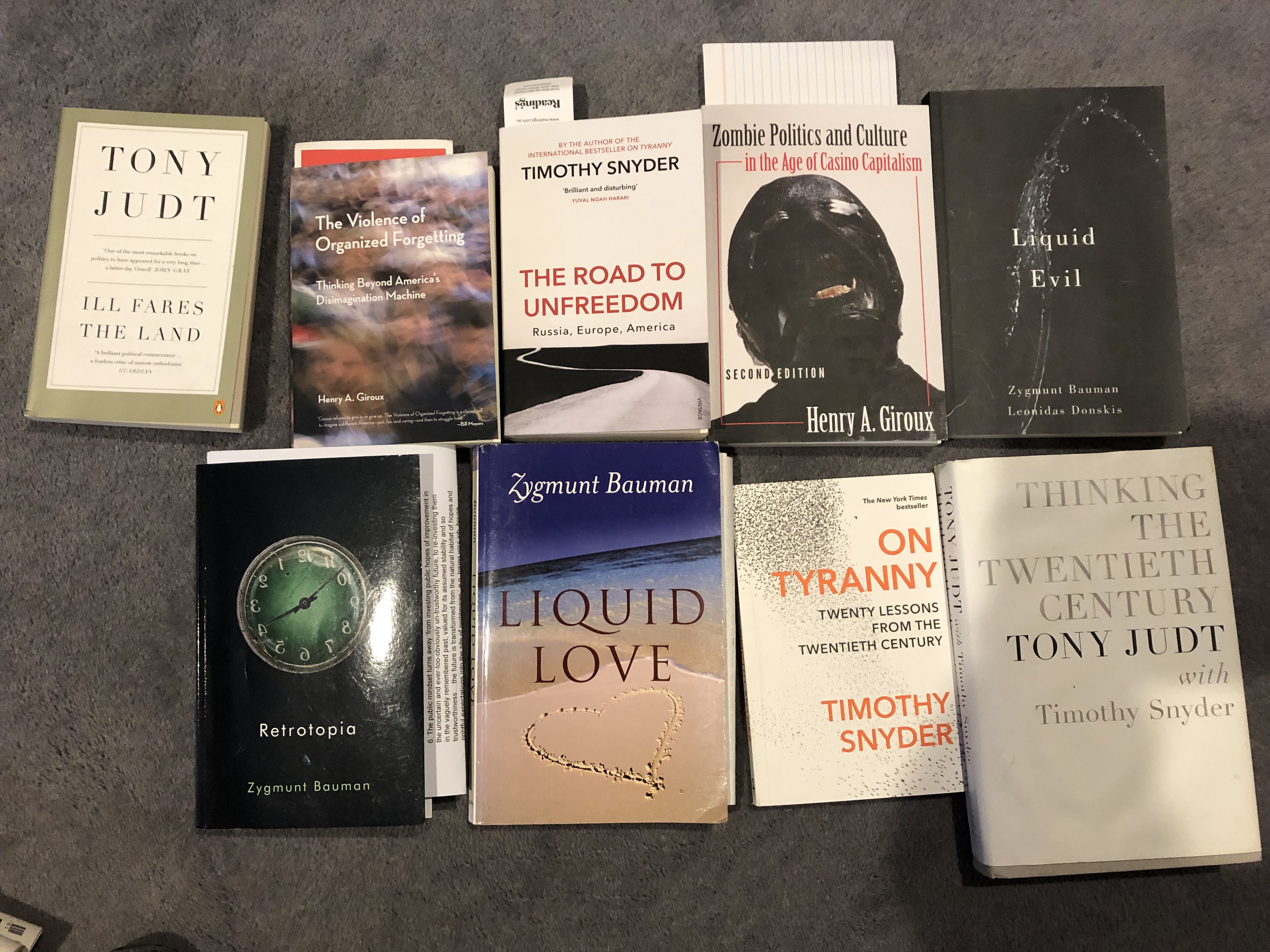
Zygmunt Bauman. LIQUID LOVE: p. 8 ‘Love is a mortgage loan drawn on an uncertain, and inscrutable future.’
Leibniz took music to be ‘God’s algebra’. (Steiner ERRATA, p.75)
Edith Wharton. THE TOUCHSTONE. (P.110) ‘Vanity contents itself with the coarsest diet; there is no palate so fastidious as that of self-distrust.’
Mohsin Hamid. THE RELUCTANT FUNDAMENTALIST. (p.71) ‘Nostalgia was their crack cocaine… and my childhood was littered with the consequences of their addiction: unserviceable debts, squabbles over inheritances, the odd alcoholic or suicide.’
Sebastian Barry THE SECRET SCRIPTURE
p. 70 ‘We have neglected the tiny sentences of our life.’
p. 72 ‘There was a cold cheap cankered-looking moon…’
AI can regurgitate the OED, it can rearrange the OED, but can it go outside definition to metaphor? And what about art, art like Rothko’s, could an AI have produced that? Rothko was original. There was nothing that came before him that could be seen as feeders to Rothko’s extraordinary paintings. The same could be said for Cezanne and, more recently, those wildly evocative furry sculptures of Kathy Temin. Original art appears to come out of nowhere – where ‘nowhere’ is a unique human imagination. Could AI produce never-before-seen art, never-before-imagined art? And then there’s music. The great composers we revere today, wrote music that surprised and often shocked at the time. It was new, and it seemed that nothing had prepared their contemporaries for this music. I’ve heard music produced by AI. It’s nice enough but it does not have the shock value of a Gershwin who combined classical with jazz, or Schoenberg’s 12-tone music, or the uncanny transcendence of Bach’s music for solo piano and the cello suites.
The hearty spruikers of AI often refer to science when promoting AI’s skills, and certainly when it comes to medical science, AI has proved very useful, as it has with coding. But what about theoretical science? Could AI have hypothesized a nuclear chain reaction as did Leo Szilard as he crossed Southampton Row in London in 1938? And much of Einstein’s work had to wait decades before his theoretical, which is to say imaginative work, could be grounded in reality. Or Lisa Meitner’s extraordinary imaginative leap that lead to nuclear fission?
In the arts, in literature, in music and in theoretical physics, the imagination has produced work that comes from way outside the boundaries of current knowledge, current understanding, current reasoning, and previous imagining. Can AI do that?
_________________________________________________________________________________
And while I’m here, you may be interested in the following EVENT
1. I will be in conversation with Susan Wyndham about her latest book, the biography of the enigmatic Elizabeth Harrower, The Woman in the Watchtower. Susan is the former literary editor of the Sydney Morning Herald; she has worked as a foreign correspondent, has written a range of non-fiction, she is an excellent interviewer herself – I know from personal experience – and is a regular at all the literary festivals. Her new book is fascinating. This should be a terrific event.
When: Thursday, November 27th
Where: The Hill of Content, Bourke Street, Melbourne
Time: 6-7pm
Bookings essential: If this link doesn’t work, the link is on the Hill of Content website.
[1] I was furious. It was an affront to all who’d been murdered here, and all who had come to remember them. These boys were stealing memorial candles. I yelled at them as I ran towards them. They dropped the candles and fled.
[2] In recent years, the correlation has been given a neuroscientific basis. Demis Hassabis, neuroscientist, all-round genius, and winner of the 2023 Nobel Prize of Chemistry, published a paper in 2007 in which he linked memory and the imagination. He revealed that similar brain activity occurred during tasks employing memory of the past and tasks requiring an imagining of the future, and both were grounded in the hippocampus. Since then, much further work has been done in the neurological connections of memory and the imagination.
[3] I’m a writer, not a scientist. I have followed developments in generative AI and the predictions for artificial general intelligence in publications like The New Yorker and the New York Review, and in books aimed at a general audience – not in scientific journals. Consequently, I might be way off the mark. However, having just listened to the latest episode of The Times and the Sunday Times podcast, The Story, about the AI actor Tilly Norwood, I’m not going to back down just yet.https://podcasts.apple.com/au/podcast/the-worlds-first-ai-actress-and-her-creator/id1501716010?i=1000737864964
 Andrea Goldsmith