Category Archives: Imagination

ESSENTIALLY HUMAN (2)

Imagination and AI 

My previous post on memory, imagination and creativity, bought some great replies both on-line and off (track back – they are worth looking at). Might these essentially human functions be lost to we humans and taken up by AI? It was this question that prompted a follow-up article.

There was a time in the latter part of the last century, when ‘false memory syndrome’ featured regularly in the press. This condition, now largely discredited, caused me to widen my view of memory. How it was possible to make up memories of events that did not happen? Could one imagine a trauma? And might there be a connection between memory and imagination? And if there were, might it explain the common occurrence of two siblings having vastly different memories of the same family event. Was one correct /true/solid and the other false, or were both, infused by personal idiosyncrasies, partly imagined? Might my own memory of pivotal events in the past swing with my present desires and circumstances and be altered by them? Might it be loyal primarily to them? 

These sorts of musings came to the fore while writing my fourth novel, The Prosperous Thief (2002), in which memory is central. While most of the narrative takes place in the present day, the long shadow of the Holocaust hovers over the lives of the characters. As soon as I’d finished the first draft, I visited Germany and Poland for the sort of idiosyncratic and instrumental research novelists do. 

One November day, I spent an afternoon walking the paths and woodlands of Auschwitz 2, Auschwitz-Birkenau; this is the site where most of the killing at Auschwitz occurred. Here is the familiar rail track with the long platform where it was decided who would die immediately and who would be allowed to live a little longer (the ‘selections’), here is the pointed-roof gatehouse, and here, inside the complex, are the long huts where people lived and suffered and died. It’s a huge area, and apart from two cyclists taking a short-cut through the former death-camp, and three Polish schoolboys pilfering some Yahrzeit candles,[1]this place of mass murder was deserted. 

I wandered the pretty woodlands still rosy with late autumn colour where over a half century earlier Jews were herded together, made to wait their turn for the gas chambers. I stood in the ruins of crematoria 2, 3, 4 and 5 where hundreds of thousands of men, women and children had been reduced to ash. I wandered the seemingly endless columns and rows of wooden huts where Jews were crammed onto wooden bunks: the sick, the dying, the starving, and the steadfastly surviving all tossed in together. 

I walked past several of these huts down to the memorial slotted between the ruins of Crematoria 2 and 3. This is the International Monument to the Victims of Auschwitz. Built in 1967 in Soviet brutalist style, it consists of huge cement blocks in a geometric pile. In front of the blocks and set into the horizontal brickwork are plaques carrying the terrible statistics. This unimaginative monument is big and strikingly unbeautiful and, to my mind, communicated nothing about this terrible place. It was also totally unnecessary: this place, this Birkenau, was memorial enough. 

That visit to Auschwitz-Birkenau occurred twenty-five years ago, but I can still see the autumn colours and the school boys, I can hear the crunch of my shoes on paths made of gravel mixed with shards of human bone, I can smell the autumn mulch, I can recall my sorrow and anger and bafflement as I wandered that death-filled landscape. But of course I don’t ‘see’, I don’t ‘hear’ and I don’t ‘smell’, I imagine these impressions. And, as well, I add to them. I find myself musing on human brutality and prejudice, and what turns ordinary men into monsters; I think of the crimes that are committed in the name of patriotism and nationalism; I think of Trump and his MAGA movement; I think of the destruction of Gaza and the homeless Palestinian people. When I now remember my visit to Auschwitz, rather than a set of immutable images, I experience a far more impressionistic, complex event, one that acknowledges the numerous books I’ve read about Nazi Germany and the Holocaust, the films I’ve seen, the conversations I’ve had, the visits I’ve made to other parts of central Europe, values I hold, my knowledge of other horrors. My original visit to Auschwitz has become far richer in recollection, in that my entire cognitive landscape – experience, study, conversations, other memories, and fresh reasoning – has been recruited. 

This is how the imagination works. It shapes a memory that is fluid and intense and illuminating. It is also unpredictable: you cannot determine beforehand what knowledge and experience will be pulled into play during recollection, nor the ideas that will emerge from the mix. And it is unreliable, too. As a photo is not the whole story, that there is, as Barthes wrote, a ‘blind field beyond the frame’; so too with memory. All memory involves partial forgetting (outside the frame), and within the frame are new considerations, as my memories of Auschwitz show. Memory is rarely, if ever, static, nor is it neutral. We select what is to be remembered, and depending on the prevailing circumstances, what is selected this year will be different from what will be selected next year or in ten years. Far from being solid and immutable, this memory we trust is both delicate and infinitely corruptible, it is also free-ranging and expansive, linking with a swill of experience, desire, emotion, understanding, doubts, values and attitudes. 

Monuments provide a useful example to both the protean nature of memory and that it is never neutral. Memory, exactly what is remembered of a past event/desire/person is always in service to current values/desires/propaganda/politics. When monuments are built to mark pivotal events in a nation’s past, or to memorialise individuals killed in wars or terrorist attacks or murdered through genocide, there is an implicit assumption of an enduring, unchanging memory and commemoration. But the recent avalanche of falling statues of statesmen from the past who were involved in the slave trade or the murder of indigenous peoples is testimony to how changing values and culture affect how and what is remembered from history.

It was around the time I went to Auschwitz that I first put into words what should have been obvious to me and all those writers, visual artists, musicians, theoretical physicists, and mathematicians engaged in creative work (i.e. new work and ideas that have never existed before), that memory, fertile and changing memory, creative and illuminating memory, is an imaginative process, one dependent on the imagination and in turn constructing it.[2]

Which brings me to AI.[3] AI is an expert problem solver. In addition, having been ‘fed’ the contents of the web, AI can answer almost any question put to it – though not without mistakes. (There’s the oft-told story about an AI asked how to combat climate change, replied: ‘eradicate humans’ – not so much a mistake, because this would certainly work for climate change, but ignoring a number of other fairly essential issues.) Solving problems and answering questions is a matter of accessing already-existing data, it is not creative, nor does it necessarily demonstrate understanding. Understanding is different from thinking. Thinking is not the same as reasoning. And reasoning is not the same as creating.

What would an AI make of ‘the foul rag-and-bone shop of the heart’? Metaphor courses from the imagination. An effective metaphor is tangential to reality; it extends the meaning of that reality. Metaphor illuminates, it goes beyond the immediately obvious, beyond routine understanding.

Below are few more examples of metaphor – perhaps too many, but I do delight in metaphor

– Bernice Rubens: SPRING SONATA: ‘she tried to insinuate herself into the quicksands of her mother’s skin’

– Steiner in REAL PRESENCES: ‘memorising forms the ballast of the self.’

– John Banville’s THE UNTOUCHABLE: p.83. ‘The couple who ran the place were out of a seaside postcard, she a big blancmange with a wig of brass curls, he a lean little whippet of a fellow with a Hitler tash and a tic in one eye.’

– Toibin’s THE MASTER p.20 ‘the great flat foot of the public.’

– Auschwitz: ‘the eternal failure of all mankind’

– Virginia Woolf: ‘ideas are the only efficient air-raid shelter.’ (Essay: Thoughts on peace in an air Raid)

– Dorothy Porter: ‘In love I have no style. My heart is decked out in bright pink tracksuit pants.’  (THE MONKEY’S MASK)

‘The ripe teenage mulch of his bedroom.’ Ian McEwan. SATURDAY. p. 30

About Baxter: ‘that unpickable knot of affliction.’ p.272 ibid

‘You are like a tin of mixed biscuits.’ Iris to Carrington in Holroyd’s Strachey p. 352

Amichai OPEN CLOSED OPEN: ‘Enchanted places are the opiates of my life’  (69)

Zygmunt Bauman. LIQUID LOVE: p. 8 ‘Love is a mortgage loan drawn on an uncertain, and inscrutable future.’

Leibniz took music to be ‘God’s algebra’.  (Steiner ERRATA, p.75)

Edith Wharton. THE TOUCHSTONE. (P.110) ‘Vanity contents itself with the coarsest diet; there is no palate so fastidious as that of self-distrust.’

Mohsin Hamid. THE RELUCTANT FUNDAMENTALIST. (p.71) ‘Nostalgia was their crack cocaine… and my childhood was littered with the consequences of their addiction: unserviceable debts, squabbles over inheritances, the odd alcoholic or suicide.’

Sebastian Barry THE SECRET SCRIPTURE

p. 70 ‘We have neglected the tiny sentences of our life.’

p. 72 ‘There was a cold cheap cankered-looking moon…’

AI can regurgitate the OED, it can rearrange the OED, but can it go outside definition to metaphor? And what about art, art like Rothko’s, could an AI have produced that? Rothko was original. There was nothing that came before him that could be seen as feeders to Rothko’s extraordinary paintings. The same could be said for Cezanne and, more recently, those wildly evocative furry sculptures of Kathy Temin. Original art appears to come out of nowhere – where ‘nowhere’ is a unique human imagination. Could AI produce never-before-seen art, never-before-imagined art? And then there’s music. The great composers we revere today, wrote music that surprised and often shocked at the time. It was new, and it seemed that nothing had prepared their contemporaries for this music. I’ve heard music produced by AI. It’s nice enough but it does not have the shock value of a Gershwin who combined classical with jazz, or Schoenberg’s 12-tone music, or the uncanny transcendence of Bach’s music for solo piano and the cello suites.

The hearty spruikers of AI often refer to science when promoting AI’s skills, and certainly when it comes to medical science, AI has proved very useful, as it has with coding. But what about theoretical science? Could AI have hypothesized a nuclear chain reaction as did Leo Szilard as he crossed Southampton Row in London in 1938? And much of Einstein’s work had to wait decades before his theoretical, which is to say imaginative work, could be grounded in reality. Or Lisa Meitner’s extraordinary imaginative leap that lead to nuclear fission?

In the arts, in literature, in music and in theoretical physics, the imagination has produced work that comes from way outside the boundaries of current knowledge, current understanding, current reasoning, and previous imagining. Can AI do that?

_________________________________________________________________________________

And while I’m here, you may be interested in the following EVENT

1. I will be in conversation with Susan Wyndham about her latest book, the biography of the enigmatic Elizabeth Harrower, The Woman in the Watchtower. Susan is the former literary editor of the Sydney Morning Herald; she has worked as a foreign correspondent, has written a range of non-fiction, she is an excellent interviewer herself – I know from personal experience – and is a regular at all the literary festivals. Her new book is fascinating. This should be a terrific event.

When: Thursday, November 27th
Where: The Hill of Content, Bourke Street, Melbourne
Time: 6-7pm
Bookings essential: If this link doesn’t work, the link is on the Hill of Content website.


[1] I was furious. It was an affront to all who’d been murdered here, and all who had come to remember them. These boys were stealing memorial candles. I yelled at them as I ran towards them. They dropped the candles and fled.

[2] In recent years, the correlation has been given a neuroscientific basis. Demis Hassabis, neuroscientist, all-round genius, and winner of the 2023 Nobel Prize of Chemistry, published a paper in 2007 in which he linked memory and the imagination. He revealed that similar brain activity occurred during tasks employing memory of the past and tasks requiring an imagining of the future, and both were grounded in the hippocampus. Since then, much further work has been done in the neurological connections of memory and the imagination.

[3] I’m a writer, not a scientist. I have followed developments in generative AI and the predictions for artificial general intelligence in publications like The New Yorker and the New York Review, and in books aimed at a general audience – not in scientific journals. Consequently, I might be way off the mark. However, having just listened to the latest episode of The Times and the Sunday Times podcast, The Story, about the AI actor Tilly Norwood, I’m not going to back down just yet.https://podcasts.apple.com/au/podcast/the-worlds-first-ai-actress-and-her-creator/id1501716010?i=1000737864964
ESSENTIALLY HUMAN. 

Memory, Imagination and creativity.

When I was eight years old, I had three ambitions. The first was to be a ballerina – more a matter of wishful thinking than creative passion, given I wanted to be tall and slim, I was keen to wear a tutu, and I longed to be borne aloft by men who resembled fairy-tale princes. That ambition soon disappeared, snuffed out by common sense and a maturing aesthetic. The second ambition was to be a novelist. For as long as I could remember, novels had provided a refuge from the crush and uncertainty of my child’s life – a very necessary refuge given that childhood and I were not an easy fit. Filled with anxiety that I was getting the child role wrong, and ever alert to any tools that might help me navigate those perilous years, I studied other children in order to learn the ropes. The price of such vigilance was inexhaustible exhaustion. I was watchful during the day, and the nights were spent analysing the previous day’s mistakes and planning protective strategies for the next. The most reliable respite I had from this anxiety was not sleep (with so much to do I was a poor sleeper) but novels. I would slip into other lives and other places and relieved of my deficient yet demanding self, I would feel stimulated, invigorated, engaged, even happy – although like Samuel Beckett, I discovered that happiness was not as lively as I would have thought. Fiction supported me through the seemingly endless years of childhood, and from a young age I was determined to become a novelist. 

That I had decided to be a writer of novels could be explained in terms of the pleasure principle, self-preservation and escape. But I couldn’t escape all the time so what I needed was a reliable means of holding life in place. This need shaped my third ambition, namely, to have a perfect memory, the sort of memory that could learn poems by heart, that could reel off a page of numbers briefly glimpsed, that never forgot a person, place, event or story. If I could remember everything that had ever happened to me in the past, I would better manage the troubles that plagued my present, and gain a grip on the uncertain future.

My concept of memory in those long-ago days was akin to memorising. And I did so love memorising – poems, psalms, one year the entire geography book (I disliked geography but memorising the book as I walked around a deserted tennis court had a pleasing, hypnotic effect). In one respect, memorising was similar to reading in that both activities, by capturing my entire attention, removed me from the trials of childhood and my burdensome self. But that was the only similarity. Reading invigorated me, it sparked my imagination; I would travel to times and places not my own, and mix with people not to be found anywhere in suburban Melbourne. In contrast, my childhood memorising filled the time with a vaguely narcotic calm – like doing Lego or jigsaws or painting by numbers.[1]

To be a novelist and to have perfect memory: two linked ambitions to help steer me through the bewildering world in which I found myself, and through primary and secondary school they sustained me well. It was during my first year at university that I realised my dual ambitions were incompatible. I read The Mind of a Mnemonist, written by the great Russian neurologist, A.R. Luria, a book detailing the extraordinary memory of a man called ‘S’. This was followed a couple of months later by Borges’s Labyrinths, most especially, the short story, ‘Funes the Memorious’. Funes, an ordinary man in most respects, remembered everything; he could neither select nor forget. Beset by details, filled with details, Funes’s imagination was stifled. He was a man incapable of ideas or insight.

 ‘S’ and Funes demonstrated extraordinary feats of memory, like remembering pages of numbers or lists of nonsense syllables or poems in foreign languages, or the foreign language itself. Funes, for example, learned Latin in a week by memorising the Latin of Pliny the Elder as written in Pliny’s Naturalis Historia. But in  both cases this sort of memorising blocked the free-ranging imagination so essential to the novelist; it was a memory confined to particulars – a type of memory that excludes reflection and reason, inspiration and illumination. 

Novelists require a versatile, athletic imagination, one that can leap and loiter in the uncertainties of an emerging narrative. The novelist’s imagination is an explorer and thrill seeker. Perfect memory of the sort to which my childhood self had aspired is in service to safety and certainty; it is memory without imagination, it is memory at odds with metaphor, it is a memory as discreet and as immoveable as a picket fence. 

The memory that fuels human life and endeavour is far more creative than this. If I remember an event, say the breakup of an affair, it is not identical to the actual break-up. My recollection is overlaid with other experiences, other understandings, conversations, desires. Memory relies upon the recruitment of an entire cognitive landscape – experience, study, conversations, other memories. Just as Magritte’s painting of a pipe, Ceci n’est pas une pipe, so too my memory of the break-up, or, indeed, any memory. Memories are created, and what they recall is re-created differently with each recollection. 

This notion of memory is fluid and often illuminating. It is also unpredictable: we cannot determine beforehand what knowledge and experience will be pulled into play during recollection, nor the ideas that will emerge from the mix. And it is unreliable, too. As a photo is not the whole story, that there is, as Barthes wrote, a ‘blind field beyond the frame’; so too with memory. All memory involves partial forgetting, but what is forgotten is not erased, indeed, it is a common occurrence that, triggered by an experience in the present, a formerly forgotten element rises to consciousness. In addition to being unpredictable and unreliable, memory is not neutral. We select what is to be remembered, and depending on current circumstances, what is selected this year will be different from what will be selected next year or in ten years time. Memory is in service to the present far more than the past event it purports to preserve. Far from being solid and immutable, this memory we trust is both delicate and infinitely corruptible, it is also free-ranging and expansive, linking with a swill of experience, desire, emotion, understanding, doubts, values and attitudes. This notion of memory, this fertile and changing memory, this creative and illuminating memory, is one dependent on the imagination and in turn constructing it.[2]

We draw on memory to make sense of ourselves as we trek through daily life. It is memory that fuels imaginings of the future, it is memory that helps plan for it. It is memory that feeds the hopes and desires that drive us to seek out this person and abruptly turn from another. It is memory that seeds great art, composes memorable music, writes heart-stopping poetry and life-changing novels. A life without imagined, creative memory has been described by great neuroscientists like Luria, and it is a life confined in an ever-present where nothing much changes and art is indistinguishable from dust. A life without imagined, creative memory would be, for most of us, unbearable.

And yet it seems we are heading straight into that darkness.

Memory, imagination and creativity require a few simple conditions: uninterrupted time, solitude, no external distractions and the ability to sustain attention and focus.

In the digital age, for many, perhaps most people, simple factual memory – recall – of a name, a book or a film, has been rendered vestigial by web searches. Stop, I say, when someone reaches for their phone because they can’t remember the name of a book, an actor, a film. Stop, I say, give your mind time, give it space, the name will come to you. Mostly the person does not stop, does not wait. What would be the point? they imply, with a nod at their phone. Indeed, we have adapted so quickly to having information at our fingertips that when we want to know something, we want to know it now, whether it be the closest bagel shop (with pictures to show if the bagels are authentic), or a video clip of the admirable Jonas Kauffman singing Andrea Chenier (there is); it doesn’t matter what the nature of the information, we expect to have it immediately. 

Skills, which once were ubiquitous, have been lost. It would be a rare millennial or post-millennial who could read a map, but neither would they regard this as a loss Why bother, when they have GPS? And simple mathematical calculations – multiplying, division, percentages – these calculations would be beyond many people. But again, why bother, when you always have a calculator in reach? 

The history of human progress is also the history of lost skills. Few people these days would know how to rub sticks together to produce fire. Few people would know how to build a fire in a grate; quite a few people would not know what a grate is. And who would know how to read a sundial these days? But the loss of fire-making skills or telling the time by the sun, or reading a map, or doing simple maths do not diminish our humanness: they do not fundamentally alter what it is to be human.

Creativity is in a different sphere, creativity is essentially human. In our switched-on, digital world, sustained attention on a single idea, problem or issue has been lost to the dings and clicks of social media, news feeds, email, texts. Turn off notifications and that little screen still flashes. Solitude has being shoved aside by the need for constant connection and approbation. Checking a phone every few minutes is akin to laboratory rats pressing a lever for food, knowing that eventually they will be rewarded. So, too, with social media.

The mobile phone is the metaphorical heart beat of the modern individual. We sleep with it, run with it, eat with it. It accompanies us to the bathroom, it’s in reach while we have sex. It is a common sight to see two people seated together in a café each occupied with their phone, the only communication occurring when one shares their screen with the other. With WIFI blanketing the earth, even in wilderness landscapes the digital heart beats strongly. There is no repose. There is no time to mull in your own thoughts, to reach into the troughs of forgetting, there is no time for the imagination to flourish. 

Multi-tasking has inflamed the situation. Attention spans have not shortened in the digital age, but the nature of attention has changed. Juggling several tasks simultaneously is counter-productive to the singular attention – the obsessiveness –that creative work requires. With solitude and privacy under assault, and sustained attention of the sort the imagination requires fast going the way of the typewriter and the tape cassette, the conditions for creative work are being steadily eroded. 

Creative skills are surprisingly frail. As a writer, I know that when I return to my desk after just a few weeks away, the words don’t come so easily, the ideas are sluggish or, worse, non-existent. It takes a few days for the creative skills to muscle up again. The imagination, if neglected, readily becomes dormant; if it is not nurtured, it can actually decay. Muscles that are unused become stiff and painful and thereby draw attention to themselves. Unfortunately, the imagination goes far more quietly.

Running alongside this assault on human creative processes is the vast and increasingly complex advances in Generative Artificial Intelligence and Artificial General Intelligence. Generative AI has been designed with the capacity to learn and develop new data from its own actions/work, while Artificial General Intelligence is human-level intelligence that can do everything the human mind can do – and more.

An example of Generative AI was portrayed in a 2016 Go tournament between Lee Sedol, the world champion at the time, and the computer programme AlphaGo. Demis Hassabis, the scientist who produced the early work linking the neurological substrates of imagination and memory, was the primary creator of AlphaGo.[3]  

There were good reasons to choose Go to test the limits of the AlphaGo computer. There had been many AI-versus-human chess tournaments, but Go is far more complex than chess and, for seasoned players, creativity and intuition play a role. Many players speak about the game in quasi-spiritual terms. This spiritual dimension combined with the role of intuition underscore Go as a distinctly human-grounded game. 

AlphaGo demonstrated a level of self-learning in the tournament with Lee Sedol that even surprised its creators. One particular move, move 37 in the second game, was described by one Go Master as ‘not a human move’ but ‘beautiful, so beautiful’. This move had not been a part of AlphaGo’s programmed memory, rather the machine had created it.

Sedol lost the tournament 4 to 1 and, not long after, he resigned from the professional circuit. Since then other programs to play Go have been developed that are even more capable than AlphaGo. 

Generative AI is already with us, and artificial general intelligence with its open-ended creative skills is fast developing. There are daily warnings of the dangers of AI, including some from the founders in the field.[4] There are worries expressed over AI-written student essays and AI-generated novels, but there are far more serious concerns over the possibility of AI surpassing human intelligence and subjugating we humans. 

Whatever the future brings, it has already begun, and running in parallel has been the erosion of the very skills needed to maintain control of our human future. In our eagerness to embrace all the digital world has to offer, we have neglected to take stock of what we have complacently relinquished. Human imaginative work runs the risk of dying out, and with artificial general intelligence, creativity will become the province of the machines that human imagination and ingenuity produced. In short, we are creating the conditions of our own demise. AI isn’t taking over human creative endeavour, we have already ceded the territory.


[1] This childhood memorising is very different from the memorising of my adult years when, consciously and fully alert, I have worked to absorb poems and quotable quotes into the fabric of mind. As George Steiner memorably wrote: ‘To learn by heart is to afford the text or music an in-dwelling clarity and life-force…What is committed to memory and susceptible of recall constitutes the ballast of the self.’ (Steiner. Real Presences. pp 9-10).

[2] In recent years, the correlation between memory and the imagination has been given a neuroscientific basis. Demis Hassabis, neuroscientist, all-round genius, and winner of the 2023 Nobel Prize of Chemistry, published a paper in 2007 in which he linked memory and the imagination. He revealed that similar brain activity occurred during tasks employing memory of the past and tasks requiring an imagining of the future, and both were grounded in the hippocampus. Since then, much further work has been done in the neurological connections of memory and the imagination.

[3] An excellent account of the tournament is the documentary, AlphaGo, directed by Greg Kohs, and available on YouTube. Also Benjamin Labatut in his brilliant, unorthodox novel MANIAC, devotes the last chapters to the game of Go, in particular, this tournament between Lee Sedol and AlphaGo. 

[4] In his book Homo Deus: A Brief History of Tomorrow, Yuval Noah Harari analyses recent advances in AI and what they may mean for the future of humankind. The book was published in 2016, developments (some would prefer the term ‘progress’) since then are cause for far greater concern.

OF WONDERS WILD AND NEW

(From poem at the beginning of Lewis Carroll’s Alice’s Adventures in Wonderland.)

I must have been in need of a role model when first I heard of Eve and her transgressions in the garden of Eden, because from the beginning I disagreed with the interpretation promulgated both by my Methodist school and my Jewish background. Feed off the tree of knowledge and suffer for all eternity? It made no sense. Without curiosity and its rewards, childhood, with its trials and expections, would be unbearable. God’s Eve might have been bad and disobedient, but my Eve was rebellious and dismissive of parental authority. She’d had no say in the Adam’s rib business, but her response to the snake revealed her to be curious and confident and courageous. Thereafter, she flaunted her independence and showed Adam who ought to be boss. 

‘And when the woman saw that the tree was good for food, and that it was pleasant to the eyes, and a tree to be desired to make one wise, she took of the fruit thereof, and did eat, and gave also unto her husband with her; and he did eat. And the eyes of them both were opened…’ (Genesis 3:6-7. King James Authorized Version).

Later, when I read Milton’s Paradise Lost, my admiration for Eve only increased. Milton is no 17th century feminist. His Satan locates authority, intelligence and valour in man, and ‘coy submission’, beauty and grace in woman. But how is this demonstrated? Eve acts, while Adam only responds. Eve defies authority, and does so with determination. Milton proves my case, not his – nor God’s for that matter.

As for curiosity, it is the greatest of the human passions – not that I was aware of this as a child. I embraced curiosity because it worked for me. The family is a crowded place; I shared a bedroom with my sister and the living room was communal space, but curiosity was private. It was fed and satisfied by books and thoughts, and it opened up endless possibilities located far away from suburban Melbourne. And that was the wonder of it: one question led to other questions, and you’d find yourself in imagined terrain that was fabulously interesting and sparking with risk. And given you didn’t need to leave home, you didn’t even need to leave your chair or the nook at the end of the garden, you were entirely safe – an important consideration for a child so anxious that even sleeping was a threat. Crucially, curiosity removed me from the daily terrors of being a child, and at the same time, it made solitude a most desirable state. I was rarely bored during the interminable years of childhood, nor was I decades later during the seemingly endless covid lockdowns. With curiosity powering the imagination and stirring the currents of memory, no one need ever be bored.

                                    *          *          *          *

There’s an epidemic of loneliness and boredom in societies like ours, yet it seems we’ve never been busier. Frenzied digital connection from unlimited Wordles to compulsive checking of social media to fevered on-line shopping and mesmerising doom scrolling distract from the boredom and loneliness while, at the same time, being a symptom of these, and probably further feeding them.

So much activity with so little to show for it, accompanied by a pervasive dissatisfaction that seems unappeasable. As for the smart-phone: sometimes it feels like the phone controls you and not the other way around, a bit like the oppressive partner you know you should leave but you can’t bring yourself to do it. The solution is not constant, mind-numbing activity, but active, ceaseless curiosity. This is not a quick google search for the name of a film, a song, a place, a date, that’s not curiosity, that’s just a quick-fix for frustration over a forgotten fact. Curiosity is the determined search for new understandings, a hunger for new experiences, new people and places; it’s invigorating and productive, it starts at one point and shoots off vectors in all directions. With curiosity in full flight, boredom and loneliness don’t get a look-in.             

An active curiosity is like the ardent traveller: implicit to both is the notion of search, of a journey into the unknown. You spend a day wandering in x direction, the next day you change course. You gather knowledge and understanding from both the forward movement and the wrong turns, and when you arrive back at the starting point, you are filled with new understandings and, as T.S. Eliot famously wrote, you return to where you began and know it for the first time. 

Most significantly, given the prominence accorded to the self in the digital age; curiosity turns you away from yourself towards the world, towards new places and other eras, and into the lives of people very different from you. Curiosity could make humanitarians of us all. 

Surrounded as we are in constant noise and an avalanche of information, this greatest of the passions, this resource for living has been left to moulder away in a dark corner of mind. It is hard to think of another resource that costs nothing and is available to all human beings. You can activate it while cooking, or changing the bed-sheets, or watching your child play footy; you can slip into it while travelling to work, delivering noodles, ploughing a field, while walking the dog. The major requirements of curiosity are time and privacy and solitude. Turn off the music, resist your favourite podcasts, don’t call your sister/mother/son/best friend. Put your phone in a drawer or put it on silent and go mental wandering – curiosity by another name.

Which leads me to Trump, as most musings do these days. Even though we know his power is hinged to having our attention, his being plastered across the news and social media, filling podcasts in umpteen different languages makes it is so difficult to ignore him, to turn him off. And besides, for many of us, there is a macabre fascination with this man who has colonised the hearts and minds of millions, who has turned the Republican Congress into a forelock-tugging bunch of lackeys, a man who, either deliberately or simply shuttered within his massive ego, is upending the world order. This man, so loved by his MAGA followers, is seen as a dangerous narcissist by his detractors, a man who disregards anything that does not enhance himself and his power. This is a man so satisfied with himself, not only does not demonstrate curiosity, he has no need for it. 

I don’t believe I’ve ever known Trump to ask a question – and not surprising in a man convinced of his own perfection, his own greatness, his rightness. He does not seek advice from his advisors (given the lack of appropriate skills and experience of most of them, this could be seen as an unexpected benefit), he seeks confirmation only for what he already thinks/wants/believes/needs, which is to say, himself, Donald J. Trump and the web of his selfhood. 

There’s nothing special about Trump’s narcissism; like any narcissism it is incompatible with curiosity about people and events and places beyond his personal domain. Indeed, if Trump’s minions fail to stroke his ego, they find themselves unemployed, and, in many cases, unemployable. This man, entrusted with the lives and fate of not just Americans, but much of the rest of the world, lacks the fundamental passion of what makes us human; this saviour of the working American, this nasty narcissist does not give a damn about his adoring followers, nor all those drooling republican congressman, and he certainly does not give a damn about the conflicts in the wider world (unless, of course, he can insert himself as the fixer-saviour). This narcissist, inoculated as he is against curiosity, is, simply, not interested.

UNSPOKEN DESIRE, UNREQUITED LOVE

(published in The Weekend Australian, March 1st, 2025)

Desire is so…desirable. How bland and static life would be without it. And there’s so much to recommend it. It comes in a great many varieties – no chance of boredom – and it’s so portable: where I go, so, too, my desires. But the feature that most appeals to me is that desires can remain private. Most desires are created by the mind, and there they can stay – no need to subject them to reality to enjoy their pleasures and enlightenment. This is a very good thing, because when they are exposed, it can be a disturbing, even distressing experience.

There was a teacher I admired during my high school years, admired and adored; I shaped my behaviour to win her approval, I owned beliefs because I knew they were hers; this teacher inspired a clutch of desires and was, in turn, enhanced by them. A couple of years ago, while artist-in-residence at an organisation of which my former teacher was a member, she and I attended the same lunch function. Decades had passed, yet I felt all the tremors of youth when I caught sight of her. Emboldened by my position as artist-in-residence, I found the courage to greet this woman who had exerted such an influence in my adolescence. I approached her table and stood by her chair; she looked vaguely at me. I said my name: there was no recognition. I fumbled a few more facts and when there was still no recognition, I mentioned the name of my best friend at school, and immediately her face lit up: an exceptional girl, my former teacher said, one who would go far. My friend was remembered, but I had been forgotten; worse, it was if I had never existed. There were flyers throughout the building displaying my photo, my name, a brief biography, and still I was a total stranger to this woman who had meant so much to me during those impressionable years. All those private desires that had channelled me through high school, desires that attached to ambition, to ideas, to music, desires that had remained polished and private throughout my adolescence and beyond, and she did not know me.

I wish I’d not seen her. Desire, imagined desire, untainted by reality is never disappointed.

In my latest novel, The Buried Life, there is a romance between a forty-three-year-old man, Adrian, and a fifty-seven-year-old woman, Laura. Adrian is not at all bothered by the age difference, it is Laura who worries. She’s self-conscious about her ageing body, the newly-acquire flab on her abdomen and thighs, the beginnings of crepe in the underside of her arms, but it is mostly desire itself that is on her mind, and in this instance it is the intensity of her sexual desire for Adrian Her thirty-year-old self, even her forty-year-old self would have said that anyone approaching sixty would be beyond such feelings. Perhaps one never was, perhaps at that very moment there were nonagenarians rolling around in an erotic frenzy at their aged-care facility.

And perhaps there are, but I doubt it. Though I would like to think that rampant desires – artistic, sporting, intellectual, epicurean – are filling the minds of the aged-care residents. As the body ages, it becomes irritating, intrusive, burdensome, but, in the absence of cognitive decline, the imagination, that crucible of desire, goes from strength to strength. This is one of the great benefits of advancing age.

Imagined desire, there’s little to equal it and, aside from reality, nothing to stop it. Imagined desire is bold, curious, energetic. And imagined desire – private desire – can also be very productive.

I have enjoyed an unrequited love of more than thirty years duration, a passion that ripples with many kinds of desire. This man is a similar age to me, I’ll call him P (not his initial, but with that whispered plosive, /P/ is my favourite letter). P was beautiful, brainy and bookish when first I met him, and so he remains. We meet very occasionally, always with eager anticipation and always with outward decorum. But even though it has never been acknowledged, I am sure P harbours a secret passion for me, too.

And such a satisfying love mine has been. I’ve orchestrated long and complex conversations with him; no idea, no book, no topic is beyond us. P has fired up sexual desires both for me and for my characters. I can spend time with P when I look a mess, when I’m grumpy at the end of a tiring day, when I’ve gained weight. And P, himself, has no downside, no qualities to spoil his perfection. He may be less bookish and brainy than my desires require him to be, but it doesn’t matter. If he scatters his clothes across the floor, I don’t see it. If he has a sour odour in the mornings, I don’t smell it. If he complains about this relative or that colleague, I don’t hear it. Any faults, and I expect he has a few, are outside the realm of my P. 

I can imagine every embrace with P, every sexual act (including those I’ve never tried but wish I had), and I can make use of these, have made use of them in the books I have written. Indeed, for most of my nine novels any satisfying and sexy relationship has been fuelled by P. And it doesn’t stop at sexual desire. I have crafted conversations with him while taking solitary walks or while idling at my desk – rigorous, referenced, and ranging over a variety of topics. These conversations can occur almost daily if I am trying to get to the nub of a particularly knotty conundrum.

Reality would not simply spoil this, it would stop it altogether.

In the early drafts of The Buried Life, I made Laura’s desire for Adrian unrequited. But an unrequited love like mine, so satisfying in real life produced narrative tedium in the novel. And besides, at fifty-seven, and caught within a long marriage, Laura deserved some good sex and stimulating conversation. 

But for me, I would always choose my long, intense, unrequited and unacknowledged love with its bottomless well of desires. Wholly satisfying and forever untainted, it remains ageless and reliable.

AN UNRELIABLE MARRIAGE. The writer’s life and the life of the work

Flaubert said: ‘Emma Bovary, c’est moi.’ Can he be trusted? Should he be trusted? And if it were true, does it enhance the reading of Madame Bovary

We live in the Age of the Individual. Personal experience reigns supreme. Descartes’ Cogito ergo sum, I think therefore I am, has become I AMTHEREFORE I AM.

One need look no further than memoir for evidence that the self and the individual have become the project par excellence. Memoir is thriving, and not just for those with a public life: anyone can and is co-opting the form. Publishers love memoirs – because memoirs sell. It seems that in these days of Facebook and the like, we can’t get enough of other people’s private lives. 

Without a societal focus on the individual, without a significance accorded to the ‘truth’ of individual lives, the issue of author biography and its relationship to the author’s fiction and/or poetry, would probably not arise.*

Like many others, I believe that a poem or a novel needs to be able to stand alone, separate from its author, otherwise it will have no life. A glance at the work that has survived down the years: Shakespeare, Austen, Dickens, both Eliots George and T.S., Keats, Coleridge, the Brontës, it is clear it is the work that matters. After all how many readers know about Shakespeare’s son, Hamnet who died at the age of ten? How many readers know about T.S’s conversion and his treatment of his wife Vivienne, and George’s sinful life with a married man? How many know about Coleridge’s opium habit and the Brontës difficult dad? And does it matter? This work lives on, the work thriveswithout knowledge of the author’s life.

The fact is, we humans have not fundamentally changed in the past 4 millennium – since we started writing things down. And those works that endure are those which explore and tap into fundamental – and enduring – human qualities: love, jealousy, joy, revenge, envy. 

And yet there are certain classics in which knowledge of the author does help, and certain others wherein biographical fixing is essential for any significant understanding. 

Much of Henry James’s work centres on wealthy and naïve Americans lost in the clutches of old Europe. It can enrich a reading of Henry James to know he was an anglophile and ex-patriot American – but it’s not essential. 

It deepens understanding when reading Animal Farmand 1984to know that Orwell was a socialist, ardently and critically opposed to Soviet communism. It further helps to know that the left was polarised between Communists and anti-Communists. Of course, reading Orwell’s marvellous essays would provide all the information required. 

It helps, in reading Thomas Mann’s Magic Mountain, to know that Mann opposed the Nazi regime and was forced into exile because of it.

In contrast, there ARE certain works in which the author biography is essential.

Much of Sylvia Plath’s work, for example, although in some instances the biography has overwhelmed the art.

And Proust. All those heated, sexless, obsessive loves with girls in A la recherche du temps perdu, these make a lot more sense when informed by Proust’s homosexuality. And this novel, deeply concerned with the aristocracy and social class, acquires greater meaning when Proust’s Jewishness is taken into account.

And Oscar Wilde’s DEPROFUNDISmakes no sense whatsoever without the biographical details (Bosie, Lord Alfred Douglas, the terrible trial and Wilde’s subsequent imprisonment). 

SOCIAL AND POLITICAL CONTEXT

Rather than specific biographical detail, often what is required in deriving the most from a novel or poem is a knowledge of the social and political context surrounding the author. Pasternak and the other great 20thC Russian writers writing within the strictures of Stalin’s regime are prime examples; Dante’s Divine Comedy, with all those notable C14th Italians confined for all eternity in the circles of hell, is another; Coetzee’s Disgraceand Justin Cartwright’s White Lightning, make little sense if unaware of South African Apartheid and the post-apartheid period; an understanding of the poetry of Paul Celan requires a knowledge of the Nazi atrocities; the work of Kamila Shamsie and Mohsin Hamid makes little sense without a knowledge of the widespread persecution of Muslims; and full appreciation of books from indigenous Australians like Melissa Lucashenko and Tara June Winch requires a knowledge of the history of dispossession and discrimination against aboriginal Australians. Beyond the world of print, Picasso’s ‘Guernica’ and Shostakovich’s ‘Leningrad’ symphony (premiered during the siege of Leningrad) as two works whose meaning is firmly attached to the prevailing social and political context. 

But history is in trouble at the moment. 

We live in an ever-present. The present shouts at us 24 hours a day. There’s the 24-hour news cycle. There’s Twitter. There’s an avalanche of notifications. A knowledge of history was, not so long ago, considered to be crucial for the well-rounded, well-educated person, but not any more. The phone is now the beating heart of the 21stcentury individual. 

What history remains is often, blatantly, in service to the present. I know I am not alone in the irritation engendered by all those period TV series, more concerned with today’s mores than any sort of verisimilitude, depicting aristocratic dinner tables with black people sitting as equals with the white lords and ladies. We moderns might well wish it did happen like that back then – I certainly do – but it didn’t, and indeed, in some parts of the world it still does not happen. (It’s interesting to note that Britain was supporting slavery when many of these period dramas were set.)

Yet so many of the works of the past, if they are to be appreciated fully, require some sort of social and political context. 

So, rather than Orwell’s life, a knowledge of the times in which he wrote, the ardent communists and the equally ardent anti-communists, the pervasive influence of the Russian Revolution, the demise of imperial Britain, these flesh out his work immeasurably.

A good deal of Osip Mandelstam’s poetry makes much more sense when you know about his persecution and exile, when you know what the Soviet regime demanded of its artists – its most creative citizens. 

Take, for example, Mandelstam’s famous poem about Stalin, for which the poet was cruelly punished. The poem makes no sense at all without the historical details. The ‘Kremlin Mountaineer’ in the poem, who comes from Ossetia, a region in Georgia, is Stalin.

MANDELSTAM POEM ON STALIN (NOVEMBER 1933)

We live, deaf to the land beneath us,
Ten steps away no one hears our speeches,

But where there’s so much as half a conversation
The Kremlin’s mountaineer will get his mention.

His fingers are fat as grubs
And the words, final as lead weights, fall from his lips,

His cockroach whiskers leer
And his boot tops gleam.

Around him a rabble of thin-necked leaders –
fawning half-men for him to play with.

They whinny, purr or whine
As he prates and points a finger,

One by one forging his laws, to be flung
Like horseshoes at the head, the eye or the groin.

And every killing is a treat
For the broad-chested Ossete.

FROM THE CLASSICS TO THE MODERNS: and the new issue of CULTURAL APPROPRIATION

My second novel, Modern Interiors, was published when I was 41 – though, at the time, I could have passed for a good deal younger. The central character of that novel is 62-year-old Philippa Finemore. On several occasions when I gave talks or readings, people would come up to me afterwards and say how surprised they were to discover how young as I was. 

The implication was clear: readers assumed that Philippa Finemore was based on the author’s life/experience. Why would a youngish woman be writing about a much older one?

The answer involves curiosity, exploration of certain ideas and the wonderful imaginative ride that is fiction. 

Fiction is a work of the imagination – that’s what makes it fiction. To write about Caesar one does not have to be Caesar. A novelist has 2 or 3 or 4 years to write a book, which is ample time (and a gift, too) to explore what is not known or particularly familiar. However, the contemporary issue of cultural appropriation undercuts this fundamental quality of fiction.

Fiction and poetry are works of the imagination. They are made up. If a writer were forced to write from her own life and her own personal characteristics: white, Australian, Jewish, childless, sexually slippery – how dull and boring this would be. Fiction provides an opportunity both for the writer and the reader to go places they have never been, to enter the hearts and minds of people (characters) they would never meet, to time travel. That’s what fiction does. 

The cultural appropriation argument puts the imagination in lockdown, it starves fiction and poetry of its essential fuel. As a writer I don’t want to be confined in this way. Currently I am writing a character from a Pentecostal family. Some Pentecostals might think I have no right. I would disagree: within the context of the novel, the Pentecostal character serves a narrative purpose. In my last novel, Invented Lives, the central character was Russian – I’m not. I created her family background through the Stalin years. I made her an immigrant to Australia – I’m not. I gave her the experience of exile – I have never experienced this sort dislocation. Fiction draws on the imagination.

I am less sure about this standpoint when it comes to writing from the point of view of a character who is an aboriginal Australian. As aboriginal writers have made clear to me, when you’ve been silenced for so long, when not simply your voices but your culture has been appropriated for reasons not yours, then a white Australian writer would be perpetuating old wrongs if she were to write an ‘aboriginal’ novel. And yet, as a writer whose novels are mainly set in contemporary Australia, I do not want aboriginal people to be absent from my books. (As I do not want Jews to be absent, and back in the days when being gay was still a criminal offence in some Australian states, I wanted gays in my books too.) 

I had an aboriginal character in The Memory Trap. She’s a uniting church minister. She’s strong, her experience of grief is illuminating, it’s a positive portrayal. She has an important role to play in the context of the novel. I was comfortable writing her, and there’s been no criticism. 

THE MAJOR PERSONAL CONNECTION WITH A BOOK, IS THAT BETWEEN BOOK AND READER – NOT AUTHOR AND READER.

A poem or a novel must connect with the reader’s biography, their sensibility, their memories, their experiences, their longings and hopes, and the issues that are compelling their attention at the time of reading. Otherwise the book will have no impact. With this in mind, knowing an author’s biography can actually intrude and diminish the power of the work for the reader. We don’t want to fill in all the spaces, after all every reading is an act of freedom – and for every reader it is an act of the imagination.

We’ve all had the experience of picking up a novel and putting it down again. It simply does not connect. But three years later you pick up the same novel and it takes hold of you. And the reverse: novels that claimed us in our twenties but fall flat decades later. 

Reading is a great intimacy. While you are reading there is the world of the book and your active imagination. It can be and often is an illuminating experience. And because different readers bring to the book different memories, different longings, different knowledge, different beliefs, so there are many different readings of the same novel. This connection between novel and reader, or poem and reader is the one that matters. 

So why this drive to know about authors, indeed, any artist, or great scientist, for that matter. Why isn’t the work enough?

 When it comes to the best work, the work is enough. But I think there is, as well, a desire to understand the creative mind, how it emerges, how it works. There were two books when I was young that I particularly loved. One was titled something like THE CHILDHOOD OF ARTISTS, and the other: THE CHILDHOOD OF SCIENTISTS. I read both these books over and over again. I wanted to know the soil of exceptionality, I wanted to understand the roots of genius, and I expect as an eight-year-old I wanted to grow up to be a great artist or scientist. 

My ambitions might have changed, but my curiosity about exceptional people has not. I read biographies, I want to know about the people, these creators whose work I admire. But I don’t think that knowing the life changes the work for me, I’m not sure it even enhances it. But I do learn about creative lives, their highs and lows, the fits and starts, the exhilaration and the despair – and the mistakes both in the life and the art. (There’s a sense that if a famous person can act foolishly, then I should perhaps be more forgiving of my own similar sins.)

Or is this just high-falutin justification for what is essentially a desire to know the gossip and shenanigans? Is my interest nothing more than a desire to peep through the keyholes of those who are creative and intellectually exceptional rather than the rich and famous like actors and rock stars?

Or perhaps there is some innate hunger to know the other, but know it in safety, through the pages of a biography. The ‘meetings’ in a biography, satisfy our curiosity without demanding that we be witty and intellectually playful ourselves.

CAN THE AUTHOR BE FOUND IN THE WORK?

During the covid-19 shutdown, I had reason to reach for a biography of Thomas Mann. His opposition to Hitler and the Nazi regime had been briefly alluded to in a book I’d just finished and I wanted to know more. About three years ago I started reading a biography of Mann, one that filled its pages searching out Mann’s homoerotic tendencies in his novels. I put aside that biography in disgust. I know that often novels are effective disguises for who you are – so don’t go searching there for the author. This time I reached for another biography, by a German writer that had been well-received. Fortunately, there was no particular focus on Mann’s homoerotic sensibility, but nonetheless, this biographer still chose to portray Mann’s life through an analysis of the work. I did not finish that book either.

Of course, the author’s biography infuses the work to some extent. In my own case, the themes I choose to explore in my novels are autobiographical. 

Around the time I turned fifty, I found myself reconnecting with friends from my childhood. We had gone our own way during the previous 25 years, they to making families and me doing what I did; but by the time we reached 50, many of the differences had lessened, and, crucially, I was far less judgmental than I had been. This change in my life started me thinking about the nature of enduring friendship. Reunion, published in 2009, reflects this. 

The Memory Trap, a novel that explores the complexity of memory, a novel that has at its centre a character who is an international consultant on memorial projects, was written in the years immediately following the death of my partner. The connection is obvious. And Invented Lives, a novel that explores exile in all its manifestations, was written during a time when Australia’s treatment of asylum seekers was uppermost in my mind. 

The themes are autobiographical. But, as I want to keep my friends and family, the characters are made up, the situations are made up, the narrative is made up.

THE CASE OF HELEN DEMIDENKO

It can be dangerous looking for an author in a novel, and in the case of Helen Darville-Demidenko, back in the mid 1990s, it can be downright destructive.

In 1993 the Australian Vogel award for an unpublished novel written by an author under 35 was won by Helen Demidenko for The Hand that Signed the Paper. Two years later, the novel won the most prestigious literary prize in Australia: The Miles Franklin Award. It was after the Miles was announced that the controversy began. It was long and heated and it divided the literary community.

Helen Demidenko purported to be the daughter of Ukrainian immigrants. Her family, so she said, had suffered in Stalin’s dread famine of the early 1930s; her family had also been involved in the massacre of Jews during WW2. She fictionalised these events in her award-winning novel. Crucially, the judges referred to the significance of her biography in their appreciation of the novel.

Much was said and written about the book, most of it critical: about the quality of the writing, about the impoverished sense of history, whether the book was anti-Semitic and/or anti-Ukrainian, and much much more. But there have been controversies about winners of prizes before, and it probably would have died down. Except that after winning the Miles, it was revealed, by the principle of Helen’s old school that far from being Helen Demidenko of Ukrainian descent she was, in fact, Helen Darville, daughter of British immigrants. (And why her origins remained secret for so long, why someone had not spoken out earlier, is mystifying.)

If the book had been worthy of acclaim, if the author’s purported biography had not been co-opted in enhancing the book, the deception would not have mattered. 

I spoke and wrote against this book. I thought it was poorly written, I thought the history in the book read more like propaganda; the emotional flatness of the characters echoed the moral barrenness of the book, and, significantly, far too much was made of the author’s purported biography when the book, this apparent work of fiction, was being praised (and awarded prizes). 

Below is an excerpt from an article I wrote at the time:

‘From the time The Hand that Signed the Paperwas awarded the Vogel, judgments of its worth have been inseparable from the biography of the author. When it was awarded the Miles Franklin, the judges made much of the multicultural significance of the book. If this novel had been written by a Helen Darville with no Ukrainian ancestry, on the judges current criteria, it would not have won. When historical inaccuracies in were highlighted, the author resorted to her family history to defend the book. Her grandfather, she says, was murdered by Jewish Bolsheviks – hard to argue against that….Whenever moral issues were raised, the author defended her work as a personal quest to come to terms with her family history.

‘A novel should stand apart from its author, yet Darville-Demidenko has consistently drawn on a family history – now shown to be false – to defend the book, and both she and her supporters have used what now emerges as false biographical data to bolster the book’s significance. Separate the author from this book, as the recent revelations have done, and what is left is the work: … a novel of questionable literary merit with severe moral and historical flaws.’

THE CASE OF HEATHER MORRIS AND HER BOOKS THE TATTOOIST OF AUSCHWITZAND CILKA’S JOURNEY

Here the biography in question is not the author’s but the central characters, who were real people: Lali Sokolov, the Tattooist, and Cecilia Klein in Cilka’s Journey. Morris herself refers to both books as novels, novels based on real people, and actual events. Events she tampered with – with fictional abandon.

The families of the central characters in both these books, who assisted Morris in her research, believe their relative has been used and abused. Additionally, people (and/or their descendents) who were involved in the same events, Jews who survived Auschwitz for example, feel wronged, abused, but even worse, experience something akin to a denial of their horrendous experience. From their point of view, events that have scarred their lives have been distorted for entertainment, for material gain, and fame.

The problem here is a problem that besets most so-called FACTION. You can’t have it both ways: this hybrid form rarely does justice to history or to fiction. Morris has justified what she did by referring to her ‘composite’ characters. She takes no responsibility either to the families, who were generous informants, or to Lali Sokolov, the Tattooist, or Cilka/Cecilia. 

When it comes to Heather Morris, the only aspect of her biography that interests me, is what it is about her that made her a ‘fabulist’ of other lives not once, but twice. I’m interested in this type of person, I’m not interested in her work at all.

Truth and fiction have had a long and successful co-operation. Many years ago, the biographer and novelist, Peter Ackroyd, when asked about the two different strands to his work said that he leaves his truths for fiction. This is something every novelist knows. I can explore complex truths using a variety of characters and differing points of view. Furthermore I can flesh out these truths by choosing particular narrative lines, particular scenes, particular setting. Truth and fiction work well together. But truth and fact are not the same.

As a reader, I also look for my truths in fiction – MY truths, not the author’s truths. I trust myself as a reader. And I will continue to read biographies, yes, in search of the springs of creativity, but also for prurient entertainment too. Diaries? Rare is the person who starts a diary entry: I’m so happy today. As someone once said to me about her own diaries, they were the site for emotional sewerage. But letters, they’re in a category of their own, straddling as they do the private and the public. I love reading letters of famous people. Letters are so revealing. They are generally written quickly and without undergoing several drafts. There’s lots to be found there about both the life and the work – and an intimacy often lacking in the rest of life.

__________________________

* In this discussion, I will be concerned specifically with fiction and poetry. Clearly an author’s life is essential to autobiography and memoir. And modern history too, when that history occurs within the lifetime of the author, e.g. a history of the Vietnam War written by a veteran.

Hectic Reading. Starting all over again (3)

HECTIC READING. STARTING ALL OVER AGAIN (3)

It’s happening again: I’m reading hectically. I’m filling up. Little in the way of rhyme or reason at this stage, just following the imagination’s peccadilloes. I finish a book and within minutes I’m reaching for a new one. Every few days I stop long enough to write notes, prompted by my jottings in the back of each book and the wanderings of a mind set free. The jottings and the notes sometimes bear no relation to anything that has gone before, but more often they feed the new novel that is slowing forming, or, not so much the novel as a whole, but the characters who will carry the story.

Here are the current volumes.

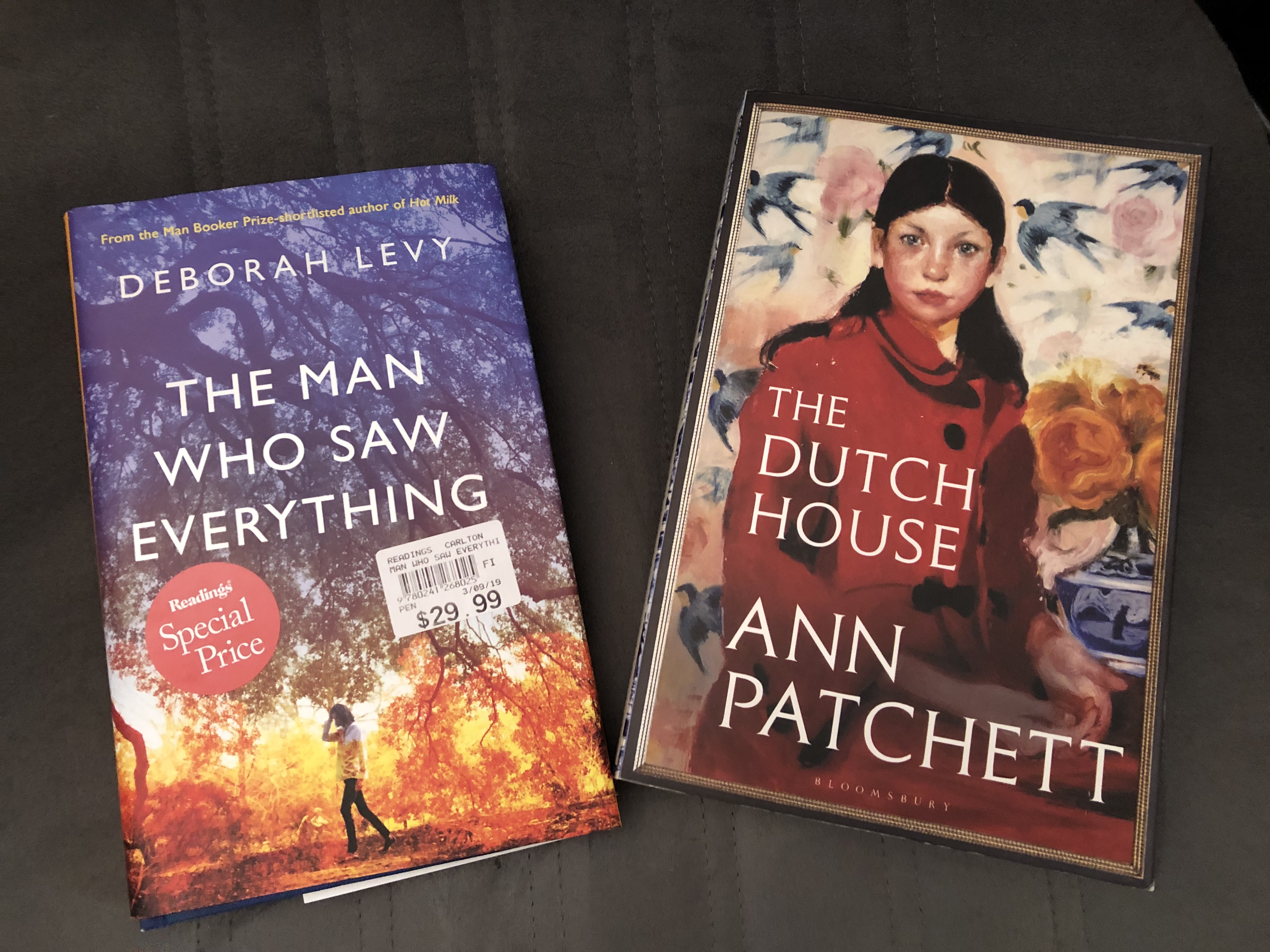
  1. Deborah Levy. The Man Who Saw Everything. I’m reading this book because of Ann Patchett’s new novel, The Dutch House. I went to Readings Bookstore in Carlton to buy the Patchett, and there, in the new releases was Deborah Levy’s new one, a novel that traverses the 1980s to the present day, character-based and ideas-driven, and written in Levy’s lucid rich prose. I am 1/3 the way through and Levy’s characters are provoking some surprising thoughts about my own very different characters. (Incidentally, Patchett has returned to form with The Dutch House. Such a subtle, yet intricate portrayal of family relations.)

  1. David Biale. Gershom Scholem. Master of the Kabbalah. Mention of this book was made in a recent article in the NYRB. It occurred to me that while Scholem’s name was very familiar to me, I knew nothing about him, nor the Kabbalah. Biale’s book is part of the excellent Yale Jewish Lives Series – a recommendation in itself.

Jewishness in any of its manifestations is not a theme in my new novel, but suddenly it seemed essential, and urgent, too, that I learn about Scholem. I read the book over two days. Scholem was a great scholar and there are some wonderful quotes in Biale’s book about the power of writing, of language, of story. One quote from Goethe’s Faust particularly struck: ‘Parchment – is that the secret fount/ from which you drink, to still your thirst forever?’ And from Scholem himself: ‘the desiccation of the language has dried out our hearts.’

One of the characters in my new novel, Adrian, is grappling with the problems of meaning, and, in particular, the nature of meaning without language. I put my books aside and listen to Mahler’s ‘Das Lied von der Erde’, a piece of music that has a profound effect on Adrian early on in the new novel, an effect that, wordman as he is, he simply does not understand. I let the music lift me out of the quotidian into the imagination’s swirl. The music plays, the voice lures, and I travel without will, without any monitoring whatsoever, through memory, musings, ideas, images that are not in the least essayist, but more like a Kandinsky painting.


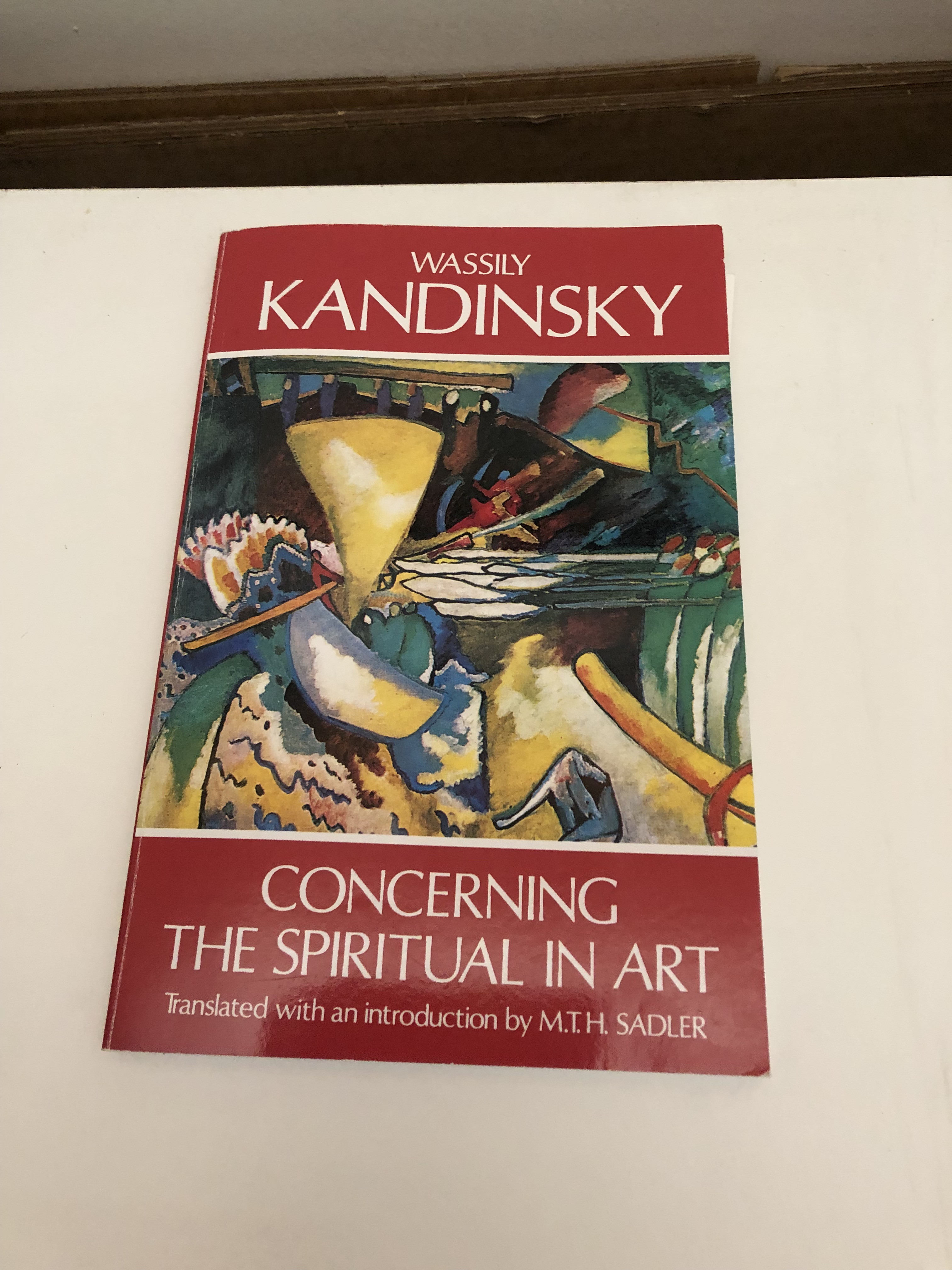
  1. Wassily Kandinsky. Concerning the Spiritual in Art

In this book, Kandinsky explains his theory and understanding of art, music, and the numinous. In the years 1911-1914, Kandinsky produced a number of large lyrical paintings. I’ve always loved these paintings, but it was only this past November, when I saw some of them again at Munich’s Lenbachhaus, that I realised the connection these paintings have to music and, more generally to a meaning that seems to circumvent language (Rothko’s work has the same effect). As I read Kandinsky’s book – it’s a slender book, but it demands a careful reading – some of the struggles and insights that beset my character, Adrian, sharpen and, at the same time, acquire a firmer foundation. Rather than the usual fragments that characterise this early stage of a novel, I actually reach for a proper notebook and write several pages.


  1. While I was in Germany I read Marjorie Perloff’s Edge of Ironyin which she, like others before her, visits the Hungarian intellectuals of the mid-twentieth century, an extraordinary group that included the mathematician John von Neuman, Arthur Koestler and Robert Capa, my favourite physicist Leo Szilard, and Elias Canetti – although Canetti could be said to have come from several places including Bulgaria and Vienna. Anyway Canetti was mentioned by Perloff, and I realised I had not read his three-volume autobiography. I’d always assumed I had, it being one of the books I OUGHT to have read.

I’ve read the first volume now, The Tongue Set Free, and am 2/3 the way through the second volume, The Torch in My Ear,the volume that charts his late teens through his twenties.

Books find you at the right time, and this is clearly my time for the Canetti autobiography. This morning I read a section in which Canetti may or may not be in love with a Russian chemist, Eva, who works in the same laboratory as he does. I think of the ramifications of not knowingif you love someone, and I’m not thinking of Canetti and the Russian chemist, I’m thinking of another of my characters, Claire, caught in a marriage that she regards as deep and meaningful and everyone else sees as cruel and destructive. I make some jottings and read on. Several pages later, Canetti writes of a specific type of hearing, a rare type of hearing that ‘was impossible unless you exclude your own feelings.’ My character Claire thinks about the common intrusion of this ‘I’. What people usually hear is first sieved through a mesh of their own desires and disappointments. And Claire starts to wonder about her own husband, what actually drives him in his relationship with her. I reach for the notebook.


  1. And poetry. I’m still dipping into Ted Hughes’ Crow— my character Adrian is an expert on death – and I’m about to pull down Goethe’s Prometheusfrom the shelf (it was mentioned in the Canetti autobiography), and I’ve not long finished The Death of Empedocles, both Hölderin’s and Matthew Arnold’s versions.

So this is just the current reading. If I glance down my lists for the last months of 2019 there are a lot of books, and very diverse. And what emerges from all this reading? An imagination that is ranging far and wide (definitely without a roadmap), new thoughts, new ideas, nascent characters who are gaining in flesh and sensibility, interesting scenes and curious events (most of which won’t survive the first draft), and three roughish chapters.

And so it goes. At the end of it all one hopes there’ll be a new novel. Ihope there will be. But it couldn’t happen without reading. Indeed,lifecouldn’t happen without reading.

.


Thoughts on Travelling and Fiction

I have been to Paris, Amsterdam, Venice, Berlin, and a dozen other European cities. I’ve driven through Britain and Ireland, I’ve traversed America and Canada and South America. I’ve seen lions and leopards and other exotic creatures in Botswana and Tanzania; I’ve witnessed erupting volcanoes in Hawaii and New Zealand. I feel at home on the Upper West Side of New York City, and I enjoy a comfortable familiarity with London. Of all the earth’s territories, only Asia is missing on my travel map: I don’t like the heat and, more particularly, heat does not like me. I console myself that I can’t do it all.

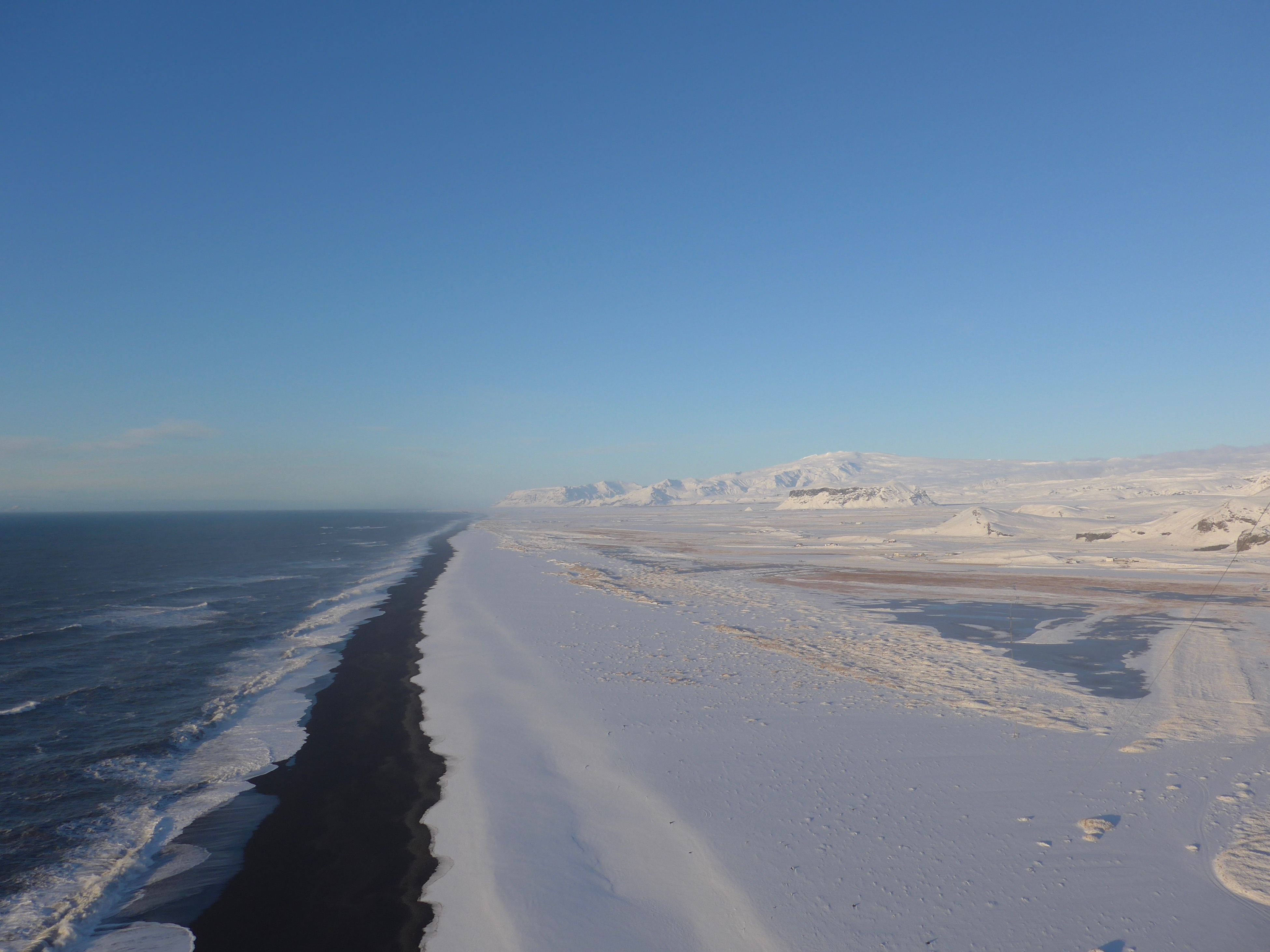
I am particularly drawn to cold wilderness landscapes. I have been to Antarctica, Patagonia, Lapland and Iceland. I have trudged through snow-filled environments at -25 degrees Celsius, and have sped through snowy forests and across frozen lakes with my own dog-sled team. In Iceland, I walked across a white isolated undulating plain, surrounded on all sides by low mountains, the smooth crunchy snow unmarked by human or animal; and later on that trip, I stood on a beach covered in fresh snow, the grey stormy Atlantic raging in front of me, and a strip of startling black sand where the waves had washed the snow away. I have walked alone in the silent, shadowless environment of a mid-winter Lapland day feeling an extraordinary peace in that strange, soft-edged land.


When I went to Antarctica, it occurred to me that if there were to be a physical landscape that represented the imagination it would be this place. Borderless, untouched, silent, monochrome, with towering mountains and broad sinuous glaciers, its seas covered with sheets of ice and huge icebergs the size of a city blocks.

I have stepped inside the imagination, I thought, over and over again.


Fiction and travelling are very similar. Both are a journeying into the unknown. Both require curiosity and courage, and both, if they are to be fully explored, require an active imagination. When travelling, you can join a tour or follow a guidebook, or you can wander – at will or whim – entering the current of a place, trusting in yourself even though all is strange and new. But it is precisely because you are in a new and strange place that you are willing to take a risk, for who knows what you will find and what you will see, and how it might change you.

And opening a new novel: you might begin with a vague notion of the story, but basically you enter the narrative, trusting that the author has done the necessary work for your fictional journey. You plunge in without knowing where you are going, but hoping at the end of reading, you’ll be moved and changed by the experience.

The comparison with travelling is equallly relevant when writing a novel. You start the project with a stack of blank pages and a head full of possibility. And you’re nervous too, just like the nerves as you board the plane. You’re heading into the unknown, you’re fearful that the journey might prove just too hard, you can’t conceive of your destination much less being confident that you’ll achieve it. But just with journeying in the real world, you have to trust, and you must have courage, and if things go wrong, if you take the wrong path, even enter the wrong country, you’ll imagine what might have been and you’ll change direction. And if you find yourself again in the wrong place, again you will imagine other possibilities and try another way.

Fiction and travel: I love them both. The one feeds the other, the one inflates and illuminates the other, and both of them are testimony to the power, the pleasure and the pitfalls too of that essential and unique quality of being human, namely, the imagination.

Next stop for me: Shetland.
And the next novel: it has begun…

For those of you in Melbourne, the Writers’ Festival has begun. Shaped around the theme of love there are some very seductive sessions. I am involved in 3 sessions, including an in-conversation with Marieke Hardy – Festival director and very fine friend – Saturday September 7, 10am. I suggest you go to the MWF website and check out the program. It really is a beauty.


Times Past, Times Present.

My last visit to London was a couple of years ago, the January that Trump was inaugurated. I was visiting alone, and with work behind me in Melbourne and more work ahead of me in Berlin, my stay in London was to be a holiday. Rather than my usual rental in Bloomsbury, I borrowed the flat of a friend. It was located in Marylebone, south of Baker Street and a short distance from Wigmore Hall. My friend had briefed me about the area: the cheese shop, the wine shop, Daunt Books in the high Street, and the weekend market in a carpark at which, she said, she had once seen the writer, Julian Barnes, shopping for vegetables.

The day after I arrived, rather than explore the local area, I went to the RA. It was the last day of an abstract expressionist exhibition, the central exhibit, at least to my Australian eyes, being Jackson Pollock’s stunning Blue Poles. Afterwards, filled with that pleasant, lightly exhilarated feeling one gets with the best of art, I popped across the road to Hatchards.

It still felt like the old Hatchards, or rather, it did not feel like another Waterstones, and I browsed happily, and at my leisure. I ended up buying a memoir by a woman about her sister’s suicide – I thought my interest in death books might have dwindled, but even now, ten years after D’s death, it still hasn’t; I indulged in a little fun book calledI Wandered Lonely as a Cloud…and other poems you half-remember from school; and lastly, I bought a new Vintage edition of Julian Barnes’s Metroland, his first novel and one I’d not previously been aware of. (Would I have bought this book if not already oriented in Barnes’s direction by my friend’s mention of him? I think not, although when I purchased the book I don’t believe I made the connection.)

It was a beautiful edition, a ‘special archive edition’, with a repeated graphic of a small cluster of suburban homes front and back in orange and magenta, folded flaps for the blurb and author bio, and illustrated end pages decorated with another repeated graphic, this one in orange and grey and also of houses but with the addition of the Eiffel Tower, so you know these are Parisian houses and not the London suburbs of the front and back covers.


A lovely edition, although less lovely to read – nothing to do with the print or the layout, but rather the spine was reinforced with steel-like glue. There was no bending this spine, no possibility of hands-free reading, the book lying independently on a table while I sipped my coffee or ate my breakfast or made the occasional jotting or just stretched my arms or shifted my position without missing a reading beat. The spine needed the strength of a weight-lifter to keep the book open.

This not withstanding, I was hooked from the very first page, indeed, by the very first line: There is no rule against carrying binoculars in the National Gallery.It was the word ‘carrying’ that particularly pleased; it contained so much more narrative possibility than the more prosaic ‘using’.

The novel is structured in three sections, with Chris the first-person narrator throughout. The first and longest section enters the world of Chris and his best friend Toni in 1963. Chris and Toni are all-knowing, all-critical, 16-year-old intellectuals. They are steeped in French writers, they assume an air of superior alienation and ennui, they deride parents, school and, above all, life in Metroland, that area of London served by the Metropolitan tube line. They look forward to the day when they are free to escape and enter LIFE PROPER.

How familiar I found this attitude, although in my case it came equipped with far less confidence and less superiority than that revealed by Chris and Toni. How familiar, even though it happened a half a century ago in the late 1960s, on the other side of the world, and at a time of life I preferred to forget. (I never really got the hang of childhood or adolescence, would have done better to begin life at 30.) Back in those long-ago days, I was reading the same French books as were Chris and Toni, and I was writing angst-laden poetry about not being understood, and in the same way that Chris and Tony dreamed of escaping Metroland, I dreamed of escaping suburban, far-from-everything Melbourne. London was the location of my LIFE PROPER. Already steeped in the Bloomsbury writers and artists, I would live a short walk from the BM – I, too, rejected the Metropolitan line without even knowing it – and I would write books. (My first published story was titled ‘If Patrick White Married Virginia Woolf’ in which a misunderstood Australian girl imagines the perfect life: PW married to VW, living and working in London along with their children, an Australian-born girl and Hurtle Duffield from White’s The Vivisector. Clearly I’d made the not-particularly-large leap from angst-filled poetry to hope-filled, biographically-stifled fiction.)

But back to the present. I am living in an area of London that may or may not be associated with Barnes, reading his first novel, I’mburiedin his book, in the longings of his young characters that match my own long-ago longings (perhaps the same longings experienced by all bright children), longings that reappear to me exactly as they once were, untouched by time or experience. And then, unbidden, I find myself, in the whirl of my own early escape to London, that first impoverished visit of wonders, that at-last-I-can-start-life sense of boundlessness and fear. I haven’t moved. I’m still sitting in my friend’s flat in Marylebone, reading Metroland, Julian Barnes first novel, I am in the mire of my 16-year-old self’s longings, and I am alone in London as a 21-year-old. And all this is happening simultaneously.

It’s like being in a three-dimensional Blue Poles, or better still, a three-dimensional Rothko (his is such a deep imagination), or inside a Mahler symphony. Linear time and linear space have been demolished by limitless imagination. Times past, times present and times future all mixing and mingling at the same time.

It was a fevered, fantastic experience, and while not the first time it has happened to me, there was a particular intensity on this occasion. Good fiction, the fictions that seduce and hold until the last page, invariably illuminate your lived experience. As I read Barnes’s Metroland,and relived times past, and also idly wondered if I might see Barnes himself at the Farmers’ Market the following weekend, there were swervings and touches and connections occurring in the imagination, enriching that vital swirl just beneath consciousness. And some time in the future, while occupied with the mundane business of life, doing the washing, walking an aisle in the supermarket, I will be aware of sparks and curiosities that emerge from that rich swirl, that shape into possibilities that firm into ideas and understandings. Standing in front of the oils and vinegars, I will be astonished and delighted by this wonder that is the imagination: the fuel of the LIFE PROPER.


Me, You and Us: the Problem with Memoir.

We are suffocating in memoir. Titles clog the bookshop shelves: My Life, Living with Cancer, My Abusive Mother, Poor Little Rich Girl, Poor Little Rich Boy, Skating on Thin Ice, Running a Marathon, Starving for Love, Living Black, Living under Cover.

The list goes on. And every month there’s another avalanche. Of course, in the rubble there are some gems, memoirs that reach out to a reader, that are about much more than Me Me Me, memoirs with ideas and reflections that stretch beyond the events of a single individual’s life. But unless you already know the author – Oliver Sacks, for example, or Jenny Diski, or Robert Gottlieb (his Avid Readeris a gift to all writers and readers) – it can be hard to find the good amongst the dross.

There’s a mistaken belief that memoirs are true, but when someone writes a memoir they select from life and they select from memory. It is not the whole story, it is not even an accurate portrayal of part of it. When people write a memoir they do so for one or more of many possible reasons, and those reasons shape what goes into the memoir. Of course a memoir does not reveal the truth, the full truth, the only truth.

Then there are the fictionedmemoirs, like Siri Hustvedt’s new book, Memories of the Future, and Lisa Halliday’s Asymmetry. These are memoirs with a glaze of fiction, a hybrid form that seems to do little justice either to fiction or memoir, but gives ample room for a writer to resurrect aspects of her/his past and dwell on these. Clearly the author gets something out of it, or else they wouldn’t bother: a sense of play perhaps, or an innocent indulgence, or the pleasure of placing one’s own experience centre-stage. But when the subject matter draws on the author’s relationship with a well-known writer, as is the case with Halliday’s book, there can be something quite instrumental and calculating in the events selected. (Can Halliday’s book stand on its own, without the Roth connection? Yes, it can. It’s well-constructed, and well-written. Is it one of the best May-September novels ever written? No it’s not. Would readers have taken notice of it, and, more to the point would publishershave taken notice of it – it’s a first novel – without the Roth connection? Probably not.)

So what is happening here with all these memoirs and fictioned memoirs? Why in an era where the self has so many platforms and stages, do books need to be co-opted as well? Surely with Facebook, Twitter and Instagram, with blogs and millions of web groups, with reality programs occupying more and more of free-to-air TV, the self has ample opportunity to bare its chest, to dance a tango, to do whatever it likes. And it can do it all the time. With people posting on social media numerous times daily, and checking for ‘likes’ even more often, the self never need to take a break from itself.* And perhaps that’s the nub: the self and the selves of our circle (which, these days, can stretch to thousands of strangers) are our main project, and for some of us, our sole project.

So many of the memoirs portray the self, the central character, as a victim. Of course, the very fact of writing the memoir, means the author has triumphed over their victim status, over adversity, but why would anyone want to dwell on it, and dwell for the years it takes to write a book? Why would I want to share my pain with you, a pack of strangers? And why would you, strangers all, want to read about me?

Voyeurism is not the whole explanation, but it plays a role. In much the same way that hardship stories fill the magazine programs on TV, we are drawn to hard-luck stories, particularly from the comfort of our own lounge room. But there are other factors at work here. The boundary between life and entertainment has blurred, and what’s real and what’s contrived/invented has similarly blurred. And being a promoter of self is so easy; it takes far less effort and imagination than learning about other people, people different from you. In the current world we reveal ourselves to people who are like ourselves, and vice versa. In this world, despite its porous borders and its multicultural societies, we are in danger of becoming more insular than ever before. Then there’s the clamouring NOW. Being a promoter of self, roots you in an ever-present, and history becomes irrelevant. With the demise of history, the major source of analysing and understanding the present is being lost.

Not so long ago (but, I’m pleased to note, before Invented Liveswas published) a friend asked me where all the good novels had gone. ‘Into memoir,’ I replied, ‘into memoir.’ Memoir is replacing fiction, self is replacing character, remembered facts are replacing an active imagination. The plethora of memoirs is doing more than just filling our leisure time, it is feeding a new type of person whose major concern is the cultivation of self, whose imagination is sluggish, who is constantly busy, stressfullybusy, with little to show for it at the end of the day.

I have often joked that fiction readers make better citizens. But the fact is that the deep immersion in fiction, the connecting in an imaginative way to characters/people who are very different from you, who might live at another time and/or in another culture, develops an understanding of life beyond your own experience. Fiction can take you into the world, and indeed the mind, of a dictator, a child soldier, a politician. Fiction can take you out of yourself. And what a gift and a relief that can be.


* What exactly do we derive from those ‘likes’? That people appreciated your post? Understood it? Laughed at it? Engaged with it? Or is it all about you wanting to be reassured you are not alone in your life? When togetherness is reduced to a click, we’re in a good deal of trouble.

THE WORLD ACCORDING TO…

Jewish Book Week Gala performers.

The 2018 Jewish Book Week in Melbourne opened with a gala choreographed by Galit Klas along with Evelyn Krape. 6 writers were asked to write a short piece shaped around the phrase: The World According to… While others chose a specific person (e.g. a 16th century mathematician, Batman, a Batmitzvah girl) I took a different tack. The readings were accompanied by music and large screen visuals. The evening was tied together with some fabulous singing from Galit. The piece I performed is written below.


THE WORLD ACCORDING TO….

Pamela Simon was an excellent wife, an excellent mother, and an excellent grandmother. Indeed she had been imbued with excellence from childhood when, as Pammy Silverstein, she had excelled at her studies, played flute in the youth orchestra, and lead the school debating team to the state finals.

She had married the very excellent David Simon straight after university, and while she had planned to continue her studies with an MA and then a PhD in the border frontier of philosophy and literature, she knew she could return to university later. In the meantime she kept a note book in which she transcribed interesting and punchy quotes from poets and novelists, philosophers and other thinkers.

Ambitions change – or perhaps are supplanted when babies come: first Jonathan then Melanie. And by the time Melanie started kindergarten, rather than a return to university, with David’s printing firm thriving, Pamela joined him in the business.

The years passed, the children flourished, the business went from strength to strength. Every now and then Pamela would pick up her quote-book and read through the inspiring lines; very occasionally she added a new quote drawn from her current reading

The years turned into decades. With David now in his mid-sixties, Melanie was taking over more of the day-to-day running of the business. Retirement was on the horizon, and Pamela was eager for the next stage.

Then her excellent life exploded.

David was indeed retiring from the business, but not to be with her, not to do the things they had long planned together, but to live with Kylie from accounts who was expecting his child. If it were not her own life, her own tragedy, Pam would think she had stumbled into a political soapie.

David moved out of the house and in with Kylie. With the bedroom of the past forty years now full-strength toxic, Pam withdrew to her sewing-come-hideaway room. Jonathan and Melanie, both appalled at their father’s behaviour, tried to coax her out. But she did not want to be coaxed. Her life was over.

‘I would prefer not,’ she said when Melanie on the other side of the closed door invited her mother for lunch, for dinner, for outings with the grandchildren.

‘I would prefer not,’ Pam says, recognising it as a quote from someone. She rummages through her book cases, and there it is: ‘Bartleby the Scrivener’, a short story by Herman Melville. ‘I prefer not,’ Bartleby says, when assigned various work tasks that do not appeal.

Hard to argue against that.


The voices begin soon afterwards.

The 19th century philosopher Schopenhauer is first: ‘Life is a miserable thing’, he says. ‘I have decided to spend my life thinking about it.’

Pamela is smiling, the first time in weeks, and then actually laughing when she recalls that the world according to Schopenhauer was not known for its laughs. It’s a pleasant respite in her life of woe. But before long she’s back in the stifling blackness, back in the gluey swamp of grief, loss, anger, misery.

‘The emotions are not skilled workers.’

Another voice, again faintly familiar, cuts through the silence. Pamela, perched on the day bed, reaches for her old quote book. She wipes the dust from the cover, and leafs through the pages of faded ink. So many wise words in this book of hers, all written out in her hand. And there, she’s found it, and another smile. The words are Ern Malley’s, the non-existent poet created by James McAuley and Harold Stewart in what became Australia’s greatest literary hoax. In the world according to Ern Malley:The emotions are not skilled workers.

‘You’re probably right,’ she says aloud. ‘But emotions are so damned insistent. So intrusive. So domineering. Reason doesn’t stand a chance.’

Outside the sewing room, Melanie and Jonathan are eavesdropping on their poor mother. She needs help, they decide, professional help. But how to help someone who refuses to be helped.

Inside her room Pamela is pacing. ‘I liked my life as it was.’

The world according to modern historian Tony Judt intrudes with its usual perspicacity. ‘Nostalgia makes a very satisfactory second home.’

Pam is quick to respond. ‘At least nostalgia dulls the pain. The loneliness, too.’

On the other side of the door Jonathan and Melanie decide on an emergency home visit from the doctor. They hasten from the house their mobile phones clamped to their ears.

Inside the sewing room the conversation continues.

‘Solitude is the best cure for loneliness.’

Pamela riffles through her quote book. Yes, there it is, the world according to the American poet, Marianne Moore. Solitude is the best cure for loneliness.

And hasn’t she longed for solitude day after day, year after year, through the clutter and noise of her busy life?

The world according to the artist and poet Jean Arp joins in.

‘[Human beings] ha[ve] turned [their] back on silence,’ he says. ‘Day after day [they] invent(..) machines and devices that increase noise and distract humanity from the essence of life, contemplation, meditation.’

Jean Arp wrote this more than seventy years ago. What on earth would he think of the constant talking, typing, texting, beeping, buzzing, connecting of today’s world, Pamela wonders.

So much activity and so much noise. No time to think, to contemplate, to loiter in the imagination. And if we don’t think and we don’t imagine, how are we live? And how will we live with people who are different from ourselves?

Pamela searches through her quote book. Whose thoughts are these? Whose world? She can’t find the source, quickly grabs a pen and writes the thought down on a fresh page in her quote book.

People often praised her for what they called her intuitive understanding of others – even when the person was very different from herself. But it was simple really: she would IMAGINE what it was like to be in their position, to be them. Being an avid reader of fiction had honed this ability. She would read about people so different from herself, people who lived in different countries, different eras, different cultures, different circumstances, and by entering the world of these characters so her imagination was fed. Perhaps fiction readers make better citizens, wiser and more welcoming citizens, and she quickly jots that down too. Whatever the reason, she did seem to understand others, and not just Mrs Nextdoor, or the pharmacist, or family and friends. She understood what it was like to be so desperate you’d risk your life to take a leaky boat to a distant shore where you know no one where you don’t speak the language, where you are exiled from all that is familiar. She can imagine what it’s like to flee persecution in your own country only to be imprisoned by another, a country that you thought would be safe, would be kind. What she can’t imagine is what on earth goes on in the minds of those who demonise these desperate people.

She turns to the world according Thomas Hardy in her quote book.


We are getting to the end of visioning
The impossible within this universe,
Such as that better whiles may follow worse,
And that our race may mend by reasoning.

To reason and imagine in the way Hardy suggests requires uninterrupted time. She has plenty of time. The imagination requires solitude. She has plenty of solitude. The imagination does not like boundaries and schedules. With her life blasted to pieces, she lacks boundaries and schedules.

You must change your life.

The world according to the German poet Rilke sets up a chant.

You must change your life. You must change your life.

The words come rhythmically, they take her over like music. She rises from the bed, collects her hand bag, checks her makeup, leaves the room, walks down the passageway, opens the door and leaves the house.

As she enters the street, the voice in her head shifts to a different register. It is the world according to Emma Goldman and it puts bounce in her step:

If I can’t dance I don’t want to be part of your revolution.