
INSPIRATIONS: IRIS MURDOCH
Way back in 2020, in a post titled WHEN THE LIGHTS GO DOWN: Truth, authenticity and personal allegiance in fact-based film, I mentioned a piece I had written for The Australian (April 26-27, 2003) following the death of Iris Murdoch. I recently reread the article, the first time in many years. It speaks of the passion for reading, the gifts of the imagination, and it spoke to me now in this time when attention is being pulled every which-way, it spoke to me even though I was the writer. So I decided to post it here.*
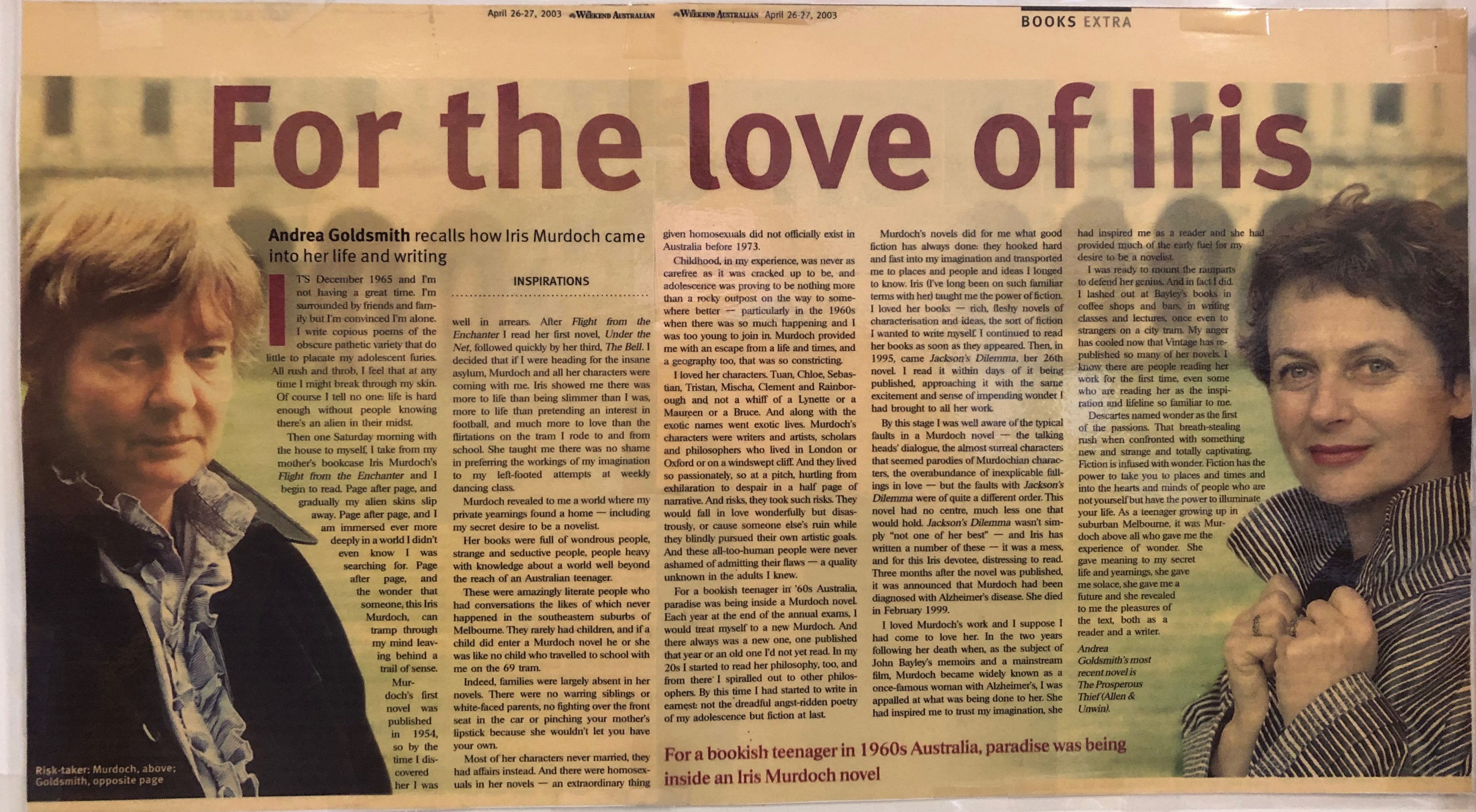
It’s December 1965 and I’m not having a great time. I’m surrounded by friends and family but I’m convinced I’m alone. I write copious poems of the obscure pathetic variety which do little to placate my adolescent furies. All rush and throb, I feel that at any time I might break through my skin. Of course I tell no one: life is hard enough without people knowing there’s an alien in their midst.
Then one Saturday morning with the house to myself, I take from my mother’s book-case Iris Murdoch’s Flight from the Enchanter and I begin to read. Page after page, and gradually my alien skins slip away. Page by page, and I am immersed ever more deeply in a world I didn’t even know I was searching for. By the halfway mark I’m struck with wonder that someone, this Iris Murdoch, can tramp through my mind leaving behind a trail of sense.
Murdoch’s first novel was published in 1954, so by the time I discovered her I was well in arrears. After Flight from the Enchanter I read her first novel, Under the Net, followed quickly by her third, The Bell. I decided that if I were heading for the insane asylum, Iris Murdoch and all her characters were coming with me. Iris showed me there was more to life than being slimmer than I was, more to life than pretending an interest in football, and much more to love than the flirtations on the tram I rode to and from school. She taught me there was no shame in preferring the workings of my imagination to my left-footed attempts at compulsory sport. Iris Murdoch revealed to me a world where my private yearnings found a home – including my secret desire to be a novelist.
Her books were full of wondrous people, strange and seductive people, people heavy with knowledge about a world well beyond the reach of an Australian teenager. These were amazingly literate people who had conversations the likes of which never happened in the south-eastern suburbs of Melbourne. They rarely had children, and if a child did enter a Murdoch novel he or she was like no child who travelled to school with me on the 69 tram. Indeed families were largely absent in her novels. There were no warring siblings or white-faced parents, no fighting over the front seat in the car or pinching your mother’s lipstick because she wouldn’t let you have your own. Most of her characters never married, they had affairs instead. And there were homosexuals in her novels – an extraordinary thing given homosexuals did not officially exist in Australia at that time.
Childhood, in my experience, was never as happy and carefree as it was supposed up to be, and adolescence was proving to be nothing more than a rocky outpost on the way to somewhere better – particularly in the 1960s when there was so much happening and I was too young to join in. Iris Murdoch provided me with an escape from a life and times, and a geography too, that was so constricting.
I loved her characters. Tuan, Chloe, Sebastian, Tristan, Mischa, Clement, Rainborough, with not a whiff of a Lynette or a Maureen or a Bruce. And along with the exotic names came exotic lives. Murdoch’s characters were writers and artists, scholars and philosophers who lived in London or Oxford or on a windswept cliff. And they lived so passionately, so at a pitch, hurtling from exhilaration to despair in a half page of narrative. And risks, they took such risks. They would fall in love wonderfully but disastrously, or cause someone else’s ruin while they blindly pursued their own artistic goals. And these all-too-human people were never ashamed of admitting their flaws – a quality unknown in the adults I knew. For a bookish teenager in 1960s Australia, paradise was being inside an Iris Murdoch novel.
Each year at the end of the final exams, I would treat myself to a new Iris Murdoch. And there always was a new one, either one published that year or an old one I’d not yet read. In my twenties I started to read her philosophy too, and from there I spiralled out to other philosophers and thinkers. By this time I had started to write in earnest: not the dreadful angst-ridden poetry of my adolescence, but fiction at last.
Iris Murdoch’s novels did for me what good fiction has always done: they hooked hard and fast into my imagination and transported me to places and people and ideas I longed to know. Iris (I’ve long been on such familiar terms with her) taught me the power of fiction. I loved her books – rich, fleshy novels of characterisation and ideas, the sort of fiction I wanted to write myself.
I continued to read her books as soon as they appeared. And then, in 1995, came Jackson’s Dilemma, her 26th novel. I read it within days of its being published, approaching it with the same excitement and sense of impending wonder I had brought to all her work. By this stage I was well aware of the typical faults in an Iris Murdoch’s novel – the talking heads’ dialogue, the almost surreal characters that seemed parodies of Murdochian characters, the over-abundance of inexplicable fallings in love – but the faults with Jackson’s Dilemma were of quite a different order. This novel had no centre, much less one that would hold. Jackson’s Dilemma wasn’t simply ‘not one of her best’ – and Iris has written a number of these – it was a mess, and for this Iris devotee, distressing to read. Three months after the novel was published, it was announced that Iris Murdoch had been diagnosed with Alzheimer’s Disease. In February 1999 she died.
I loved Iris Murdoch’s work, and I suppose I had come to love her. In the two years following her death when, as the subject of of John Bayley’s memoirs and a mainstream film, Iris Murdoch became widely known as a once-famous woman with Alzheimers, I was appalled at what was being done to her. She had inspired me to trust my imagination, she had inspired me as a reader and she had provided much of the early fuel for my desire to be a novelist. I was ready to mount the ramparts to defend her genius. And in fact I did. I lashed out at Bayley’s books in coffee shops and bars, in writing classes and lectures, once even to strangers on a city tram.
My anger has cooled now that Vintage has re-published so many of her novels. I know there are people reading her work for the first time, even some who are reading her as the inspiration and lifeline so familiar to me.
Descartes named wonder as the first of the passions. That breath-stealing rush when confronted with something new and strange and totally captivating. Fiction is infused with wonder. Fiction has the power to take you to places and times and into the hearts and minds of people who are not yourself but have the power to illuminate your life. As a teenager growing up in suburban Melbourne, it was Iris Murdoch above all who gave me the experience of wonder. She gave meaning to my secret life and yearnings, she gave me solace, she gave me a future, and she revealed to me the pleasures of the text, both as a reader and a writer.
_____________________________
- There has been a long time between posts, occasioned by far too many annoying intrusions this past year – a situation I hope will not be repeated in the years to come. And…I have a newly renovated study, so splendid I expect I’ll want to spend most of my life in here.


