Category Archives: Imagination

ODYSSEUS AND ME

I have always believed that, at a personal level, anything is possible, that if I desire to be a particular someone or do a particular something I can. All my desires have been realistic: no hankerings for time travel or reinvention as a theoretical physicist – though both have enormous appeal – my desires have been possibilities: working as a volunteer in Africa, joining a choir, mountaineering, falling helplessly in love, winning the Miles Franklin. The only things to stop me would be lack of ability, lack of application, and/or lack of courage – all of which, given enough time, could be worked upon and overcome.

Time, so recently as abundant as air, is now suddenly in short supply. One day everything seemed possible, and the next, my life wasn’t exactly on its knees, but neither was it leaping with anticipation.

When did it happen that all the things I planned to do became the things I will never do? I will never climb a mountain, I will never win the Booker, I will never sleep alone in the outback under a big Australian sky; even the choir and the hot love affair have gone the way of all flesh. The list of things not done, so recently sparkling with possibility, now weighs as heavy as sludge, and no matter how numerous your wins and achievements, it’s hard not to feel a failure. Harder still not to blame yourself for all this wasted opportunity.

This is not a good state of mind, not when you are planning on another quarter of a century of healthy and active living. I recall an interview I heard years ago on Late Night Live. Philip Adams was in conversation with the American sociologist Studs Terkel. Terkel, who published consistently throughout his long life (he died at the age of 96 in 2008) was in his early eighties at the time and had just published his latest book. Philip asked him how he managed to remain so productive. Terkel replied that he made a point of doing something new each day. It might be visiting a park or a gallery for the first time; it might be finding a new author or reading a new book; it might be listening to familiar music and hearing it differently (this happened, memorably, to me a couple of years ago when Andrew Davis conducted the MSO playing Mahler’s Third), or watching a spider build a web. It might be a journey, like one I made recently to Iceland, where I ventured into volcanic, snow-covered wildernesses. Being immersed in these beautiful and tranquil environments made me unusually and surprisingly happy.

Something new every day keeps building a life, keeps creating a dynamic growing you. The future might be diminishing, Terkel was saying, but you are not.

On my return from Iceland I was determined to hold on to the sense of wonder and aliveness I’d felt in that country, of being attuned to my environment: to be, as it were, a tourist at home. But it didn’t seem to work. It was as if home activated a stronger force. There was something about its comforts, its familiarity that slowed me down and, at the same time, dulled the questioning mind. I was lulled, stilled, my edges were blurred – like in a warm water bath. And the list of things not done was a constant background presence that grew into a punchy accusation.

And yet I had been ready to come home, and was, at least initially pleased to be back in my own space. But before long it felt as if I were functioning at half-strength. When I mentioned this to people my own age they all nodded knowingly: what I was experiencing, they said, was a fact of advancing years. But it made no sense to me that I was on the final slope, inexorably sliding down to the end. Just days before I’d been hiking over iced lakes; I’d held my ground on the side of a cliff in a bluster so strong that in the end I wedged myself in a cleft of rocks so as not to be blown off; I’d wandered snowy wildernesses alone towards unknown destinations. Age alone could not explain what was happening to me.

It was in this state that I read a review of An Odyssey. A father, a son and an epic by the American classicist, translator and essayist, Daniel Mendelsohn. I know Mendelsohn’s work, have enjoyed his essays in The New Yorker and the New York Review of Books. I checked the Readings website, the book was in stock at the Carlton store, I bought myself a copy.

Rationally, I have no special reasons for being drawn to this book. Sure, my reading group has decided on the Greek dramatists for 2018 – Aeschylus, Sophocles and Euripides – which might make me more susceptible to a book that enters the ancient Greek world; but if this were the case, surely I’d reach for Homer himself. And while I like Mendelsohn’s work, I like the work of so many of the contributors to the NYRB and I haven’t sought out their books.

There have been times in my life when the right book for the right time has simply presented itself. I never expect it, I never willit, it is an inexplicable wonder of the imagination (and heart and soul) and something for which I am deeply grateful.

Daniel Mendelsohn’s An Odysseyturned out to be one such book.

It tells a simple story. In the first semester of a new year, beginning in the depths of winter, Daniel Mendelsohn will be teaching a weekly, semester-long class on The Odysseyat Bard, a liberal arts college, about 140 kilometres north of New York City. His 81-year-old father, Jay, a retired mathematician and a man heavily steeped in the sciences, asks to attend the class. While surprised at the request, and a little worried about the effect his father might have on the other students, Daniel nonetheless agrees. Each week for a semester his father makes the long journey from NYC on the Thursday, stays with his son on Thursday night, attends the class on Friday morning and returns home by train in the afternoon. The students taking this class are under-graduates, Jay would be older than most of their grandfathers.

As a father and a very particular type of scientist there are no shades of grey for Jay. X is X, and if it’s not then either you are wrong or you need to return to the drawing board. When it comes to Homer’s great epic two fundamentals emerge as obvious to him: so-called ‘heroic’ Odysseus is not a hero because he cheats on his wife, and, given that all his men die, the so-called ‘great leader’ is in fact a poor leader of men. This becomes a regular refrain throughout the course, Jay’s regular complaint.

During the semester Daniel and Jay take an intellectual, psychological and literary journey through Homer’s epic, and when the class finishes the two embark on a physical journey: a cruise tracing Odysseus’s travels through the Mediterranean. During the course of these two journeys Daniel comes to understand his father in new and nuanced ways. The Odyssey, or rather his father’s response to it, helps explain his father’s dogmatism, his reluctance to show physical affection, his autocratic paternalism; it also makes sense of those rare and surprising occasions when warmth and softness do seep out. Mendelsohn also takes we readers on two journeys: that of Homer’s Odysseus (and a great introduction for those who have never read Homer) and that of a modern-day father and son on a journey of their own.

Mendelsohn, a translator of Cavafy, draws attention to Cavafy’s wonderful poem ‘Ithaka’ (1911) with its emphasis on the journey rather than the destination: don’t be in a hurry, is the message of this poem, don’t be impatient, embrace the risk and surprise that infiltrates all life’s journeys, soak up all the new experiences. Mendelsohn mentions an earlier version of ‘Ithaka’ called ‘Second Odyssey’ (1894), in which Odysseus, having arrived home after an absence of twenty years – ten years of the Trojan Wars, and ten years trying to get back to Ithaka – finds home dull and boring; he does not feel himself. So, too, in Tennyson’s great poem ‘Ulysses’. In Tennyson’s poem, after striving to return to Ithaka, to his wife and son and ageing father, despite all the dangers he faced on his travels, the set-backs that occurred, the yearnings that plagued him, Ulysses decides to leave home again. (A long-time favourite of mine, I always take a copy of this poem on my own travels.)

I put Mendelsohn’s book aside to reread Tennyson’s ‘Ulysses’ and Cavafy’s ‘Ithaka’ and search for a copy on-line for Cavafy’s ‘Second Odyssey’. (I have three different volumes of the collected Cavafy, as well as a biography, and in none of them is printed the ‘Second Odyssey’.) When I have finished reading I am steeped in journeying and alert to the shortcomings and deceptive pleasures of home, but most surprising of all, I feel lighter, happy even, and more energised than at any other time since my return from Iceland. And these poems I thought I knew so well, I seem to be reading them anew. Suddenly my diminished future doesn’t matter any more, and, in not mattering, neither does it feel diminished any more.

I’ve had an invigorating time these past few days with Mendelsohn, Tennyson Cavafy and, of course, Odysseus himself; all of these books and poems, these words and ideas have rejuvenated me. It’s the same sort of feeling I had in Iceland as I wandered the snowy wilderness, that sense of newness, of increased understanding, of possibility– Terkel’s way. But there has been something else as well. These Odysseys of Mendelsohn, Homer, Tennyson and Cavafy have nourishedme; even more, they have illuminated and provoked me; and they have armed me for the way ahead. They have been journeyings. And they’ll always be there. Books don’t die, they don’t leave you, they don’t lose their mind. They sit on their shelves waiting for you to find them again and again and again.

When you stop adventuring, when you avoid risk you feel useless. When the brain grows sluggish you feel useless. Life itself demands care and attention, work and revision. It can be difficult sometimes to find the right nourishment, after all, you can’t hop on a plane and fly to Iceland every time you feel bleak and useless. But books, your favourite books will always be there, offering something new and provocative on every reading. So easy to lose sight of this.

Home, certainly the ideal of home, is all about comfort and certainty. If you’re not careful, this can be counter-productive in one’s advancing years. ‘Don’t expect Ithaka to make you rich’, Cavafy writes. While there are rewards and fulfilment to be found at home much more are to be found when you venture beyond your front door – whether physically or in your imagination. To have a zest for life is to relish being alive in the first place. And life is not a warm and cosy nest, though that may be part of it, life is also the clinging to the side of a cliff and feeling the wild wind in your hair.


POEMS 

ITHAKA by C.P. Cavafy (translated by Edmund Keeley & Philip Sherrard

As you set out for Ithaka
hope your road is a long one,
full of adventure, full of discovery.
Laistrygonians, Cyclops,
angry Poseidon – don’t be afraid of them:
you’ll never find things like that on your way
as long as you keep your thoughts raised high,
as long as a rare sensation
touches your spirit and your body.
Laistrygonians, Cyclops,
wild Poseidon – you won’t encounter them
unless you bring them along inside your soul,
unless your soul sets them up in front of you.

Hope your road is a long one.
May there be many summer mornings when,
with what pleasure, what joy,
you enter harbours you’re seeing for the first time;
may you stop at Phoenician trading stations
to buy fine things,
mother of pearl and coral, amber and ebony,
sensual perfume of every kind –
as many sensual perfumes as you can;
and may you visit many Egyptian cities
to learn and go on learning from those who know.

Keep Ithaka always in your mind.
Arriving there is what you’re destined for.
But don’t hurry the journey at all.
Better if it lasts for years,
so you’re old by the time you reach the island,
wealthy with all you’ve gained on the way,
not expecting Ithaka to make you rich.

Ithaka gave you the marvellous journey.
Without her you wouldn’t have set out.
She has nothing left to give you now.
And if you find her poor, Ithaka won’t have fooled you.
Wise as you will have become, so full of experience,
you’ll have understood by then what these Ithakas mean.


THE SECOND ODYSSEY (1894) – copied from the web, translated by Walter Kaiser.

A great second Odyssey,
Greater even than the first perhaps.
But alas, without Homer, without hexameters.

Small was his ancestral home,
Small was his ancestral city,
And the whole of his Ithaka was small.

The affection of Telemachus, the loyalty
Of Penelope, his father’s ageing years,
His old friends, the love
Of his devoted subjects,
The happy repose of his home,
Penetrated like rays of joy
The heart of the seafarer.

And like rays they faded.

The thirst
For the sea rose up with him.
He hated the air of the dry land.
At night, spectres of Hesperia
Came to trouble his sleep.
He was seized with nostalgia
For voyages, for the morning arrivals
At harbours you sail into,
With such happiness, for the first time.

The affection of Telemachus, the loyalty
Of Penelope, his father’s ageing years,
His old friends, the love
Of his devoted subjects,
The peace and repose of his home
Bored him.

And so he left.

As the shores of Ithaka gradually
Faded away behind him
And he sailed swiftly westward
Toward Iberia and the Pillars of Hercules,
Far from every Achaean sea,
He felt he was alive once more,
Freed from the oppressive bonds
Of familiar, domestic things.
And his adventurous heart rejoiced
Coldly, devoid of love.


ULYSSES by Tennyson.

It little profits that an idle king,
By this still hearth, among these barren crags,
Match’d with an aged wife, I mete and dole
Unequal laws unto a savage race,
That hoard, & sleep, & feed, & know not me.
I cannot rest from travel: I will drink
Life to the lees: all times I have enjoy’d
Greatly, have suffer’d greatly, both with those
That loved me and alone; on shore, and when
Through scudding drifts the rainy Hyades
Vext the dim sea: I am become a name;
For always roaming with a hungry heart
Much have I seen and known; cities of men
And manners, climates, councils, governments,
Myself not least, but honour’d of all them;
And drunk delight of battle with my peers,
Far on the ringing plains of windy Troy.
I am a part of all that I have met;
Yet all experience is an arch where through
Gleams that untravell’d world whose margin fades
For ever and for ever when I move.
How dull it is to pause, to make an end,
To rust unburnish’d, not to shine in use!
As though to breathe were life. Life piled on life
Were all too little, and of one to me
Little remains: but every hour is saved
From that eternal silence, something more,
A bringer of new things; and vile it were
For some three suns to store and hoard myself,
And this gray spirit yearning in desire
To follow knowledge, like a sinking star,
Beyond the utmost bound of human thought.
This is my son, mine own Telemachus,
To whom I leave the sceptre and the isle —
Well-loved of me, discerning to fulfil
This labour, by slow prudence to make mild
A rugged people, and through soft degrees
Subdue them to the useful and the good.
Most blameless is he, centred in the sphere
Of common duties, decent not to fail
In offices of tenderness, and pay
Meet adoration to my household gods,
When I am gone. He works his work, I mine.
There lies the port: the vessel puffs her sail:
There gloom the dark broad seas. My mariners,
Souls that have toil’d & wrought, & thought of me —
That ever with a frolic welcome took
The thunder and the sunshine, and opposed
Free hearts, free foreheads — you and I are old;
Old age hath yet his honour and his toil;
Death closes all: but something ere the end,
Some work of noble note, may yet be done,
Not unbecoming men that strove with Gods.
The lights begin to twinkle from the rocks;
The long day wanes: the slow moon climbs: the deep
Moans round with many voices. Come, my friends,
‘Tis not too late to seek a newer world.
Push off, and sitting well in order smite
The sounding furrows; for my purpose holds
To sail beyond the sunset, and the baths
Of all the western stars until I die.
It may be that the gulfs will wash us down:
It may be we shall touch the Happy Isles,
And see the great Achilles, whom we knew.
Though much is taken, much abides; and though
We are not now that strength which in old days
Moved earth and heaven; that which we are, we are;
One equal temper of heroic hearts,
Made weak by time and fate, but strong in will
To strive, to seek, to find, and not to yield.


IMAGINATIVE EXCURSIONS

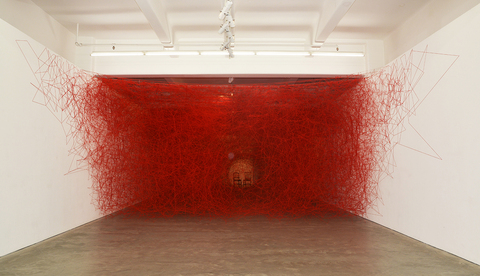
CHIHARU SHIOTA: Absent Bodies.
Anna Schwarz Gallery. Till 5th November, 2016

There have been a handful of occasions in my life when I have stood before a work of art meaning to look at it, appraise it and have found myself drawn into it. In some strange way I become part of the work. It is as if my imagination has merged with the imaginative space of the art work and, at the same time, any mind-body split has been dissolved. I have, simultaneously, a visceral and imaginative response to the work – the heart rate increases, the stomach plunges – and yet I am strangely incorporeal. I am all mind, I am all sensation. It is a pure, original, all-consuming experience.

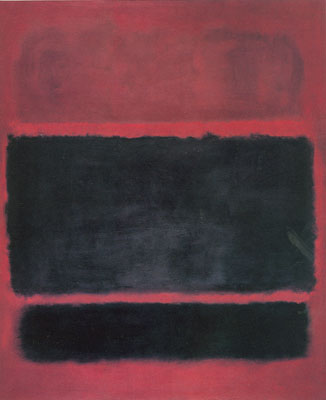
The first time this happened I was standing in a large room at the old Tate in London the walls of which were covered with huge Rothkos. I was wrapped in Rothkos. Then, all of a sudden there were no edges and I was floating in these paintings and pounding with their rhythm and even more extraordinary I was filled with a type of knowing that, for someone with a strong intellectual bent, was staggeringly new. The second time, also in London, occurred at the Courtauld when for the very first time I saw the genius of Cézanne, saw the planes and shadings, saw the landscape through Cezanne; it changed the way I have looked at landscape – real landscape, in the world – ever since. The third occasion was coming face to face with Arthur Boyd’s ‘Nebuchadnezzar on fire falling over a waterfall’. I remember the shock of understanding when I saw that painting, the utter conviction that this was how life was – the beauty and the terror. The fourth time was walking through Kathy Temin’s large work ‘My Monument: White Forest’ (see the posting Imagination Soup: How novels begin). I was absorbed into this large installation so profoundly that I was transported back ten years to a visit I’d made to Auschwitz-Birkenau – one of the places, I would later discover, that had inspired this work of Temin’s. There was no prior knowledge here, no intention, rather my imagination and the imaginative space of the artwork merged.

And it has just happened again. Today I saw ‘Absent Bodies’ by Chiharu Shiota (at Anna Schwarz Gallery, Melbourne, until 5th November). This beautiful art work, 15×4.5×4.5m takes up half the space of the gallery. It is a huge complex web, or rather webs constructed out of smooth red yarn. The obvious analogy is the network of neurons in the brain, the long axons, the ganglia where nerves meet, blown up to the size of a small house. But to reduce Shiota’s work to mere physical presence is to leach it of power, of effect.


shiota_2016_install_final-m

Shiota’s art work knows space, possesses space in the way, say, of the Grand Canyon or the open vistas of Antarctica or, indeed, the unfettered imagination. The tangle of red string creates an environment, and even though you stand at the edge you enter it (and yet physically you can’t enter it because the strings, criss-crossing in all directions, would stop you.) Again that sense of an imaginative space being coterminous with your imagination. Where the threads meet and cross one another, they are not knotted – there are no knots in this tangled environment – rather they twist around one another. And through the middle the threads thin out, may even disappear, creating a tunnel that leads to two chairs at the end; they are vacant, they are waiting for you.

This is an environment of complexity and possibility, just like the imagination. It’s all about connection and space, creativity and insight. It is, truly, beautiful. And it opens a fourth dimension – not time, in fact time is stationary in this sort of unregulated experience – the dimension running along the consciousness-unconsciousness continuum releases the imagination itself, a numinous presence that simultaneously envelops depth and motion, memory and forgetting, experience and insight. This artwork becomes you.

LETTERS (again)

Personal letters are private. Written by one individual to another, they are composed in private and intended to be read in private.

There are few other human-to-human activities that can claim this level of privacy. Sex perhaps. And good conversation, by which I mean those passionate, exploratory, discursive exchanges that occur over many hours, during which mind and language are exercised to a magnificent degree; where the conversation is a journey, a magical mystery tour, in which the stopping-off posts and the end points are adventures to be discovered.

I have fallen in love during hours of close conversation. (As has often been noted, the brain is the sexiest human organ.)

I am currently reading Ted Hughes’s letters, selected and edited by Christopher Reid. Hughes had some fine correspondents, family of course, as well as many writers and artists; and poets, too, such as W.S. Merwin, Daniel Weissbort, Al Alvarez, and Yehuda Amichai (one of Hughes’s favourite poets – mine too). Often in reading Hughes’s letters I am pulled up short by some seriously intoned astrological aside (not sharing his beliefs, I find some of them laughable), some acutely observed aspect of nature, some superbly expressed outrage. Here he is on a particular critic who had given a bad review of a friend’s work.

Davie [the critic] is a kind of parasite in the crutch & armpits of poetry very common in the States – a strident proclaimer of the latest O.K. notions all sure to be found in a pitiful form in his own latest verse. He’s a grotesquely shrunken silly imitator of Pound, forty years after the phenomenon. He’s the old receptacle of every other critic’s – particularly the American battalion – dud cartridges & empty cases & he’s trying to fit them all together, not dropping one, into a semblance of armament….He’s the mincy mean know-all kind of little office snot – a standard English type – gone into Literature, & in the branch of poetry his own practice is about the measure of his understanding – all creak & no cart. (Letter to the poet John Montague, 1961)

I am reading the letters from 1960, 1961 and 1962. I know Plath’s death occurs in February 1963, but Ted Hughes does not know what’s up ahead. As the terrible time draws closer, I read his letters and I feel for him. Feel for him, not her. I read past her death to a letter to Sylvia’s mother, Aurelia Plath, written three months after Sylvia’s death. It is several thousand words long. In this letter Hughes reveals the profound loss he feels – the Plath-Hughes love was a great and difficult one – he also writes about guilt and regret, and he writes at length about his two young children. Always clear and forthright, he states what they need and don’t need – particularly from their grandmother – at this vulnerable time. (Hughes’s relationship with his mother-in-law was never easy. After Sylvia’s death, Aurelia Plath wanted the two children to live with her in America. In this plan, Ted Hughes’s maternal aunt, Hilda Farrer, would look after them. Hilda would have none of it. Nor, of course, would Ted.)

I read this long letter a second time and wish, yes wish, this letter had been public when Robin Morgan wrote her accusation in Monster (1972) and we feminists raised our fists and fury against Ted Hughes, blaming him for Sylvia Plath’s suicide.

I felt ashamed and sorry when, more than 30 years after the publication of Monster, I read Hughes’s Birthday Letters, those brilliant poems of yearning and perplexity about his courtship and marriage to Sylvia and the terrible impact of her death. At twenty I had no idea how ignorant I was. The certainties and righteousness of youth can be so brutal.

But I digress, this article is not about Ted Hughes and Sylvia Plath, it is about letters. When published letters are by famous people you, the reader, already know the context, you know the life and the work. You are in possession of the basic narrative, a sort of connective tissue which cushions the letters and holds them together. So when Ted Hughes asks a publisher to consider a collection of poems by a poet called, David Wevill in December 1962, but expressly asks that under no circumstances should his, Hughes’s intervention be mentioned, the reader knows why. Some months earlier, Hughes and Wevill’s wife Assia had begun an affair. We know that two months after the letter was written Sylvia will kill herself, we know that Ted Hughes’s second wife will be Assia Wevill. (I find myself wanting to warn Ted.)

None of this sort of background narrative exists when letters have been written by an unknown person in an ordinary context. (An extraordinary context would be letters written by a foot soldier from the trenches in the Great War – we may not know the individual soldier, but we do know the circumstances in which he finds himself.) When it comes to an ordinary personal letter, any reader who is not the intended recipient or a confidante of the recipient is reliant on the letter itself to supply a cushioning narrative, together with the products of their own imagination. The letters of ordinary people in ordinary circumstances, letters that relate loves or losses or illness or travels or local happenings or desires or disappointments provide huge imaginative space for any unrelated reader.

Sylvie Morrow, the character in my new novel, The Science of Departures, who collects letters, is trying to understand the appeal of these private communications that are not intended for her, but speak to her in an utterly irresistible way. The man in the novel who becomes her lover gives her a stack of epistolary novels, including Samuel Richardson’s Pamela, generally considered to be the first of the modern epistolary novels. He gives her Bellow’s Herzog, Anne Stevenson’s Correspondences, a verse novel in letters (and yes, she is the same Anne Stevenson who wrote Bitter Fame: A Life of Sylvia Plath). He also gives her Dracula.

Like Sylvie I have struggled through Pamela and struggled part way through the Richardson’s 1500 page door-stopper Clarissa (many have started, few have finished). Indeed, I have read quite a number of epistolary novels in recent times. The problem, it seems to me, of the epistolary form is that the necessity of carrying the narrative actually bleeds the letters of their sense of privacy and intimacy, of being intended for just one person. Indeed, in many of the letters in epistolary novels one gains no sense of the recipient whatsoever, and not much of the writer either – the ‘I’ of the writer being too often crushed under the narrator function. In short, often epistolary novels do not read like letters at all, rather they are like any first-person narrative – replete with all the pitfalls of that particular point of view.

I’m yet to be convinced that the epistolary novel can be true to the qualities of letters AND the requirements of a novel.

How very different is the journal novel, of which Dracula reigns supreme. I read Bram Stoker’s novel for the very first time only recently. It is a gripper. The story is told through the journal entries of three main characters, with the addition of a few letters and some diary entries. The work is masterfully structured so it reads like a continuous narrative with changing character point of view. I could not put it down.

__________________

My character, Sylvie, reads the epistolary novels given to her by her lover. She decides that what she gets from her letter collection is quite different – and preferable. She wants the private tone of real letters, that clandestine atmosphere they create. It is, she decides, the very intimacy of the letter form that draws her into other people’s lives, lives that are not her own, lives that are far distant from her own. The letters in her collection, having no back-story require her own imagination to be active; it is she who supplies the connecting narrative. She decides that she wants letters to be letters and do the job of letters; the epistolary novels do not do that. She wants this whether it is the letters in her collection, or the volumes of published letters written by famous people. She wants letters that allow her to trespass on private lives.

I find myself in full agreement with her.

The Passions of Alberto Manguel

Passions require time: time to develop in the first place, time to be expanded, time to be enjoyed. Passions, like any experience/activity that requires prolonged attention and an active imagination, can be tripped up even before they’ve found their legs in our contemporary fast-paced world. It is fortunate then, that the pleasures of passionate engagement whether with music, reading, maths, theatre, people or just being alive are such that even a short exposure is generally enough to hold a person for a life-time.

There have always been people who appear to inhabit lives of uniform colour and temperature, who can walk a glacier or climb a mountain and be occupied, not by the magnificence surrounding them, but their growling muscles. There have always been people who hear Bach or read Dickinson and complain of boredom, or see a flamboyant parrot or a scampering lyrebird and remain unmoved.

And there have always been people who inhabit the world as if on alert. Nature, art, people, so many experiences elicit from these people responses that are invariably high-octane. These are exciting people to be with, their enthusiasm rubs off, you feel more alive, more geared to possibility when you are with them.

There are friends who belong in the passionate category, and there are authors too. I have thrived in the company of Iris Murdoch, Virginia Woolf, Oliver Sacks, Walt Whitman, and many others. I’m excited when there’s a new book from, say, John Banville, Ann Patchett or Justin Cartwright. And even if their latest is not among their best I still enjoy moments walking the high peaks with them.

Alberto Manguel is one such writer. Recently I reviewed his latest book Curiosity. Even if I had not known his work, the title would have lured me in. Below is the review, published in Australian Book Review, September, 2015.


CURIOSITY by Alberto Manguel.
Yale University Press, $44.95 hb, 377pp, 9780300184785

There are two broad approaches to reading Alberto Manguel’s, Curiosity. The first type of reader will study the book – or rather, the text – assiduously connecting the personal narratives that introduce each chapter with the books Manguel references in the more theoretical and discursive aspects that follow. Dante’s Commedia is a constant presence in Curiosity, so they will have their Dante in easy reach for ready consultation, and they will strive to connect Dante’s journey with Manguel’s chapter titles, all of them questions: ‘How Do We Reason?’ (Ch. 3), ‘What Is Language?’ (Ch. 6), ‘What Is an Animal?’ (Ch. 11), ‘What Comes Next?’ (Ch. 15). They will make notes as they read, in an attempt to harness the voluminous material. And they will keep a separate list of the surprisingly numerous literary references that are unknown to them. This type of reader will try to get on top of the material, bring it to heel, master it.

The second type of reader will plunge in. They will not feel the ground beneath them, rather they’ll be swept up in Manguel’s narrative. As Virgil guides Dante, and Dante Guides Manguel, so Manguel guides this type of reader. It is an unpredictable journey. In the first chapter alone, ‘What Is Curiosity?’, Manguel saunters from Dante to Thomas Aquinas; he makes a quick digression to Augustine and Aristotle before slipping past Dante to David Hume and Diderot and Jean Le Rond d’Alembert, Diderot’s co-editor of the Encyclopédie (I had always thought Diderot did the job alone); there are nods to Boccaccio, Isaiah Berlin, Seneca, Socrates, and several others like Covarrubias (a Spanish lexographer who wrote an etymological dictionary in 1611), previously unknown to this reader. This is a journey without an itinerary. A risky odyssey, it is impossible to anticipate where Manguel is heading. But this second type of reader, trusting that Manguel knows what he is doing, goes with the current. These readers are so immersed in Manguel’s wanderings, they might be in a trance as they read – this book is their entire reality – they’re prickling with awareness, in a world bathed in a golden, if sometimes opaque light. These readers are guided by Manguel but, at the same time, they are nudged along by books they’ve read themselves, experiences they’ve had, and thoughts and ideas that surface without warning.

The first type of reader seeks control of the material, the second, although no less hungry for understanding, can tolerate the mystery of the not-yet-known (and perhaps never to be fully known) and the uncertainties of an intellectual quest without a plot.

The capaciousness of Manguel’s curiosity, his voracious reading, and his eagerness to share both with his readers are simultaneously wonderful and daunting. This is old news to those familiar with Manguel’s earlier work. With an author who can leap from the mid-thirteenth century Spanish scholar Abraham Abulafia to Borges in a single paragraph, any attempt to control the material is, I believe, counter-productive. Too much in the way of analysis somehow annuls the meaning and sense of understanding that arises from this material. Trust Manguel: in The City of Words, A Reading Diary, A History of Reading and A Reader on Reading*, he has proved to be not simply a reliable guide, but the best there is outside Dante’s first circle of Hell.

Manguel, driven by his own ravening curiosity, ranges here, there and everywhere in Curiosity, so it is somewhat amusing that he adheres to a strict format in the structure of his latest book. It is comprised of seventeen chapters, each titled with a question, and each beginning with a full page illustration depicting a woodcut from the 1487 printing of the Commedia (with commentary by Cristoforo Landino). I am wedded to Doré’s illustrations to Dante, their detail and lyricism form a perfect duet with the poem. These fifteenth century woodcuts do not speak to me in the same way; they simply do not – to me – depict the terrible horrors that are related in the Inferno, nor the sublime joys of Paradiso. I am curious as to why Manguel chose them over Doré’s plates. Sometimes the connection between the particular canto from the Commedia and the chapter question is obvious, sometimes it becomes clear by the end of the chapter, and on other occasions a second or third reading will be required. Understandings surface when one reads Manguel.

The text of each chapter begins with a page or two of personal material: a happening from Manguel’s childhood, a recent illness, sexual discrimination in his childhood books (Anne of Green Gables for girls, The Coral Island for boys), Argentina’s dirty war, the economic crisis in Argentina in 2006, concern over the environment, animals, injustice in the world. Following the personal snippet are approximately ten pages during which Manguel wanders through art and literature gathering material that enhances and elaborates on the chapter question. The dynamic is reminiscent of musical improvisation.

Questions, as Manguel makes clear, are far more saturated with meaning than answers. Curiosity is short on answers. What it has are intellectual explorations triggered by all the crucial questions that comprise the human project; indeed, most of the chapter questions have inspired entire schools of philosophy. No précis nor synopsis would do this book justice. Suffice it to say that for readers of Manguel, his favourites are here – Montaigne, Plato, Alice, Don Quixote – and his customary concerns: how we make sense of the world, how we can understand one another. There are many delights. In the chapter ‘What Are We Doing Here?’, Manguel reveals Dante as an environmentalist (with a touch of Paganism) and the Commedia as an environmentalist tract. And surprising thoughts. After reading his account of Nimrod and the building of the Tower of Babel, atheist that I am, I found myself thinking that God made a big mistake, that he should have found a different punishment for the people’s heresy, anything but the confounding of language and meaning. How much more difficult it would be for hatred, prejudice, brutality and corruption to occur if we shared a common language.

The last two chapters of Curiosity, ‘Why Do Things Happen?’ and ‘What Is True?’ represent, at least to me, Manguel’s narrative assent into paradise. As I closed the book, I felt a little as Dante did when brought into the presence of his Beatrice.


*Reviewed by AG in ABR, May 2010.


VOLUPTUOUS LANGUAGE

In 1998, the National Gallery of Victoria mounted an exhibition titled, Beyond Belief – Modern Art and the Religious Imagination. The exhibition appealed to me not because of any strong religious beliefs of my own, but I was drawn (and continue to be so) by the pairing of different types of imagination, in this instance, the spiritual and the visual. I did not know which artists were to be included, but I understood from the advance publicity that many were well-known.

The day I visited the exhibition there was quite a crowd. I was alone and in no hurry, so loitered beyond the outer edge of onlookers, waiting for the crowd to thin. And so it was that I walked around a screen and there, several metres away, I saw a small Rothko (it was Black, brown on maroon, 1957). My first response was delight at the unexpected meeting with one of my favourite artists, my second response even while the delight continued, was tears. I stood there in an open space beyond the crowd gazing at this Rothko with tears rolling down my face.

Rothko. Black, Brown on Maroon

Rothko. Black, Brown on Maroon

The painting affected me in a way I did not understand. But something profound HAD happened. If I say about the experience that I was moved (and I clearly was moved) it does not do justice to what was an intense and complex reaction. If I say that I was overwhelmed by intense emotion, it still gives little indication of what I was feeling at the time.

There are certain experiences, intense and significant, for which common language usage all too often fails. The appreciation of music, for example, or the expression of pain, or a description of wonder, or my unexpected reaction to Rothko’s painting. More often than not the attempt to explicate, actually leeches the experience of its essence.

So what happened when I caught sight of that Rothko hanging on the gallery wall?

I was waterlogged with wonder

I stumbled into paradise

I gazed into the face of God

I fell into a Mahler symphony


As to which metaphor I might use, that would depend both on my experience and the person to whom I was attempting to share it with. Gazing into the face of God might hit the spot with someone of a religious disposition, the Mahler metaphor with someone musical, natural world metaphors with those connected with the natural world.

Too often we treat language as if it were arithmetic, wherein an equivalence is assumed/sought between symbol and referent. But as Magritte so aptly demonstrated in his Ceci n’est pas une pipe, language is not the thing. We might speak of the infinite nature of language, can actually show how it works in theory, but in practice, language usage is all too finite. We have nailed language to the mast of unambiguity. We have stripped it of its music. We have smoothed out its paint strokes. We have made words into Lego blocks.

When language in this unambiguous and hobbled form is used to describe an experience like my Rothko experience, of course it fails, of course it falls short. So much of my Rothko experience was non-verbal, or extra-verbal, and only language that spills its usual boundaries will do the experience justice. We humans live in a language dictatorship. Like the Russian poets during the years of Stalin, we need to go underground.

It’s not vocabulary we are wanting (although the impoverished vocabularies of most of us could do with considerable expansion), rather we need to bring imagination to language usage, we need to impregnate our language with tone and texture and sensation and atmosphere.

Of all the tools of language and communication it is metaphor that subverts the whole notion of sign-symbol equivalence, that smashes the ties of immutability between language and its referents. Metaphor is the wild child of language, the recalcitrant offspring which can turn around and teach its elders what they did not realise they did not know. Metaphor makes the familiar strange and different. Metaphor brings music to language, it brings sensation and emotion. Metaphor subverts routine ways of seeing and thinking and communicating, and thereby it illuminates the shadows of meaning.

The right metaphor can portray complex emotional and intellectual responses with great power and economy – which is why poetry, good poetry, can have such a profound effect, and bad poetry, of which there is an inordinate amount, feels like such a betrayal. But in fact prosaic and routine language usage is no less a betrayal. If an artist were to restrict his palate to green, if a composer were to confine herself to a single octave, we would feel betrayed. So, too with banal and hackneyed language usage. It’s treating the great gift of language in cavalier fashion, it is also denying what marks we humans off from other animals: language and the imagination.

And why be concerned about this now? Public language as seen in the two second rehearsed grabs of our politicians, as seen in the mindless talking in exclamation marks of comperes of reality TV shows, has never been so impoverished. If we don’t act soon we will lack the language to describe what has gone wrong, much less fix the situation.


PORTABLE PLEASURES


Recently, while sitting in a café I found myself eavesdropping on the conversation at the next table. It was a group of five, all of them bright and twentyish, all dressed in skimpy fashionable clothes, all with well-mussed, multi-coloured hair, each sporting one or more tattoos on otherwise smooth and unmarked skin. They were playing a game of ‘My favourite Things’. Their voices were resonant, they laughed a lot. First there were favourite films, followed by favourite pieces of music. Then in quick succession came favourite shop, favourite brand, favourite device, favourite sexiest person, and lastly favourite colour.

Decades ago when Malcolm Fraser was prime minister, Tammy Fraser was asked in a radio interview her favourite colour – as if there were nothing more important to ask this particular first lady. To my horror she did not sound insulted nor did she hesitate.

Yellow, she replied, my favourite colour is yellow.

At the time Fraser, and all associated with him, were not favoured by the left. Even forgetting the limited merits of yellow, the fact that Tammy took colours so seriously – and favourites always help to define oneself – condemned her to remain where we on the left had unquestioningly put her.

Life was a much more simple affair back then.

And yet I have always had favourites.

In Bunuel’s Tristana, one of the characters looks for and finds the best green pea on the plate. I watched that scene and I recognised myself. I make a point, a private point of finding my favourite pea, my favourite potato chip, my favourite cherry. I have favourite flowers and trees, not botanical favourites, but a particular flower on a particular plant. My favourite elm stands near the Yarra River where Alexander Parade turns into Punt Road. My favourite oak, planted in the 1880s and recently cut down due to age and disease, was an Algerian Oak on the edge of the oak garden in Melbourne’s Botanic Gardens. I have an ever-expanding list of favourite books, I have favourite passages and verses from books (copied into the latest of several quote notebooks). I have favourite buildings and streets, favourite towns and cities, favourite paintings and sculptures, favourite musicians and musical compositions.


Quote book

Quote book

And I have a favourite letter.

A few years before Tammy’s interview I began keeping a personal dictionary. Frustrated at having to consult my Oxford dictionary for the same words over and over again – the meaning of certain words simply would not stick – I purchased a sturdy notebook, cut an index along the right-hand side for the letters of the alphabet and every time I looked up a word in Oxford’s dictionary I copied it into my own. I also decided to include in my dictionary interesting words whose meaning I knew, but in the haste and habits of everyday life I would forget I knew, words like ‘canker’ and ‘conceit’ and ‘clotted’ which when put with other words – clotted memories, family conceits, cankerous yearnings – spiced up this whole lovely business of words.

Years passed before I realised that the words of one letter ran to several more pages than any other in my personal dictionary. That letter was ‘p’. And now, along with parrots, the music of J.S. Bach and Bleu de Basque cheese, I rank ‘p’ words high on the scale of my favourite things.

Personal Dictionary

Personal Dictionary

Take ‘patina’ and ‘palimpsest’ and ‘pentimento’. For a person such as myself burdened with secrets these words supplied some gorgeous and relief-giving metaphors. And as an eighteen-year-old desperate to get away, peripatetic peregrinations encapsulated the freedom I longed for wrapped in the lyricism of travel. My sins became the far more acceptable peccadilloes, my pessimism was readily placated by propitious signs, my lack of perspicacity was less of a failure than purblindness. My sense of being at odds with the world, the perfidious world, run by pettifoggers who lacked prescience, found an effective panacea in ‘p’ words.

The appeal of ‘p’ certainly does not reside in its sound. That voiceless puff could never, for example, compete with the sonorous ‘m’ or the tricky ‘r’. The attraction is in the phantasmagoria of ‘p’ words. ‘P’ is the verbal imagination’s favourite child. Once I wrote a letter almost entirely with ‘p’ words – it was a perfect letter.

And if not for ‘p’ I would never have produced my one and only public work of art.

To describe my artistic ability as parsimonious would be to give it airs, so when I agreed to decorate a platter for a fund-raising auction conducted by the Jewish Museum I was understandably challenged. The platter arrived; it was 43 centimetres in diameter and very blank. I was rightly perturbed. I considered a pastiche of portraits cut from various papers but that would have publicised my lack of talent. I considered a range of lies to get me out of the whole thing, but pride stopped me. As the deadline approached and I was still procrastinating, my fears were palpable and my pride was heading for a fall.

And then it occurred to me: I would make a P-Plate.

In different sized fonts I typed out ‘p’ words. Perplexed, pungent, promise, painting, propinquity, piano, politics, people, philology, pertinacious, prose, poetry, 232 words in all. I cut out the words and glued them to my platter. And then I varnished the whole thing. I produced a high-gloss p-plate. And a person purchased it, a person of impeccable taste, and for quite a pretty price too.

Many things are not portable, but all favourite things are. It is the imagination which confers their status and bestows on them their delights. And it is in the imagination they remain special. The material world is so cluttered and cumbersome, but this world of favourite things is a paradise.


READING DANTE

It is 1960, Melbourne. There’s a shed down the end of the garden. It is empty save for a bench on which sits a child with a book. There’s a musty smell overlaid with the tang of pine. The door to the shed doesn’t close and the soughing of the wind in the huge pine tree cushions the silence that surrounds the reading child.

Another scene. The same child reading a different book is sitting on the floor in a corner of a large attic room. The attic smells of dust, old smoke and neglect. There are battered suitcases and boxes, there are rickety chairs and fold-up tables, and a chest filled with ancient photos and theatre programmes. Down one end of the attic there’s a small door that opens into the roof. The child sits as far from this door as possible, yet must keep it in view, must keep a watchful eye on the demons and spirits that lurk in the roof’s blackness. And watch she does, periodically looking up from her book. But after a while it seems she has forgotten about the demons because her gaze no longer lifts from the page. She’s given herself over to fiction.

A third image. The same little girl as before is stretched out on her bed in the room she shares with her sister, an open book propped against her pillow. Beyond the bedroom family life whirls about. There are voices calling, a radio blaring, a barking dog. The child is immune to it all; she’s lost in her book.

******

Reading for me has always been a private affair. As a child growing up in the crowded world of the family, reading was my sanctuary and a time of necessary solitude. My mother valued reading so, if I had a book in my hands, I was left alone. With the book of the moment I would be whisked away to other times and places and into the lives of people very different from those who filled my ordinary days. It was the making of me as a writer. Those hours spent reading, those hours spent in a deep and prolonged immersion in the imagination is what gives rise to creative work. Reading took me into a world of make-believe. Here life was real, it was authentic, but it was made up. And even if it were not real – as a very young child I loved Enid Blyton’s fantasies and the tales of King Arthur and his knights – it seemed as if it could be.

In fact, I learned very early that fiction could convince me of just about anything.

As a very young child, I enjoyed being read to. But as soon as I learned to read independently I wanted to keep the pleasure all to myself. It was not only the stories that held me in thrall, there was the utterly seductive effect of reading itself. A unique intimacy was created between me and the characters, and through them with the imagination of the author. There is no intimacy to compare to this sort of imaginative coupling.

I never felt the need to discuss the books I read. They were part of my private world, a world that shaped my understanding and my desires. I harboured the sense that to reveal how important these books were, would both taint their effect as well as betray the life I secretly longed for, which was, in fact, the secret life I was actually living.

I grew up. Books still filled my days and still I guarded them closely. I found in them security, I found excitement, I found curiosity, I found endless stimulation, I found illumination. I did not want my reading to be public. I did not want my reading to be touched.

Then several years ago I changed the pattern of a lifetime. I asked a small group of people to join me in reading Plato’s Dialogues. Over the years I had dipped into several of the dialogues, but I had arrived at a point where I found this unsatisfactory, and all my attempts at private study had petered out long before the task was finished. The group provided the necessary structure I seemed to require.

At first I found it difficult to discuss what I had read. Being public, being in a group, felt like working against the current, trying to run with stiffened limbs. And it was difficult to listen to others with my own reading reverberating in my mind. And the pace of discussion could be irritating. You set your own pace when reading, but a discussion will sometimes pull you back or push you forward faster or slower than you would choose for yourself. But in time I adapted and came to enjoy our meetings. After a while we moved from Plato’s dialogues to Montaigne’s essays. And then, after a year or two, life with its demands and its deaths intervened, and the group stopped meeting.

Next week will see the first meeting of another group: three of us have decided to read Dante’s Divine Comedy, three cantos for each monthly meeting. Years ago I read Dorothy L. Sayers’ translation of The Inferno, and I always planned to read Purgatorio and Paradiso but never got round to it. As with Plato, a group seemed the way to proceed.

I’ve been preparing for our first meeting by a full reading of The Inferno. I have several translations at hand but have focussed particularly on those by Robert Pinsky (for the poetry), Mark Musa (for the lucidity and the detailed notes) and John Ciardi (a looser translation but very lyrical). I also have a quarto-sized book containing the hauntingly beautiful plates of Gustave Doré’s illustrations for The Divine Comedy. I love the focus of this reading, the detail, I love the study. And yet I know that if not for the group I would not be reading Dante in this way or at this time.

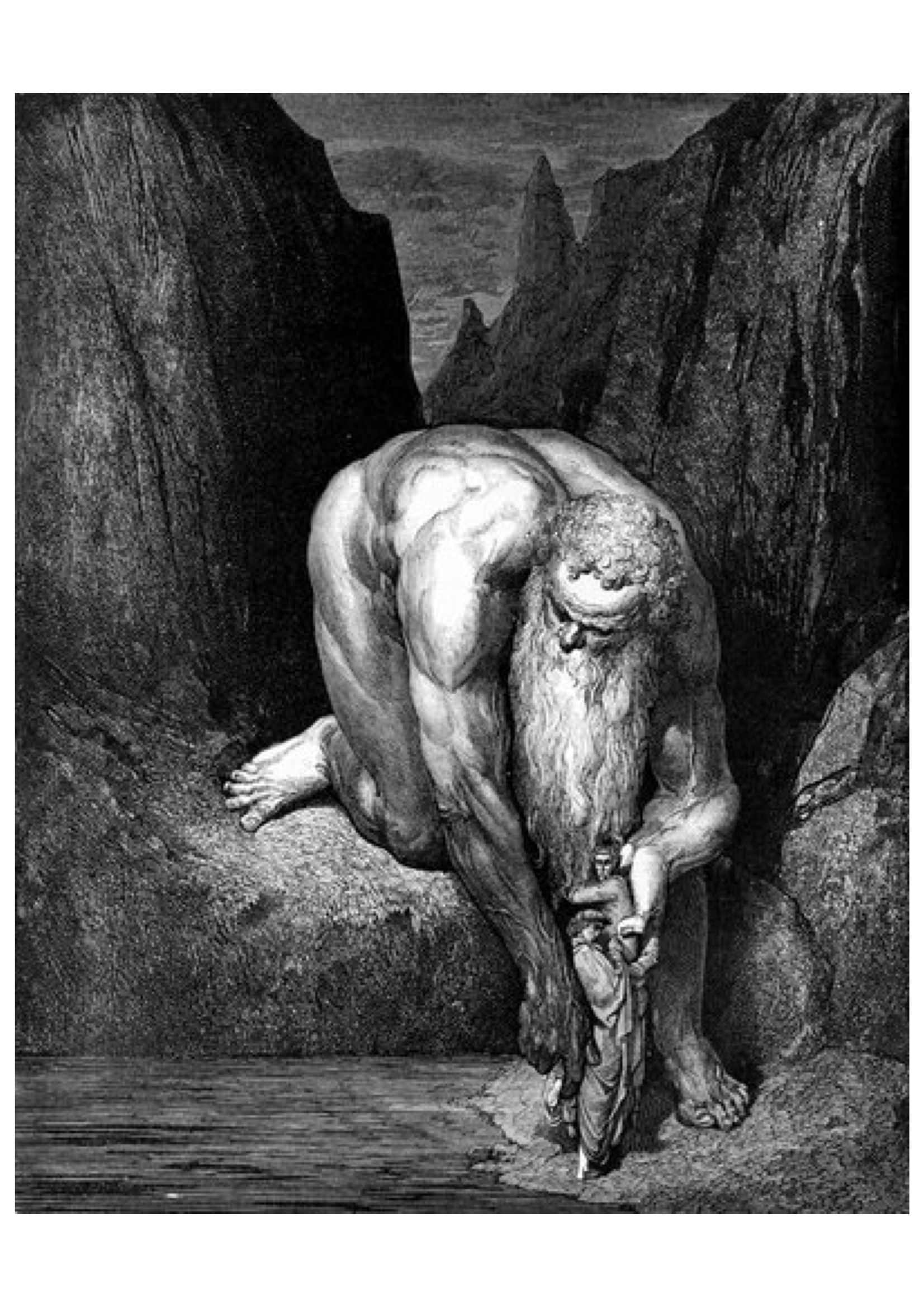
Antaeus - Descent to the last circle. Inf XXXI

What is happening here? Why a sharing of what has always been a private activity?

It seems to me that some books are so layered and so complex that to be fulfilled by them – and to find them fulfilling – requires study and discussion and the richness that comes from other minds, other thoughts, other understandings. But there’s something else as well, and it concerns the type of reading involved. When I open a novel, a novel that is the right book for the time, I find myself drawn inside the fictional world. I experience understanding from the inside; I become one of the initiated. This does not stop me from reflecting as I read, making connections between this novel and other books (novels, poetry, history, philosophy) but as soon as I start reading again I am pulled back into that imagined world.

This is not how I read Plato’s Dialogues, nor is it the way I read Dante. Here the reading is infused with study. I am grappling to understand from the outside. I am grappling rather than being immersed. Even with Dante, who has told a gripper of a story, I am not pulled inside the narrative in the way I am with, say, Jane Austen or Elizabeth Strout or Justin Cartwright.

It is reading for study rather than reading for creative life. It’s reading to know, rather than reading to be. That is not to say I won’t glean fundamental understandings from Plato or Dante, of course I will, but it is the act of reading of these books that is so different from my fiction reading.

I expect many others would want to disagree.

CONVERSING WITH FAMOUS DEAD PEOPLE

I have had a long-standing habit of conducting conversations with famous dead people. It started in early childhood. While other children had imaginary playmates, children they made up and who were much like themselves, my imaginary playmates (although we never played, only talked) were abducted from the novels I read – obvious ones like the boy in the wheelchair in The Secret Garden and less obvious ones like King Arthur. (An old friend, on hearing about my penchant for King Arthur, pointed out that my father’s name was Arthur, hinting at unresolved Oedipal conflicts. But of all my loves, that for my father was the least complicated, and his attractions quite different from King Arthur’s.)

Back in those days privacy was a rarity. Like most of my friends I shared a bedroom, and pocket money might stretch to the Saturday afternoon matinee at the Victory or a session at St Moritz skating rink but little more. Certainly there was no sulking in your own bedroom to the comfort of your very own record player turned up to a hostile boom in order to obliterate the family from the adolescent consciousness. Even if a greater number of props to solitude had been available back in those days, the disposable income was not – and even if it had been, a child was unlikely to be the main beneficiary. Back then, childhood was a time of deprivation, at least relative to what your parents seemed to have. There were spoiled children who were showered with gifts, but for most children fun, although plentiful, was necessarily cheap.

Privacy within the home was rare, but outside the home was quite another matter. Kids were told to get out from under their parents’ feet. We would walk alone to the corner milk bar for a polly waffle or choc wedge, or a little further to the park to play, or on your bike and riding the neighbourhood streets. And then there was the cubby at the back of the garden. Cubbies were so private there were passwords for entry.

While my sister hung out in the front garden behind the hedge smoking Turf filter tips with her friend Joan, I occupied the back shed, not far from the incinerator, for long leisurely conversations with the best of the best. Darcy and Elizabeth Bennett, Heathcliffe, Scarlett O’Hara, a whole swathe of characters from Iris Murdoch novels, Leon Uris heroes, and many many more. Private, cheap, entertaining, enormously satisfying, infinitely rich conversations.

As my reading broadened so, too, did my choice of companion, with a major shift from characters to their creators. By the time I left school I was conversing with famous dead people, regular conversations with Madame Curie, Jean-Paul Sartre and Virginia Woolf – not together, of course, that would never do, in fact all my conversations have been one-on-one. At the time I knew next to nothing about the real life personae of Virginia and Jean-Paul and wanted to keep it that way. Indeed, I protected my conversations by steering shy of all biographies and autobiographies except those which might serve my purpose, like Sartre’s Paroles, which had the effect of inserting the author more firmly, and certainly more appropriately into my private sphere.

My conversations with famous dead people have afforded me enormous pleasure; they have also been the primary way in which I have clarified my ideas. Once admitted to the circle I rarely get rid of anyone, although our meetings might diminish to an occasional imagined letter. In addition to Curie, Sartre and Woolf, there have been Bertrand Russell, Aldous Huxley, Theodor Adorno, Debussy, Barthes (my Debussy and Barthes speak excellent English). And there have been others, still alive, but irrevocably distant from my real existence like Iris Murdoch, Hannah Arendt, George Steiner. (Years ago, when my friend Robert Dessaix interviewed George Steiner on the ABC’s books programme, I remember feeling embarrassed – and a little jealous too – as if someone had caught me out doing something not quite legitimate).

Such perfect conversations these are, with such assured outcomes, and I always so fluent, so erudite, and so unselfconscious when compared with real conversations where I’m liable to talk rot and am struck by brilliant insights ten minutes too late. Perfect conversations in which I control the ebb and flow of ideas. And even though I remain unsure where the conversation will end, I am absolutely certain that not only will I survive to the end, I’ll do so with flying colours. These conversations, always so intellectually and morally sound, persist unencumbered by corporeal distractions like body odour, or constipation, or unsightly moles, or personality constraints like vanity, or hypochondria, or a dull and intransigent resentment of early family life. And I, too, exist unencumbered by any imperfections in these conversations, whether undesirable personal qualities or, indeed, the risks and slips of the usual face-to-face interaction.

But I do not fool myself – have never fooled myself. My perfect imagined conversations, their intellectual rigour notwithstanding, are nonetheless contrived, and while permitted to meander here and there, they do so only under my direction. This perfection is restricted and solely under my control. It makes a nice change to the rest of life.

Restricted perfection. What an interesting notion.

GALAPAGOS WONDERS


Marine iguana

Marine iguana

Practised writers know to resist the temptation to write about an exceptional experience until it has had time to be rinsed through the nervous system. A week, a month, or more likely several months or years is required, during which the original experience having passed through a complex web of memory, aesthetics and ethical gateways will eventually produce an essay or article that manages to expose the essence of the original experience.

This certainly was the case with my trip down to Antarctica made in November, 2006. Apart from the occasional metaphor, I did not draw on my Antarctic experience until years later, most particularly in a long personal essay titled ‘Home Triptych’, included in Home Truths, an anthology edited by Carmel Bird and published by 4th Estate in 2010. The trip to Antarctica was unique, it was life-changing. It was a journey into a landscape of the imagination, the landscape of the imagination. It was an experience that challenged language. It needed time.

I have just returned from the Galapagos Islands. I came home to a bulging email inbox. One email, in preparation for an upcoming gig, asked me to complete the statement: my key life learning is…

I wrote about curiosity and an openness to wonder as fuel for everyday life; I wrote, too, about the importance of finding the extraordinary in the ordinary. I wrote my reply and after I sent it off it occurred to me that, for the first time in my life, in the Galapagos I had witnessed the extraordinary as an ordinary, everyday occurrence. I walked past bevies of marine iguanas draped over sea-splashed lava benches, I swam with sea lions and turtles, I dived with penguins, I passed within an arm’s length of nesting frigatebirds and blue-footed boobies, I did all this and much much more on a daily, even an hourly basis.

Blue-footed booby with chick Land iguana Frigatebirds

So many wonders.

And this morning, reading a biography of the artist and cartoonist Saul Steinberg (most famous for his cartoon of Manhattan and the rest of the world) I came across a play on Descartes’ Cogito (incidentally it was Descartes who named wonder as the first of the passions). Instead of cogito ergo sum was written dubito ergo sum: I doubt therefore I am. The dubito stance is entirely consistent with a ravenous curiosity and an openness to wonder. I love the notion of dubito ergo sum.

The Galapagos Islands filled me with wonder, no less now that I am home than when I was actually walking among some of the most extraordinary creatures on the face of the earth, and across a variety of landscapes unique in my experience. It may be simple enthusiasm, it may be untamed excitement, it may be the force of the adventure itself, but this Galapagos experience won’t wait. Which is not to deny that when I draw on the same experience in two or three or four years time it will yield far deeper, more considered and thoughtful work.

So much of what I saw in the Galapagos Islands was unimaginable, and even when I was there a breath away from a land iguana, the creature right there in front of me, to make sense of it required all my imaginative resources. These animals – the iguanas, the yellow warblers that flitter around my feet, the turtle swimming towards me, the weird and weighty giant tortoise that lumbers past me on the way to the water-hole – these animals are so vastly different to what I’ve been used to, they challenge all my taken-for-granted assumptions.

Red-footed booby Giant tortoise

And the terrain, too, has a similar effect. There are fields of lava everywhere, ageing red and grey crumbling lava, and fresh gorgeously black stuff in organic slabs and swirls. I could be anywhere – but nowhere I’ve ever been before.

Organic lava Landscape with lava

These animals and birds, this landscape, these seas, all usher me into new terrain. It’s like entering a film or a novel or a piece of music. A landscape unlike anything I’ve ever seen before demands the same sort of total attention and creative response as does a work of art. Good art astonishes. Good art takes you out of the everyday – and so too this landscape and these creatures.

Don’t forget this, I tell myself as I watch four orcas frolicking in the seas in front of the boat, don’t forget this, I tell myself as I swim out of the path of a floating turtle. Live always with the shock, the wonderful shock of the new.

Great blue heron

Great blue heron

Yellow warbler

Yellow warbler

American oyster-catcher

American oyster-catcher

Storm-petrel dancing

Storm-petrel dancing

Dolphins!

Dolphins!

Frigate-bird with fledgling

Frigate-bird with fledgling


READING LIVES: MORE THOUGHTS ON BIOGRAPHY

For the first forty years of my life I avoided biographies. I believed that to read them was to queer one’s intellectual purity (and would have said so in such pompous terms). My ideas about biography came to me from a friend and sometime lover whom I viewed with blinkers so large and glasses so rose-coloured it was a wonder I managed to stand and walk. My friend and sometime lover, whose intellectual prowess I never questioned, condemned the reading of biography as nothing more than prurience and despicable voyeurism. If I were to read the lives of people (whether I admired their work or not) I would be letting down the intellectual team. At the same time I would be relegating myself to the gold coast of lightweight thought. In those days it was hard to imagine a worse fate.

‘Read their work,’ my formidable lover commanded. ‘The work is what matters, the work is enough.’

I suppose it was – but then I didn’t know what I was missing. I would gobble up the biographical note accompanying a book and any introductory personal remarks. Only occasionally would I capitulate and read a biography, and then it was confined to the Bloomsbury crowd, in whom I was besotted almost to the same extent as I was to the forceful lover. But it was guilty reading: I knew I was letting the intellectual side down.

Lovers change, life changes, work and leisure change. The erstwhile friend and lover was replaced by my partner-poet – a great and unapologetic reader of biography. When I floated my views on biography to her she dismissed them as mad. So I began reading biography – uneasily at first, as if I were a peeping Tom, but soon with the same curiosity and pleasure that holds me in thrall to characters in fiction. And just like with fiction, there was identification and recognition with these biographical subjects, and elaboration of my own experiences in friendship, in love, with publishers and the literary world.

When I decided to make Elliot in The Memory Trap a biographer, it was an indication of how far I had transgressed my former lover’s intellectual rules and regulations. And if Elliot was to be a biographer, I would need to read a lot of biographies. I was familiar with the Partisan Review writers, but I was curious to learn more about the group, so I made Elliot interested in them too. I began with a memoir of the early Partisan Review days, The Truants by William Barret. An excellent biography of Koestler by Michael Scammell led me to an equally good life of Mary McCarthy by Frances Kiernan (where I learned that Koestler had made a move on McCarthy). From McCarthy I went to other big women (Elliot, I decided, would be a biographer of significant women), Victoria Glendinning’s Elizabeth Bowen, and then her Rebecca West. In lieu of a Elizabeth Hardwick biography (one is currently being written by Frances Kiernan, and my Elliot wrote one in The Memory Trap), I read Ian Hamilton’s gripping Robert Lowell (published in 1983 but wearing well). I rounded off the Partisan Review reading with Partisan View a memoir by William Phillips one of the co-founders and editors of Partisan Review. There were more biographies – of Jean Rhys, Elizabeth Bishop and Djuna Barnes. I was having a ball, and even if my research was no more than a high-brow version of the Who Weekly or Hello Magazine phenomenon, I really didn’t care.

Although it wasn’t the same. And it isn’t the same.

The people I read about are creators – and not just confined to writers and artists and musicians. For the past dozen years I have explored the lives and times of the early nuclear physicists. I have read about the Cavendish laboratory and the first particle accelerators and the Manhattan Project; and the great phycisists: Oppenheimer, Szilard, Teller, Meitner, Rutherford and many many others. I have steeped myself in these minds at their explosive best. I have known their moments of illumination. And, as with all good biography, it’s a very particular type of knowing. In the same way that you can look into a painting or listen to a piece of music and find yourself ranging through new and unexpected imaginative territory, so too with biography and autobiography. But with the latter there is, in addition, a peculiar intimacy that removes even the tiniest barriers to mind. You read for an hour or two and you come away with ideas you could not have dreamed of. And there’s a sense of privilege too, an entrée into heart and mind as special on the page as across a dinner table.