Category Archives: Memory

ESSENTIALLY HUMAN (2)

Imagination and AI 

My previous post on memory, imagination and creativity, bought some great replies both on-line and off (track back – they are worth looking at). Might these essentially human functions be lost to we humans and taken up by AI? It was this question that prompted a follow-up article.

There was a time in the latter part of the last century, when ‘false memory syndrome’ featured regularly in the press. This condition, now largely discredited, caused me to widen my view of memory. How it was possible to make up memories of events that did not happen? Could one imagine a trauma? And might there be a connection between memory and imagination? And if there were, might it explain the common occurrence of two siblings having vastly different memories of the same family event. Was one correct /true/solid and the other false, or were both, infused by personal idiosyncrasies, partly imagined? Might my own memory of pivotal events in the past swing with my present desires and circumstances and be altered by them? Might it be loyal primarily to them? 

These sorts of musings came to the fore while writing my fourth novel, The Prosperous Thief (2002), in which memory is central. While most of the narrative takes place in the present day, the long shadow of the Holocaust hovers over the lives of the characters. As soon as I’d finished the first draft, I visited Germany and Poland for the sort of idiosyncratic and instrumental research novelists do. 

One November day, I spent an afternoon walking the paths and woodlands of Auschwitz 2, Auschwitz-Birkenau; this is the site where most of the killing at Auschwitz occurred. Here is the familiar rail track with the long platform where it was decided who would die immediately and who would be allowed to live a little longer (the ‘selections’), here is the pointed-roof gatehouse, and here, inside the complex, are the long huts where people lived and suffered and died. It’s a huge area, and apart from two cyclists taking a short-cut through the former death-camp, and three Polish schoolboys pilfering some Yahrzeit candles,[1]this place of mass murder was deserted. 

I wandered the pretty woodlands still rosy with late autumn colour where over a half century earlier Jews were herded together, made to wait their turn for the gas chambers. I stood in the ruins of crematoria 2, 3, 4 and 5 where hundreds of thousands of men, women and children had been reduced to ash. I wandered the seemingly endless columns and rows of wooden huts where Jews were crammed onto wooden bunks: the sick, the dying, the starving, and the steadfastly surviving all tossed in together. 

I walked past several of these huts down to the memorial slotted between the ruins of Crematoria 2 and 3. This is the International Monument to the Victims of Auschwitz. Built in 1967 in Soviet brutalist style, it consists of huge cement blocks in a geometric pile. In front of the blocks and set into the horizontal brickwork are plaques carrying the terrible statistics. This unimaginative monument is big and strikingly unbeautiful and, to my mind, communicated nothing about this terrible place. It was also totally unnecessary: this place, this Birkenau, was memorial enough. 

That visit to Auschwitz-Birkenau occurred twenty-five years ago, but I can still see the autumn colours and the school boys, I can hear the crunch of my shoes on paths made of gravel mixed with shards of human bone, I can smell the autumn mulch, I can recall my sorrow and anger and bafflement as I wandered that death-filled landscape. But of course I don’t ‘see’, I don’t ‘hear’ and I don’t ‘smell’, I imagine these impressions. And, as well, I add to them. I find myself musing on human brutality and prejudice, and what turns ordinary men into monsters; I think of the crimes that are committed in the name of patriotism and nationalism; I think of Trump and his MAGA movement; I think of the destruction of Gaza and the homeless Palestinian people. When I now remember my visit to Auschwitz, rather than a set of immutable images, I experience a far more impressionistic, complex event, one that acknowledges the numerous books I’ve read about Nazi Germany and the Holocaust, the films I’ve seen, the conversations I’ve had, the visits I’ve made to other parts of central Europe, values I hold, my knowledge of other horrors. My original visit to Auschwitz has become far richer in recollection, in that my entire cognitive landscape – experience, study, conversations, other memories, and fresh reasoning – has been recruited. 

This is how the imagination works. It shapes a memory that is fluid and intense and illuminating. It is also unpredictable: you cannot determine beforehand what knowledge and experience will be pulled into play during recollection, nor the ideas that will emerge from the mix. And it is unreliable, too. As a photo is not the whole story, that there is, as Barthes wrote, a ‘blind field beyond the frame’; so too with memory. All memory involves partial forgetting (outside the frame), and within the frame are new considerations, as my memories of Auschwitz show. Memory is rarely, if ever, static, nor is it neutral. We select what is to be remembered, and depending on the prevailing circumstances, what is selected this year will be different from what will be selected next year or in ten years. Far from being solid and immutable, this memory we trust is both delicate and infinitely corruptible, it is also free-ranging and expansive, linking with a swill of experience, desire, emotion, understanding, doubts, values and attitudes. 

Monuments provide a useful example to both the protean nature of memory and that it is never neutral. Memory, exactly what is remembered of a past event/desire/person is always in service to current values/desires/propaganda/politics. When monuments are built to mark pivotal events in a nation’s past, or to memorialise individuals killed in wars or terrorist attacks or murdered through genocide, there is an implicit assumption of an enduring, unchanging memory and commemoration. But the recent avalanche of falling statues of statesmen from the past who were involved in the slave trade or the murder of indigenous peoples is testimony to how changing values and culture affect how and what is remembered from history.

It was around the time I went to Auschwitz that I first put into words what should have been obvious to me and all those writers, visual artists, musicians, theoretical physicists, and mathematicians engaged in creative work (i.e. new work and ideas that have never existed before), that memory, fertile and changing memory, creative and illuminating memory, is an imaginative process, one dependent on the imagination and in turn constructing it.[2]

Which brings me to AI.[3] AI is an expert problem solver. In addition, having been ‘fed’ the contents of the web, AI can answer almost any question put to it – though not without mistakes. (There’s the oft-told story about an AI asked how to combat climate change, replied: ‘eradicate humans’ – not so much a mistake, because this would certainly work for climate change, but ignoring a number of other fairly essential issues.) Solving problems and answering questions is a matter of accessing already-existing data, it is not creative, nor does it necessarily demonstrate understanding. Understanding is different from thinking. Thinking is not the same as reasoning. And reasoning is not the same as creating.

What would an AI make of ‘the foul rag-and-bone shop of the heart’? Metaphor courses from the imagination. An effective metaphor is tangential to reality; it extends the meaning of that reality. Metaphor illuminates, it goes beyond the immediately obvious, beyond routine understanding.

Below are few more examples of metaphor – perhaps too many, but I do delight in metaphor

– Bernice Rubens: SPRING SONATA: ‘she tried to insinuate herself into the quicksands of her mother’s skin’

– Steiner in REAL PRESENCES: ‘memorising forms the ballast of the self.’

– John Banville’s THE UNTOUCHABLE: p.83. ‘The couple who ran the place were out of a seaside postcard, she a big blancmange with a wig of brass curls, he a lean little whippet of a fellow with a Hitler tash and a tic in one eye.’

– Toibin’s THE MASTER p.20 ‘the great flat foot of the public.’

– Auschwitz: ‘the eternal failure of all mankind’

– Virginia Woolf: ‘ideas are the only efficient air-raid shelter.’ (Essay: Thoughts on peace in an air Raid)

– Dorothy Porter: ‘In love I have no style. My heart is decked out in bright pink tracksuit pants.’  (THE MONKEY’S MASK)

‘The ripe teenage mulch of his bedroom.’ Ian McEwan. SATURDAY. p. 30

About Baxter: ‘that unpickable knot of affliction.’ p.272 ibid

‘You are like a tin of mixed biscuits.’ Iris to Carrington in Holroyd’s Strachey p. 352

Amichai OPEN CLOSED OPEN: ‘Enchanted places are the opiates of my life’  (69)

Zygmunt Bauman. LIQUID LOVE: p. 8 ‘Love is a mortgage loan drawn on an uncertain, and inscrutable future.’

Leibniz took music to be ‘God’s algebra’.  (Steiner ERRATA, p.75)

Edith Wharton. THE TOUCHSTONE. (P.110) ‘Vanity contents itself with the coarsest diet; there is no palate so fastidious as that of self-distrust.’

Mohsin Hamid. THE RELUCTANT FUNDAMENTALIST. (p.71) ‘Nostalgia was their crack cocaine… and my childhood was littered with the consequences of their addiction: unserviceable debts, squabbles over inheritances, the odd alcoholic or suicide.’

Sebastian Barry THE SECRET SCRIPTURE

p. 70 ‘We have neglected the tiny sentences of our life.’

p. 72 ‘There was a cold cheap cankered-looking moon…’

AI can regurgitate the OED, it can rearrange the OED, but can it go outside definition to metaphor? And what about art, art like Rothko’s, could an AI have produced that? Rothko was original. There was nothing that came before him that could be seen as feeders to Rothko’s extraordinary paintings. The same could be said for Cezanne and, more recently, those wildly evocative furry sculptures of Kathy Temin. Original art appears to come out of nowhere – where ‘nowhere’ is a unique human imagination. Could AI produce never-before-seen art, never-before-imagined art? And then there’s music. The great composers we revere today, wrote music that surprised and often shocked at the time. It was new, and it seemed that nothing had prepared their contemporaries for this music. I’ve heard music produced by AI. It’s nice enough but it does not have the shock value of a Gershwin who combined classical with jazz, or Schoenberg’s 12-tone music, or the uncanny transcendence of Bach’s music for solo piano and the cello suites.

The hearty spruikers of AI often refer to science when promoting AI’s skills, and certainly when it comes to medical science, AI has proved very useful, as it has with coding. But what about theoretical science? Could AI have hypothesized a nuclear chain reaction as did Leo Szilard as he crossed Southampton Row in London in 1938? And much of Einstein’s work had to wait decades before his theoretical, which is to say imaginative work, could be grounded in reality. Or Lisa Meitner’s extraordinary imaginative leap that lead to nuclear fission?

In the arts, in literature, in music and in theoretical physics, the imagination has produced work that comes from way outside the boundaries of current knowledge, current understanding, current reasoning, and previous imagining. Can AI do that?

_________________________________________________________________________________

And while I’m here, you may be interested in the following EVENT

1. I will be in conversation with Susan Wyndham about her latest book, the biography of the enigmatic Elizabeth Harrower, The Woman in the Watchtower. Susan is the former literary editor of the Sydney Morning Herald; she has worked as a foreign correspondent, has written a range of non-fiction, she is an excellent interviewer herself – I know from personal experience – and is a regular at all the literary festivals. Her new book is fascinating. This should be a terrific event.

When: Thursday, November 27th
Where: The Hill of Content, Bourke Street, Melbourne
Time: 6-7pm
Bookings essential: If this link doesn’t work, the link is on the Hill of Content website.


[1] I was furious. It was an affront to all who’d been murdered here, and all who had come to remember them. These boys were stealing memorial candles. I yelled at them as I ran towards them. They dropped the candles and fled.

[2] In recent years, the correlation has been given a neuroscientific basis. Demis Hassabis, neuroscientist, all-round genius, and winner of the 2023 Nobel Prize of Chemistry, published a paper in 2007 in which he linked memory and the imagination. He revealed that similar brain activity occurred during tasks employing memory of the past and tasks requiring an imagining of the future, and both were grounded in the hippocampus. Since then, much further work has been done in the neurological connections of memory and the imagination.

[3] I’m a writer, not a scientist. I have followed developments in generative AI and the predictions for artificial general intelligence in publications like The New Yorker and the New York Review, and in books aimed at a general audience – not in scientific journals. Consequently, I might be way off the mark. However, having just listened to the latest episode of The Times and the Sunday Times podcast, The Story, about the AI actor Tilly Norwood, I’m not going to back down just yet.https://podcasts.apple.com/au/podcast/the-worlds-first-ai-actress-and-her-creator/id1501716010?i=1000737864964

ESSENTIALLY HUMAN. 

Memory, Imagination and creativity.

When I was eight years old, I had three ambitions. The first was to be a ballerina – more a matter of wishful thinking than creative passion, given I wanted to be tall and slim, I was keen to wear a tutu, and I longed to be borne aloft by men who resembled fairy-tale princes. That ambition soon disappeared, snuffed out by common sense and a maturing aesthetic. The second ambition was to be a novelist. For as long as I could remember, novels had provided a refuge from the crush and uncertainty of my child’s life – a very necessary refuge given that childhood and I were not an easy fit. Filled with anxiety that I was getting the child role wrong, and ever alert to any tools that might help me navigate those perilous years, I studied other children in order to learn the ropes. The price of such vigilance was inexhaustible exhaustion. I was watchful during the day, and the nights were spent analysing the previous day’s mistakes and planning protective strategies for the next. The most reliable respite I had from this anxiety was not sleep (with so much to do I was a poor sleeper) but novels. I would slip into other lives and other places and relieved of my deficient yet demanding self, I would feel stimulated, invigorated, engaged, even happy – although like Samuel Beckett, I discovered that happiness was not as lively as I would have thought. Fiction supported me through the seemingly endless years of childhood, and from a young age I was determined to become a novelist. 

That I had decided to be a writer of novels could be explained in terms of the pleasure principle, self-preservation and escape. But I couldn’t escape all the time so what I needed was a reliable means of holding life in place. This need shaped my third ambition, namely, to have a perfect memory, the sort of memory that could learn poems by heart, that could reel off a page of numbers briefly glimpsed, that never forgot a person, place, event or story. If I could remember everything that had ever happened to me in the past, I would better manage the troubles that plagued my present, and gain a grip on the uncertain future.

My concept of memory in those long-ago days was akin to memorising. And I did so love memorising – poems, psalms, one year the entire geography book (I disliked geography but memorising the book as I walked around a deserted tennis court had a pleasing, hypnotic effect). In one respect, memorising was similar to reading in that both activities, by capturing my entire attention, removed me from the trials of childhood and my burdensome self. But that was the only similarity. Reading invigorated me, it sparked my imagination; I would travel to times and places not my own, and mix with people not to be found anywhere in suburban Melbourne. In contrast, my childhood memorising filled the time with a vaguely narcotic calm – like doing Lego or jigsaws or painting by numbers.[1]

To be a novelist and to have perfect memory: two linked ambitions to help steer me through the bewildering world in which I found myself, and through primary and secondary school they sustained me well. It was during my first year at university that I realised my dual ambitions were incompatible. I read The Mind of a Mnemonist, written by the great Russian neurologist, A.R. Luria, a book detailing the extraordinary memory of a man called ‘S’. This was followed a couple of months later by Borges’s Labyrinths, most especially, the short story, ‘Funes the Memorious’. Funes, an ordinary man in most respects, remembered everything; he could neither select nor forget. Beset by details, filled with details, Funes’s imagination was stifled. He was a man incapable of ideas or insight.

 ‘S’ and Funes demonstrated extraordinary feats of memory, like remembering pages of numbers or lists of nonsense syllables or poems in foreign languages, or the foreign language itself. Funes, for example, learned Latin in a week by memorising the Latin of Pliny the Elder as written in Pliny’s Naturalis Historia. But in  both cases this sort of memorising blocked the free-ranging imagination so essential to the novelist; it was a memory confined to particulars – a type of memory that excludes reflection and reason, inspiration and illumination. 

Novelists require a versatile, athletic imagination, one that can leap and loiter in the uncertainties of an emerging narrative. The novelist’s imagination is an explorer and thrill seeker. Perfect memory of the sort to which my childhood self had aspired is in service to safety and certainty; it is memory without imagination, it is memory at odds with metaphor, it is a memory as discreet and as immoveable as a picket fence. 

The memory that fuels human life and endeavour is far more creative than this. If I remember an event, say the breakup of an affair, it is not identical to the actual break-up. My recollection is overlaid with other experiences, other understandings, conversations, desires. Memory relies upon the recruitment of an entire cognitive landscape – experience, study, conversations, other memories. Just as Magritte’s painting of a pipe, Ceci n’est pas une pipe, so too my memory of the break-up, or, indeed, any memory. Memories are created, and what they recall is re-created differently with each recollection. 

This notion of memory is fluid and often illuminating. It is also unpredictable: we cannot determine beforehand what knowledge and experience will be pulled into play during recollection, nor the ideas that will emerge from the mix. And it is unreliable, too. As a photo is not the whole story, that there is, as Barthes wrote, a ‘blind field beyond the frame’; so too with memory. All memory involves partial forgetting, but what is forgotten is not erased, indeed, it is a common occurrence that, triggered by an experience in the present, a formerly forgotten element rises to consciousness. In addition to being unpredictable and unreliable, memory is not neutral. We select what is to be remembered, and depending on current circumstances, what is selected this year will be different from what will be selected next year or in ten years time. Memory is in service to the present far more than the past event it purports to preserve. Far from being solid and immutable, this memory we trust is both delicate and infinitely corruptible, it is also free-ranging and expansive, linking with a swill of experience, desire, emotion, understanding, doubts, values and attitudes. This notion of memory, this fertile and changing memory, this creative and illuminating memory, is one dependent on the imagination and in turn constructing it.[2]

We draw on memory to make sense of ourselves as we trek through daily life. It is memory that fuels imaginings of the future, it is memory that helps plan for it. It is memory that feeds the hopes and desires that drive us to seek out this person and abruptly turn from another. It is memory that seeds great art, composes memorable music, writes heart-stopping poetry and life-changing novels. A life without imagined, creative memory has been described by great neuroscientists like Luria, and it is a life confined in an ever-present where nothing much changes and art is indistinguishable from dust. A life without imagined, creative memory would be, for most of us, unbearable.

And yet it seems we are heading straight into that darkness.

Memory, imagination and creativity require a few simple conditions: uninterrupted time, solitude, no external distractions and the ability to sustain attention and focus.

In the digital age, for many, perhaps most people, simple factual memory – recall – of a name, a book or a film, has been rendered vestigial by web searches. Stop, I say, when someone reaches for their phone because they can’t remember the name of a book, an actor, a film. Stop, I say, give your mind time, give it space, the name will come to you. Mostly the person does not stop, does not wait. What would be the point? they imply, with a nod at their phone. Indeed, we have adapted so quickly to having information at our fingertips that when we want to know something, we want to know it now, whether it be the closest bagel shop (with pictures to show if the bagels are authentic), or a video clip of the admirable Jonas Kauffman singing Andrea Chenier (there is); it doesn’t matter what the nature of the information, we expect to have it immediately. 

Skills, which once were ubiquitous, have been lost. It would be a rare millennial or post-millennial who could read a map, but neither would they regard this as a loss Why bother, when they have GPS? And simple mathematical calculations – multiplying, division, percentages – these calculations would be beyond many people. But again, why bother, when you always have a calculator in reach? 

The history of human progress is also the history of lost skills. Few people these days would know how to rub sticks together to produce fire. Few people would know how to build a fire in a grate; quite a few people would not know what a grate is. And who would know how to read a sundial these days? But the loss of fire-making skills or telling the time by the sun, or reading a map, or doing simple maths do not diminish our humanness: they do not fundamentally alter what it is to be human.

Creativity is in a different sphere, creativity is essentially human. In our switched-on, digital world, sustained attention on a single idea, problem or issue has been lost to the dings and clicks of social media, news feeds, email, texts. Turn off notifications and that little screen still flashes. Solitude has being shoved aside by the need for constant connection and approbation. Checking a phone every few minutes is akin to laboratory rats pressing a lever for food, knowing that eventually they will be rewarded. So, too, with social media.

The mobile phone is the metaphorical heart beat of the modern individual. We sleep with it, run with it, eat with it. It accompanies us to the bathroom, it’s in reach while we have sex. It is a common sight to see two people seated together in a café each occupied with their phone, the only communication occurring when one shares their screen with the other. With WIFI blanketing the earth, even in wilderness landscapes the digital heart beats strongly. There is no repose. There is no time to mull in your own thoughts, to reach into the troughs of forgetting, there is no time for the imagination to flourish. 

Multi-tasking has inflamed the situation. Attention spans have not shortened in the digital age, but the nature of attention has changed. Juggling several tasks simultaneously is counter-productive to the singular attention – the obsessiveness –that creative work requires. With solitude and privacy under assault, and sustained attention of the sort the imagination requires fast going the way of the typewriter and the tape cassette, the conditions for creative work are being steadily eroded. 

Creative skills are surprisingly frail. As a writer, I know that when I return to my desk after just a few weeks away, the words don’t come so easily, the ideas are sluggish or, worse, non-existent. It takes a few days for the creative skills to muscle up again. The imagination, if neglected, readily becomes dormant; if it is not nurtured, it can actually decay. Muscles that are unused become stiff and painful and thereby draw attention to themselves. Unfortunately, the imagination goes far more quietly.

Running alongside this assault on human creative processes is the vast and increasingly complex advances in Generative Artificial Intelligence and Artificial General Intelligence. Generative AI has been designed with the capacity to learn and develop new data from its own actions/work, while Artificial General Intelligence is human-level intelligence that can do everything the human mind can do – and more.

An example of Generative AI was portrayed in a 2016 Go tournament between Lee Sedol, the world champion at the time, and the computer programme AlphaGo. Demis Hassabis, the scientist who produced the early work linking the neurological substrates of imagination and memory, was the primary creator of AlphaGo.[3]  

There were good reasons to choose Go to test the limits of the AlphaGo computer. There had been many AI-versus-human chess tournaments, but Go is far more complex than chess and, for seasoned players, creativity and intuition play a role. Many players speak about the game in quasi-spiritual terms. This spiritual dimension combined with the role of intuition underscore Go as a distinctly human-grounded game. 

AlphaGo demonstrated a level of self-learning in the tournament with Lee Sedol that even surprised its creators. One particular move, move 37 in the second game, was described by one Go Master as ‘not a human move’ but ‘beautiful, so beautiful’. This move had not been a part of AlphaGo’s programmed memory, rather the machine had created it.

Sedol lost the tournament 4 to 1 and, not long after, he resigned from the professional circuit. Since then other programs to play Go have been developed that are even more capable than AlphaGo. 

Generative AI is already with us, and artificial general intelligence with its open-ended creative skills is fast developing. There are daily warnings of the dangers of AI, including some from the founders in the field.[4] There are worries expressed over AI-written student essays and AI-generated novels, but there are far more serious concerns over the possibility of AI surpassing human intelligence and subjugating we humans. 

Whatever the future brings, it has already begun, and running in parallel has been the erosion of the very skills needed to maintain control of our human future. In our eagerness to embrace all the digital world has to offer, we have neglected to take stock of what we have complacently relinquished. Human imaginative work runs the risk of dying out, and with artificial general intelligence, creativity will become the province of the machines that human imagination and ingenuity produced. In short, we are creating the conditions of our own demise. AI isn’t taking over human creative endeavour, we have already ceded the territory.


[1] This childhood memorising is very different from the memorising of my adult years when, consciously and fully alert, I have worked to absorb poems and quotable quotes into the fabric of mind. As George Steiner memorably wrote: ‘To learn by heart is to afford the text or music an in-dwelling clarity and life-force…What is committed to memory and susceptible of recall constitutes the ballast of the self.’ (Steiner. Real Presences. pp 9-10).

[2] In recent years, the correlation between memory and the imagination has been given a neuroscientific basis. Demis Hassabis, neuroscientist, all-round genius, and winner of the 2023 Nobel Prize of Chemistry, published a paper in 2007 in which he linked memory and the imagination. He revealed that similar brain activity occurred during tasks employing memory of the past and tasks requiring an imagining of the future, and both were grounded in the hippocampus. Since then, much further work has been done in the neurological connections of memory and the imagination.

[3] An excellent account of the tournament is the documentary, AlphaGo, directed by Greg Kohs, and available on YouTube. Also Benjamin Labatut in his brilliant, unorthodox novel MANIAC, devotes the last chapters to the game of Go, in particular, this tournament between Lee Sedol and AlphaGo. 

[4] In his book Homo Deus: A Brief History of Tomorrow, Yuval Noah Harari analyses recent advances in AI and what they may mean for the future of humankind. The book was published in 2016, developments (some would prefer the term ‘progress’) since then are cause for far greater concern.

RELICS FROM THE PAST

(Published in THE MONTHLY, September, 2025)

On an Autumn day in Melbourne not so long ago, while travelling home on the train, I was caught by a scent. It wafted over from a woman seated across the aisle. Her hair was short and blow-waved neat, her coat was buttoned, her handbag was upright against her hip; she was a woman in her middle years, occupied with her phone. I willed her not to disembark until I had found the memory of the smell. It was teasingly familiar, yet I knew it lodged in the distant past. I inhaled more deeply and felt a flush of happiness. A moment later, the happiness was swamped by a wave of anxiety and longing.

What was that smell? I rummaged through memory, but despite the powerful feelings it engendered, the original source remained out of reach. 

The woman slipped her phone into her bag, stood up and moved to the door; soon she would be gone. I wanted to grab her, hold her back till the scent revealed itself. The train slowed, the platform of the station appeared, then, just before the doors opened, it came to me: it was hairspray, the Elnett hairspray my mother used to helmet her hair back in the 1960s. (I would normally avoid turning a noun into a verb, but the hairspray did, in fact, make of her hair a helmet, and it did so actively enough to warrant a verb.)

I had solved the mystery of the smell, but I was curious about its emotional baggage.  

My mother died in 2012. Twenty years earlier, while in her mid-sixties, her cognitive skills began to dwindle. In the last eight years of her life, she recognised none of her family; in the last three years of her life, she could neither walk nor talk. Before the dementia, and probably because I was more like her than were my sister and brother, my relationship with my mother was not easy. I spent my childhood trying to win her approval, or perhaps, more simply, her attention. I would stand beside her as she sat at her dressing table, one of those old-fashioned ones with a central mirror and two side wing mirrors – three versions of my mother as she teased her thin hair and stiffened it with Elnett hairspray. The last element of her beauty regime was to apply perfume to her neck and behind her ears – it was Je Reviens by Worth in a small round blue bottle – then she would turn to me, silent and desperately hopeful, and dab some of the perfume behind my ears. The anxiety and longing disappeared in a moment of pure happiness.

Smells and memory, such a powerful, yet mysterious coupling. I can bring to mind something visual, I can imagine a voice or a piece of music from the past, but I cannot imagine a smell – nor, with a nod to Proust, taste. But perhaps such considerations are moot, given the capriciousness and capaciousness and plain bloody-mindedness of memory. After all, each time memory summons up a particular past it produces a different version. The life since the event changes the perspective on the past event, as do the reasons for wanting to recall it. Memory is always in service, first and foremost, to the present and not the event it seeks to restore. I may not be able to recall a smell or taste in the way I can a picture, a face or a piece of music, but the fact is, no memory is faithful to the past.

And yet, there was that raw longing, that look-at-me ache, conjoined with the Elnett hairspray. It was primitive, juvenile, it served no purpose, so I wanted to believe, to the adult I have become. It was of then, and it trespassed into my now.

I was nineteen or twenty when I first came across Sartre’s 1964 memoir of his childhood, Words  (Les Paroles). I was immediately drawn to it because of the cover of my Penguin edition. Instead of the usual image, the cover carries a quote from the book in a huge font: ‘I loathe my childhood and all that remains of it…’ 

I shared this sentiment – I still do, although with a little less vehemence than Sartre. But what most appealed was that a very famous person dared contradict the assumed innocence and care-free quality that defined childhood.

I wanted to pack childhood away as soon as it was finished, but childhood will not go so quietly; indeed, I’ve come to believe that childhood claims the better part of memory for itself. Miserable or happy, privileged or deprived, pivotal aspects of childhood are tenaciously entrenched. Yet, as my experience with the Elnett hairspray demonstrates, these memories can hibernate beyond conscious reach for years, even decades, only to bombard as you make your way through maturity.

There’s nothing new about this: a century ago, Freud revealed that the ignored past, the forgotten past, the past of which you are unconscious, can nonetheless exert a powerful effect on who you are and how you behave. And yet we live, most of the time, as if unaware of being tethered to the past, and when old events gate-crash the present they result in surprise and shock, they can readily throw you off balance. 

These thoughts led me back to Walter Benjamin’s essay on Proust. Benjamin writes of ‘purposive remembering’ with its strenuous efforts to recollect and, in the case of A la recherche du temps perdu, to imaginatively restore the past. ‘Purposive remembering’ suggests that a reconstruction of the past is possible. But it’s not, and why imagination is essential to memory – not simply to fill in the gaps, but also to provide the multi-dimensions of lived experience: the facts, the movements, the emotions, the smells and tastes

In the days following the Elnett hairspray event, I mulled over the liquid connections between imagination and memory. Joyce wrote that ‘Imagination is memory’; I would propose the reverse: that memory is imagination – not the entire infinite stretch of the imagination but rather memory is a process of the imagination.[1] The idea that memory is fused with the imagination, that all memories are distilled in the imagination, provides for the malleability of memory. The fact is that when I focus my mind on the child standing at her mother’s dressing table now, I understand the situation slightly differently than I did just a few weeks ago, feel it differently, and know it differently, too.

There was a postscript to the Elnett hairspray incident. Driven by nostalgia (definitely not curiosity) I went on-line and discovered that the perfume my mother used, Worth’s Je Reviens, was still being produced and was available from a shop in the Melbourne CBD. (As to why the perfume and not the hairspray: I use perfume every day, but have no need for hairspray). I caught the train to the city, I went to the shop. The perfume came in two sizes, each sealed in the familiar blue box. I bought the large bottle – far better value, according to the woman in the perfume shop, but that was not what convinced me: I assumed my mother, who used the perfume every day, would have used the large version (even though in my memory the round blue bottle was quite small). But I was wrong. When I removed the perfume from the box the bottle was the right shape and the familiar rich blue colour, but it was far too big. My mother used the small size – which, I expect, was the only size available back in those long-ago days. I was so disappointed, I was wanting exactly the same, I was wanting to revisit exactly that old scene. To experience it again. Fortunately, the scent had not changed. I put some on my wrists, I wanted to keep smelling it, smelling the better part of a difficult childhood. 

The headache began almost immediately, first the shadow that presages the pain, then the pain itself which, in most instances will morph into migraine. There are many perfumes that do this to me, but surely not Je Reviens

I persisted – I so wanted to wear this perfume – but so did the migraine. I gave the bottle to my sister. And the memory? It has changed again.


[1] in 2007, a team led by Demis Hassabis published a paper in which memory and the imagination were linked. They showed that similar brain activity occurred during tasks employing memory of the past and tasks requiring an imagining of the future, both being grounded in the hippocampus. Since then, much further work has been done on the neurological connections of memory and the imagination.

THE SIMULTANEOUS TIME ZONES OF LIFE

Recently I was in London. I am familiar with the city, indeed, next to Melbourne, London is the city I know best. I first visited as a 21-year-old and have returned perhaps a dozen times since, sometimes staying just week or two, other times for months.

On that first visit, in 1972, the King’s Road was still the King’s Road, indeed, the sixties, most of which I’d been too young to explore fully, were still very apparent in clothes, in music, in a loud fuck-you attitude to traditional institutions, in a ‘new left’ that still had a presence. Of course, within a couple of years, the prevailing belief of the 1960s that the personal was political would metamorphose into the personal growth and development movement. Indeed, by 1975, politics had almost entirely disappeared, and what Tom Wolfe termed the ‘Me Decade’ was in full swing. Instead of storming the barricades of the past and of privilege, ‘realising one’s potential’, ‘finding the real me’, ‘remodelling the self’ had become the raison d’être of a meaningful life. This trend was described as ‘the new alchemical dream’ and the ‘sweetest and vainest of pastimes’ by Tom Wolfe in his essay ‘The Me Decade’ – which still reads well, more than forty years on.

I lived in London for several months that first time. The plan had actually been to stay indefinitely, but a boyfriend in Melbourne and a lack of confidence in my own capacities brought me home within a year. But still I managed to cover a lot of ground. I walked the streets of London, I walked for hours, for days, and I walked alone. And I read. I read the existentialists finding a vocabulary for my own angst, I read books on the sociology of alienation, I read the soul-breakers of poetry, Baudelaire and Rimbaud (my brothers, my brothers) and I read Virago’s recently discovered feminists as well as George Eliot and Edith Wharton and many others.

It was a very solitary time. There was no one to disturb my reverie and no one on whom to test my thoughts. As I walked the London streets, my mind was alive: to the books I was reading, the people and scenes around me, as well as memories, longings and imaginings. It all mingled together, hard to separate the facts from fiction and both from desire. Not that I minded, I was never lonely in a George Eliot novel, I was never clumsy or misunderstood when a part of alienated youth, I was never shy or reticent in my imaginings.

On my latest trip, unlike the several that had preceded it, impressions from my first visit to London surfaced with particular vividness. In fact, there were times when I felt as if I were simultaneously living in different time zones, that now was also then, and, given my awareness and knowledge of this experience, much of the time in between. There were two factors that marked this trip as different: the first was a book – Julian Barnes’s first novel, Metroland – the second, an exhibition about the 1960s that was showing at the V&A.

Back in the old days before e-books and electronic readers, books would take up a good portion of my suitcase when I travelled. While I will always prefer reading a paper book to a screen, these days I travel with my iPad loaded up with both new and old titles (I never leave home, for example, without the complete works of Jane Austen), I travel with the equivalent of several suitcases of weightless books. But I was in London and staying around the corner from Daunts, and I simply could not resist.

For booklovers who don’t know Daunt Books in Marylebone put it on your list if you aredaunt-books-marylebone-high-st-london going to London. In the meantime, visit the Daunt Books website and take the virtual tour through this lovely Edwardian bookshop (make sure to check out all three floors). I found an essay by Brodsky on Venice that I’d not known about before, and a fat family memoir by Mary-Kay Wilmers, the editor of the LRB; I picked up a new Justin Cartwright, Lionheart, and Julian Barnes’s first novel, one of the few books of his I’d not read.

From the first page of Metroland, indeed, the first sentence I was hooked. ‘There is no rule against carrying binoculars in the National Gallery’ the novel begins. How could I not continue? Is there a rule about using binoculars, I wondered. And plunged ahead.

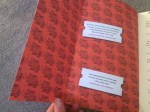
Metroland comes in a lovely edition, a ‘special archive edition’ according to the publishers (Vintage). It’s a paperback with folding flaps and a repeating graphic of stylized suburban houses on front and back, and inside both covers there’s a similar repeating graphic in a hot orange.

metroland-cover


metroland-inside-cover


The book begins in 1963 in Metroland, that area of London served by the Metropolitan line, when the narrator, Christopher, and his best friend Toni are 16 years old. Christopher and Toni are intellectuals, they’ve read books their fellow students have never even heard of, they pepper their conversation with French and they fancy themselves as modern-day flâneurs. And they assume that distanced, critical, somewhat superior stance of alienated youth. They are adamantly not of Metroland and will escape as soon as they can. The book is laugh-aloud funny at times, it is also very knowing.

For almost half the book the narrative stays with the boys in Metroland before shifting, along with Christopher, to Paris in 1968 – yes, that pivotal year, although unfortunately the upheavals (or, as Christopher refers to them in meaningful italics, les événements) seem to have passed him by. In the third section of the book the narrative shifts back to Metroland. Now it is 1977 and Christopher is a husband and father; he is far wiser and far happier (with neither shame not embarrassment) than his younger self.

I was captivated by the entire book, but it was the first section, the youth section, that had the major impact. I recognised those boys, not in every respect and certainly not in their fixation on sex, but in their reading and other intellectual pursuits and their sense of being different from their peers. (I wonder if all intellectual children of the second half of the 1900s gravitated to the same books.) Because there were two of them, they managed to legitimate the other and they often made light and merry of their difference. In my own case, I too met a like-minded girl in early adolescence. It’s much harder if you are alone. So I was infusing Metroland with my own experience, or Metroland was infusing my memories and I read and read and did not want the book to finish.

During this time I visited the 1960s exhibition at the V&A. The clothes, the bands, the books, the films and TV, the posters and badges, the personalities, how very familiar they all were. Best of all was a large room where a movie of Woodstock was playing, huge images covering the walls and cushions cast across the floor, and there I sat rocking along to the familiar music, gazing at those lovely familiar figures.

This entire exhibition was a banquet in identifying with the familiar. As I wandered the exhibition, I saw that most of the other on-lookers were around my age, and I saw the smiles on their faces, the pleasure of recognition, as they peered at the exhibits. I wasn’t the only one enjoying this trip to the past.

But was it the past? I was in the now, I was in the present. What I was recalling did not make me forget where I was, the pull of the past did not obliterate the present. Indeed, it was the past coming into the present, like red wine into water, a lovely mingling that softened and pleasured the present. (This is quite opposed to nostalgia, a deluded state that has you longing for a lost past.) This past was enriching the present, and the present was making more sense of the past. Simultaneous and merging time zones, I decided.

Often when explaining memory, metaphors from archaeology are evoked. So, for example, we read of the strata of time, the bedrock of events. These particular metaphorical associations are romantic in a nineteenth century type of way, but they are not accurate. The memories that burst upon us do so in a single moment, they are not sequential; simultaneously they operate together with one another and with current events. There’s nothing linear or strata’d about it.

Our sense of time is that it flows inexorably forward while now, this moment, does not. Now, this moment, if you could only hold on to it, is stationary. Now is what we experience. But for it to become experience, something reflected on, something that can be drawn upon in the future, it is no longer now, but rather it becomes part of our stock of knowledge (surely, an aspect of memory), a sort of personal and portable library.

I was learning more about the past, more about now with the sixties of Metroland, the V&A exhibition, and I actually made my way down to King’s Road, the first time in years. The days passed as if inside a movie. Movies, like novels, toy with time, years can pass in a few pages, or from one scene to the next. We might see in a flick of hair or perhaps a facial grimace alerting us that a character has remembered something, in a novel we can actually know the character’s thoughts. We are of this time and we are of all our time. Each memory affects many that have gone before and will itself be affected by many that come afterwards. And all those memories are still active as we make our way through the often tumultuous currents of today.

IN PRAISE OF FORGETTING

I have always been captivated by the idea of memory. While it has been a theme in all my novels it was THE theme in The Memory Trap. In this novel, memory in all its forms – personal biographical memory, national collective memory, memory and obsession, mementoes and memorials – was explored through the lives of the characters.

ABR coverThe American writer and film-maker, David Rieff, has made memory the subject of his past two books. I have reviewed his latest for ABR and reproduce it below

This month’s ABR has a stunning cover to accompany the announcement of the 2016 Calibre essay prize to Michael Winkler. Check out the issue at

http://www.australianbookreview.com.au


IN PRAISE OF FORGETTING
David Rieff
Yale University Press, $36.95 hb, 145pp.
ISBN: 978-0-300-18279-8

Over the past three decades, and particularly since the prime ministership of John Howard, there has been an extraordinary growth in the number of young Australians making the pilgrimage to Gallipoli. Most of these people have no ancestors among the ‘fallen’, but rather are following what has become a rite of passage for patriotic young Australians.

Lest we forget, they intone. But what exactly is being remembered? And to what purpose is it being used? After all, until recently, few young people visited the site of this appalling military failure in which Australians were used as cannon fodder by their colonial masters. For that matter, until recently, flag-waving nationalism and loud-mouthed patriotism played little part in any aspect of Australian life.

Memory and its more structured form as remembrance are considered to be positive and desirable attributes. Personal memory is thought to be the primary vehicle by which individuals define themselves, while collective memory helps define a nation. Collective memories, like Gallipoli, act as the struts and foundations of nationalism, uniting poor and rich, urban and rural populations alike. As for history and memory, they are regarded – if thought about at all – as almost exactly the same, rather like identical twins.

In his excellent new book, In Praise of Forgetting*, David Rieff questions the commonly unquestioned: namely the purposes and effects of collective memory. He shows how easily history can fall prey to morally contingent, proprietorial and emotive memory. Ranging across the Irish troubles, the Holocaust, the Rwandan genocide, Israel and Palestine, Stalin’s Russia, and the Balkans’ internecine battles Rieff reveals how collective memory invariably follows a political and ideological agenda, which is itself underpinned by specific moral imperatives. He makes clear that structured, state-sanctioned memorialising is in thrall to contemporary goals and aspirations and not the past it is purporting to preserve. As well, he points out ‘that exercises in collective historical remembrance far more closely resemble myth on one side and political propaganda on the other [more] than they do history.’ Rieff will always see the elephant in the room.

In advancing his arguments, Rieff draws on a wealth of work about memory and remembrance including that of the great Russian neurologist A.R. Luria, the Polish poet and essayist Czeslaw Milosz, Theodor Adorno’s classic Minima Moralia, and most particularly the Israeli political philosopher Avishai Margalit (The Ethics of Memory) and the social philosopher Tzvetan Todorov (Hope and Memory and Memory as a Remedy of Evil). Rieff sets up a dialogue of sorts with these latter two luminaries in which there is acknowledgement and agreement, as well as argument and disagreement; crucially Rieff extends the analysis of both men. As a thinker, Rieff is fearless and devoid of sentimentality. To take on those you admire is a difficult task, but if done well, as it is in this book, it yields far richer and nuanced arguments than if you were to pit yourself against a thinker with a diametrically opposing view.

Individual memory degrades very quickly while official memorialising is a tool in service to ideological and cultural currents. Rieff refers to Shelley’s pithy ‘Ozymandias’, as well as David Cannadine’s memoir ‘Where Statues Go to Die’ about the ‘inglorious fate’ of colonial monuments in India. My favourite monument story concerns the Bremen Elephant. This ten foot high red brick elephant was erected in 1932 to celebrate Germany’s colonial conquests, especially in Namibia. By the 1980s this particularly brutal colonisation had become a matter of shame; the monument was an embarrassment and there were calls to pull it down. In 1990, when Namibia gained its independence, the Bremen Elephant was re-dedicated as an anti-colonial monument, and in 2009 a new monument was built adjacent to the old to commemorate the lives of those Namibians who perished in the colonisation. Rather than an enduring truth about the past, monuments rise and fall depending on prevailing political and social concerns.

Official remembrance is big business these days. New monuments, memorial gardens, entire museums are popping up all the time. Rieff is rightfully critical of a number of these, including the U.S. Holocaust Museum in Washington DC, where the atrocities portrayed have been book-ended in kitsch. (For an excellent book on kitsch in memorialising see Marita Sturken’s Tourists of History, 2007.) My complaint with the U.S. Holocaust Museum is in its use of experiential exhibits. The underlying premise of this fashionable trend in museum practice is that by promoting a personal involvement in the (long-past) events being portrayed, visitors will be motivated towards a better understanding. So it happens that on entering the U.S. Holocaust Museum visitors are issued with an identity card of a real person who existed during the Holocaust. As you walk past the displays of horror, as you watch the videos, as you linger in the (real) cattle car, you clutch your identity card wondering if your person – your surrogate self, after all – has survived. You have been inserted into these horrendous events. As for the imagination as a means of understanding, it has fallen out of fashion. What this might mean for memory in general, given that memories involve an imagining of past events, is anyone’s guess.

Rieff, in highlighting past atrocities and the way they have influenced current conflicts, recommends forgetting as a means of facilitating individuals to move on. Many Holocaust survivors did exactly this. They had survived and it was incumbent on them to live fully – not only for themselves but the millions who were denied a future. They did not consult counsellors or psychiatrists, rather they drew on their own resilience and determination to separate from their terrible experiences and steer themselves into the future. In many instances, It was their children and grandchildren who insisted on dragging them back to Auschwitz. It seems that the parents’ very productive forgetting interfered with the children’s demands for remembrance – a peculiarly narcissistic remembrance. The therapeutic has indeed triumphed as the author’s father, the sociologist Philip Rieff, predicted in 1966.

Rieff sees more value in forgiveness than do I. I am of the belief that some acts and the policies that allow them to occur are unforgivable, such as the atrocities under apartheid, those committed by the Nazis, and the slaughter being carried out by ISIS now. Nelson Mandela recognised this when he established the Truth and Reconciliation Commission and not a Truth and Forgiveness Commission. There can be understanding and reconciliation, there can be a future where past enemies live together in peace, and this can occur without having to forgive the unforgivable (and thereby act in bad faith).

In Praise of Forgetting explores the powerful and often brutal effects of the seemingly benign and beneficent processes of memory and remembrance. It forces scrutiny of what has long been complacently accepted. Over the past half century or so, there has been a sacralising of memory both at the personal and collective levels. For the former it has often lead to a life of victimhood, for the latter entrenched hatreds and shocking brutality. If remembering truly were so therapeutic then such undesirable outcomes would not occur with such distressing regularity.

___________________

*In Praise of Forgetting grew out of an earlier monograph Against Remembrance (MUP, 2011). I am hoping Rieff is planning a third volume titled ‘Against Forgiveness’.


The Passion of Letters (2)

This is the follow-up article to EPISTOLARY PLEASURES, posted 22/6/15.

I am reading Jonathan Galassi’s novel, Muse, an indulgent, insider’s treatment of independent literary publishing houses, together with their publishers, editors and pesky authors. (Jonathan Galassi is publisher at Farrar Straus Giroux, and Homer Stern, one of the main characters of Muse, shares much in common with Roger Straus.) The first half of the novel consists of long, flat character sketches, with no narrative to flesh out the characters or, indeed, make them stick, dotted with pseudonyms for well-known writers such as Sontag (here a black woman writer, but otherwise Sontagian), Brodsky (can’t resist citing S and B together), Bellow, Malamud, Walcott, and many many others. (Even our Les is mentioned later in the book, and by intimate first name – no pseudonym for him.) Fortunately Muse picks up halfway through when it shifts from tuneless character description to a story with narrative pull.

So I’m reading about Ida Perkins, the famous, successful poet at the centre of this novel, when I come across a reference to onion skin paper. The American narrator associates it with European paper suppliers. That sends me on a search of French web-sites for papier en pelure d’oignon (pelure, I have just discovered in my long-neglected Petit Larousse, is the skin, peau, found on fruits and vegetables). Much to my disappointment, thirty minutes of wandering the web has yielded nothing so concrete or desirable as un canet de papier pelure (a pad of onion skin paper).

Onion skin paper, so rare in today’s world, is mentioned in Muse, a recently published novel. And I recall that Patrick White, in order to save on postage, used onion skin paper to send his manuscripts – typed single spaced – to his overseas publishers. I’m scrabbling for onion skin paper references, as if the mention might somehow conjure up the real thing. (Jean Porter, Dorothy’s mother, sent me an aged half-quarto onion skin pad containing a half a dozen airmail blue sheets. I now ask all people of a certain age to search deep in their desk drawers for long-forgotten onion skin pads. And I ask the same of you, too, dear followers of this website.) The fact is I can’t have too much of the stuff.

I pass the days with a heightened awareness of onion skin paper; I’m also alert to any references to letter-writing. The latter are surprisngly common given the ubiquity of email, twitter, texting and the like. The mind seeks out what it needs. If it is focussed on onion skin paper, it will find references to onion skin paper that would have been previously missed. A mind attuned to letters will find them, in drawers and filing cabinets, in conversation, and most particularly in books.

One of the great pleasures of reading is that it generously satisfies the bookish wanderlust of the devoted bibliophile. You start with one book, follow a reference to a second, double back to the first; then you might take a tangent off to a third book, a fourth, a fifth, and so on. People think that this sort of meandering was invented with the web, but of course it has been around for as long as print.

Last month was a Ted Hughes month for me. I began with Elaine Feinstein’s concise and informative biography, moved on to Hughes’s poetry, and I revisited Janet Malcolm’s excellent book, The Silent Woman, about the stoushes surrounding the writing of the various biographies of Sylvia Plath. One of these biographies was written by Anne Stevenson – a very torrid and trying project for her – who, I discovered in my rereading of Malcolm’s book, wrote a verse novel called Correspondences. A Family History in Letters, (OUP, 1974.) This detail entirely escaped my attention when first I read Malcolm’s book in London, back in 1994, but then I was not alert to letters in the same way as I am now.

I finally located a copy of Stevenson’s book through Better World Books*, and it arrived a couple of days ago. It is a lovely red cloth hardback. It carries a library catalogue number plus the imprint of the library: University of California, Riverside. The withdrawal slip on the inside of the back cover is pristine: there has not been a single borrower. The spine of the book is very stiff, it does not feel as if this book has ever been opened. Sad, I find myself thinking, but pleased that this handsome book has found a home now with me..

The earliest poem-letter in the book is dated 1829, the latest, 1968. The letters are supplemented by fictional newspaper clippings and other bits and pieces of connective tissue. The book is slender, just 88 pages. I read it at a sitting and glean through these letters the lives and times of several generations of a New England family. The letters provide plenty of narrative, but, at the same time, they open up huge narrative spaces which I willingly fill.

This, I decide, is one of the pleasures of reading the letters of others: what is written leads easily on to what is not written – but could be. Or what’s an imagination for?** So it’s not simply the entrée to a private life that’s the attraction of letters, it is also that letters, from someone unknown to you written to someone else also unknown, provide space for you: the intruder, the snoop, the trespasser, the eavesdropper, the peeping Tom, the insatiably curious, the writer in search of characters: you.

I’ve always known this. So many diaries are written with an eye to posterity; the writer at her/his desk copying out today’s offering, every now and then glancing over a shoulder to see who is watching. Letters, too, can carry this same self-consciousness – but not all of them. In a single volume of a famous person’s letters it is not so difficult to determine which have been written primarily for future generations and which are utterly rooted in the time, the place and the grievances of the author’s present. This immediacy of an authentic letter is gold for all future readers, but particularly for biographers. Indeed, letters are the gold standard in manuscripts.

Janet Malcolm expresses this exactly. (The Silent Woman. Picador, 1994. P. 110.)

‘Letters … are the fossils of feeling. This is why biographers prize them so: they are biography’s only conduit to unmediated experience. Everything else the biographer touches is stale, hashed over, told and retold, dubious, inauthentic, suspect. Only when he (sic) reads a subject’s letters does the biographer feel he has come fully into his presence, and only when he quotes from the letters does he share with his readers his sense of life retrieved. And he shares something else: the feeling of transgression that comes from reading letters not meant for one’s eyes. He allows the reader to be a voyeur with him, to eavesdrop with him, to rifle desk drawers, to take what doesn’t belong to him. The feeling is not entirely pleasurable. The act of snooping carries with it a certain discomfort and unease: one would not like this to happen to oneself. When we are dead, we want to be remembered on our own terms, not on those of someone who has our most intimate, unconsidered, embarrassing letters in hand and proposes to read out loud from them to the world.’ (Emphasis added.)

In The Science of Departures, the character, Sylvie, who collects letters knows exactly this close, intimate connection with a stranger, this artless exposure of the letter-writer; she knows, too, the thrill of secret transgression. She was taught, as was I, that to open a letter not addressed to you was tantamount to stealing. It was, simply, one of the worst sins you could commit. Sylvie’s life is narrow. Born in 1930, she is too old to benefit from the freedoms of the 1960s, and too timid to draw from feminism and free education in the 1970s. The letters in her collection, about 200 in total, transport her to times and places she would never visit in a lifetime, and they take her into the hearts and minds of men and women whom, even if she were to meet them or their ilk, she could never know – or herself – so deeply or intimately as she does from their letters.

I find myself wondering if Sylvie’s life were fuller would she continue to collect letters. I have just finished a chapter in which I introduce her to the man who will become her lover (she’s in her fifties, it will be a grand passion) so I will have to decide at some point. Yet my inclination is that her letter collecting will endure: that most lives ought to be large enough to contain more than one passion, and messy enough to benefit from the the order that accompanies any collection.

Sylvie is not the only character I’ve created whose pleasures are bound up with letters. In Reunion, (4th Estate, 2009), Jack, knows the power and pleasure of writing and receiving letters. He and his beloved Ava complete their post-graduate study in Oxford. She stays in Oxford with her husband, while Jack returns to Australia. The following is from Reunion, p.6.

‘Within days of arriving back in Melbourne Jack had written to Ava, a long humorous account of the potholes of homecoming that disguised the misery he actually felt. And she had quickly responded. The pleasure of that letter was astonishing. This written communication, Jack realised, involved the two of them in the sort of intense and intimate conversation he had always longed to have with her. Soon they were exchanging weekly letters in what would eventually become a twenty-year correspondence.’

Jack has loved Ava almost from the time of their first meeting. The correspondence between them manages to sustain his unrequited love, and it does so safely, fuelled not by uncertain and flawed reality but rather his fertile and utopian imagination.

‘Anyone who has enjoyed an intense written relationship is well-acquainted with the impact of words that are read rather than spoken. In the silence of a room, with all stops pulled out on imagination, emotions swirl like magma below a charged earth. You feel the fire and the erotic plumes, you spark with possibilities, and it begins even before you open the latest instalment, when you collect the mail and recognise her letter. You know her handwriting, the way she prints your name and address, the way she underscores the area code, you know her scrawl of sender details on the back, you can see her fingerprints, her signature as it were, all over the envelope. You feel the quickening of your heart, the thump of anticipation as you take the mail inside. You sort through the letters, you leave hers till last. Then you make yourself a fresh cup of coffee, sit in a favourite chair, open her letter and read, once, twice, three times, the burn of just you and Ava together and nothing to intrude on your secret and highly charged tryst. And during the writing and the reading and the re-readings and all the times in between as you shop and cook and clean, as you sit out the tedium of dried-out colleagues and plodding students, you not only relive your love, you make it and remake it and embed it in a world that seems both miraculous and tangible. There is nothing to compare with the clandestine enclave of letters.’ Reunion, p. 139.

And this is the case whether love is your passion, as is the situation with Jack, or whether the passion is for something else: books, ideas, humour, friendship.

Since acquiring my onion skin paper I have been writing letters. In addition to my old friend who lives in the next suburb, I have written to my agent, Barbara Mobbs (and also Patrick White’s agent). How well she remembers onion skin paper, Barbara wrote back to me. ‘Having left home at 19 and lived all over the place, I must have written hundreds of letters on that paper. And yes,’ she adds, ‘PW loved it because it made the postage cheaper when he sent the novels to London and New York.’

Most especially I have written to my old friend in London, the one with whom I used regularly to exchange long and thoughtful letters about life, ideas and the books we were working on (she is a scholar of the long 18thC). F and I have frequent contact via email, but the letter I sent her on onion skin paper and the one I received back from her have quite a different depth and tone from our emails.

I think more carefully when I write a letter, it is a far more contemplative, ruminative process than email. In preparing to write, my mind meanders, collects, connects, and in the actual writing the mind moves forward. It is a deeply pleasurable activity.

I recommend it.

________________

*Better World Books is an excellent social venture that recycles old books, primarily from libraries but also other sources. From its profits, it donates back to libraries as well as to literacy programs. If it’s a second-hand book you are wanting and a hike through your local second-hand bookstores has proved fruitless, try betterworldbooks.com rather than feeding the behemoth Amazon.


**’Ah, but a man’s reach should exceed his grasp,
Or what’s a heaven for?’
          Andrea del Sarto. Robert Browning.

_______________

On an entirely different matter: for those of you in Melbourne, I am repeating my National Library of Australia’s Ray Mathew Lecture, titled PRIVATE PLEASURES, PUBLIC EXPOSURE: the Imagination in the Digital Age, at 6pm, 5th August, Boyd Centre, 207 City Road, Southbank. The event is free but bookings are essential on PH: 03 9699 8822 or email: rsvp@australianbookreview.com.au

ESCAPE FROM CYBERSPACE

I was born into a print world.

I learned to read at a very young age and I bought my first books while still in primary school. As a university student, in addition to my study books, I read newspapers and periodicals, feminist tracts and political manifestos. I would wander through campus on the way to and from the union gathering flyers as I went. I collected roneoed foolscap sheets advertising rallies in support of the NLF in North Vietnam, demonstrations against apartheid in South Africa, lectures on Existentialism and phenomenology, a Bunuel festival, a sit-in over the slaughter in Uganda, a reclaim-the-night march down St Kilda’s Fitzroy Street. A single trip across campus and I would collect information and activity sufficient to fill a week. I never threw anything out. I worshipped print. Stored in my filing cabinet – yes, I still possess a four-drawer monster – on sheets of fading foolscap I can revisit the left-leaning liberal’s diet of times past.

There has always been too much to read for any voracious reader, but back in the days of print I managed better than most. Through a process of sifting, selecting, and settng aside reading time every day I would read two or three books a week, plus newspapers and periodicals. The situation has now changed. With numerous digital devices and twenty-four hour access to the web, the problem has become one of abundance. There is, simply, too much – and not just to read. There’s too much information, there are too many shops, restaurants, publications to explore, in short, there’s too much of everything all of the time.

I long for an off-switch or a safety overload-switch. But I keep my longings to myself, for to admit to any sort of disenchantment with these information-rich times all too readily casts one as a dinosaur of the pre-virtual world.

Don’t get me wrong, I delight in being able to access a variety of information without moving from my chair. Over coffee with friends, I’m relieved to search out the name of that 1940s Hollywood star that was on the tip of everyone’s tongue. The problem is that it doesn’t stop there. Like the kid in an IRL (in real life) candy shop, it’s so difficult to control yourself when you enter the web. And just like the child keeps piling in the sugar despite feeling sick, the pleasure and delight you initially experience is readily crushed in the frenetic dashing that takes you over. You read an article or a news item, there are two or three links, you follow one, then another, there’s an ad for a miracle face-cream, you peruse the product, don’t buy, search out another product, still don’t buy, check into Facebook, return to original article, follow another link, check your email, investigate another face-cream, back to article, breaking news, return to Facebook, more email. And an hour or a day later little, if any, of the information is remembered because there’s been no time taken to absorb it, and no opportunity to reflect on it.

This is life in cyberspace. And it has consequences.

My favourite Saturday as a child, and well into adulthood too, was one spent with a novel. I would start the book in the morning and have it finished by day’s end. I was so absorbed I had no sense of time or place; indeed, the world about me could pass through all the colours of the rainbow and I would not have noticed. That same deep, focussed attention served me well during my studies, and has continued to serve me well as a novelist. I’ve never experienced any difficulties going to my desk and staying there throughout the many drafts that novels require so they appear as if they fell onto the page fully formed.

Until recently.

My new novel, The Science of Departures (the title is taken from a Mandelstam poem) has a Soviet Russian connection. The idea for this novel emerged about two years ago. Since then I have been reading extensively about Russia through the Soviet years. Most of this reading has occurred via printed books, and includes works by Orlando Figes, Nadezhda Mandelstam, Catriona Kelly, Gary Shteyngart, Masha Gessen, Simon Sebag Montefiore, Nabokov and many others. The books have furnished me with the political and social fabric of Russia during the twentieth century. But when it comes to specifics like the sort of home lighting available in the years just after the revolution, or the location of hospitals and universities in Leningrad during the 1980s, or brands of Russian cigarettes, or daily life in the communal apartments, the Kommunalki, it is the internet with all its arcane and special interests, together with its print and picture archives, that has been astonishingly helpful.

So where is the problem? I have books for depth, I have the web for detail, and I know enough about my characters to bunker down and write the novel. (In that previous sentence I rather fancied the word ‘hunker’ rather than ‘bunker’, but had a suspicion that ‘hunker’ might not be a real word. A few months ago I would have done an on-line search, but today, just moments ago, I took down my tattered OED and looked up ‘hunker’. It is not a word in my 1997 edition. I then flipped the pages back to ‘bunker’ to help me decide whether to use ‘bunker in’ or ‘bunker down’. Consulting my old OED took about one minute. If I had gone on-line, I would still be there, following up interesting titbits offered up by my search engine, but completely irrelevant to the task at hand.)

Yes, I have changed. Rather than mindlessly capitulating to the seductions of the web I am asserting control over my usage.

For a long time I’d been aware that my ability to concentrate on a single task for hours at a time had been compromised by constant web searches, obsessive checking of email, and an unnatural attachment to my mobile phone. Novels, particularly in the early drafts of their creation, require long and deep immersion: without prolonged concentration they will not be completed. My susceptibility to the vast digital world was putting my new novel at risk.

At the same time, my memory, always so reliable, was letting me down. Or, to be more accurate, I was not taking care of it. On the third occasion I looked up the various names given to the Soviet secret police during the 70 years following the revolution, I realised I needed to change my tactics; specifically, I needed to revert to some pre-digital practices.

I found an empty notebook. This became my ‘things/facts that need to be remembered’ book. It was no longer sufficient to do as I had done in times past, that is, take a moment to stick a fact into memory. My memory had been, for too long, mollycoddled by the ever-available information on the web, and it had grown slack and flabby. By writing the information down I was simultaneously taking the time memory needs to open itself up to a fact, and I was doubly rehearsing that fact by committing it to writing.

There still remained the issue of my jittery attention span. This was dealt with in a most unexpected way. It was a Tuesday in mid-July, I was having dinner with my old friend L. L and her family are, like me, Jewish, although they are a good deal more observant than I am. In particular, they observe the Sabbath – Shabbat: from sunset Friday to sunset Saturday theirs is a time of solitary reflection, of prayer, of time spent with family and close friends. For twenty-four hours they do no work, they do no cooking, they do not handle money, they do not drive or take public transport, they use no electronic devices including sound systems, computers and phones.

It’s a day of replenishment, L said to me, and went on to add that she simply did not understand how people managed to start another busy week without a day in which to stop and take stock. To replenish.

As L talked about her Shabbat, her manner and voice became quieter and more reflective, as if demonstrating what this day meant for her and the effects it produced. It was a state foreign to my current life.

I told her how besieged I felt by email. Each day, I said, brings at least twenty new messages most of which I do not want. I trash emails without reading them; I unsubscribe from commercial communications with fury; I think I’ve finished an email thread only to receive another communication. I can end up having daily emails with someone I’ve never met – and would not want to meet. I feel stalked, hounded, battered. I told her about my susceptibility to the web, that even before a session finishes I feel like a rat in a maze. And I wondered aloud whether I might not benefit from my own day partitioned off from the rest of the week – not a religious observance but a day of solitude and reflection: reading in the morning, followed by an afternoon of music and a leisurely walk. A day with no email, no time spent on the computer, no iPad, no mobile.

L stressed that if I chose this path it must not feel like deprivation. She suggested I might begin with just two hours away from my various devices.

This conversation occurred on a Tuesday. As the week progressed I found myself eager for Saturday to arrive.

I checked my email just before midnight on the Friday night. On the Saturday morning I woke at my usual 6 am, made my breakfast and took it back to bed, along with the latest print issue of the London Review of Books and a book on the publication machinations of Pasternak’s Dr Zhivago (The Zhivago Affair by Peter Finn and Petra Couvée). Every few weeks I have breakfast in bed on a Saturday, so this in itself was not unusual. What marked it as different was that my iPad and my mobile were not on the breakfast tray, they were not even in the room. I read for an hour, I had paper and pen next to me to jot down notes and queries. I made a second cup of coffee and returned to bed. I read some more.

Far from feeling deprived, the hours were infused with familiarity. This was exactly how I used to start the weekend in the ancien régime before the digital age.

At mid-morning on that first Saturday I took my digital temperature. I didn’t feel deprived, I didn’t want to check my email, I wasn’t driven to do web searches on issues that had arisen in the course of my reading. So far so good.

I showered, I dressed, I took my dog for a walk. I was at ease. I felt gentled. And as I walked through the park my mind was in a lovely meandering – just like it used to be – moseying off into surprising and fruitful places. On the way home I bought the Saturday Age, and over lunch I read an IRL newspaper and not the on-line version. I read slowly, I finished articles.

That first Saturday afternoon I listened to a Mahler Symphony. I knitted while the music played and my mind continued its leisurely sauntering. Every now and then I put my knitting down, picked up a pen and made a note. Around four o’clock I checked my email. Only one email was waiting for me – which underscores what we all know: that the more you use email the more emails you receive. I checked my email again before going to bed. My inbox was empty.

The next morning I awoke refreshed and, yes, replenished for the day and week ahead.


I now observe digital-free Saturdays, this also includes mobile-free Saturdays. I also try to keep the day clear of arrangements. I look forward to my Saturdays, I actually start thinking about each one, planning for it a couple of days ahead.

To anyone who wants to reclaim an interior life, who wants quiet and extended periods of creative reflection, I would recommend you take a digital-free day each week. For those born into the digital age you won’t know yourself, for older people you will recognise a self from long ago, one you’ll welcome back – with relief – as a familiar.


AS QUIET AS PAPER

It was 1933, and Nadezhda and Osip Mandelstam had finally been given a flat of their own, in Furmanov Lane, Moscow. Boris Pasternak came to visit. As he was leaving he said that now Mandelstam had a flat he would be able to write poetry. The remark was passed casually, without forethought. According to Nadezhda Mandelstam in her magnificent memoir, Hope Against Hope, her husband was furious: no true poet, he believed, would be reliant on physical comforts to work.

In response to Pasternak’s remark, Mandelstam wrote a poem that begins: The apartment is quiet as paper. There’s a double irony to this line. Mandelstam composed in his head. When it came to writing his poems down, he needed nothing more than a few minutes, paper, pen and a scrap of bench; mostly the actual writing down was done by his wife, or occasionally someone else. An apartment as quiet as paper: Those words are steeped in threats: with the ubiquity of informers, all walls had finely attuned ears: and in those terrible times, no paper was ever silent or safe.

Mandelstam’s famous poem against Stalin was never written down, it was recited to a small group of friends in May 1934. This poem, now commonly known as his Epigram On Stalin, sent Mandelstam into exile and helped shape his death at a relatively young age. No paper in Stalin’s Russia was silent, but even if it were, the silence of paper is not the silence of poetry.

The Stalinist years were dangerous times, mine are not, and yet these past couple of months as I’ve been sorting through papers and manuscripts to send to a newly-established Porter-Goldsmith archive at the National Library of Australia in Canberra that line of Mandelstam’s, The apartment is quiet as paper, has reverberated in my mind.

Both Dorothy and I were life-long preservers of paper. It has been a mammoth task this finding, reading, sifting, and cataloguing our stuff. I thought I knew what lay in the cupboards, in boxes, piled in files, on shelves, slipped between the pages of books, the books themselves, I thought I knew because in these past years since Dot’s death, I have, intermittently, dipped into the paper troves and revisited our past. But I knew very little. Casual, spontaneous riffling of a box or a folder of notes as an aide to immersing yourself in a lost life has as little to do with the systematic ordering of the stuff – or bumf, to use one of Dot’s favourite terms – which has characterised these past couple of months

The house is littered with paper. On tables and shelves and scattered across the floor are sheets of manuscript, slabs of book drafts, stacks of magazines, folders of pamphlets and newspaper cuttings; there are letters, cards, notebooks, pocket diaries, and in the cavity beneath the stairs, a jagged and increasing mound of brown archive boxes with the NLA’s name and address on the top. And emanating from it all is the smudged, enveloping silence common to books and paper. When visitors enter this house of paper, I stand and watch them. They must hear it, they must hear the subterranean jangling and shuddering of all this human geology.

Archive boxes

Dot threw nothing out, not when it came to paper. Ancient, unused cab charges have been a regular discovery in her old files. When The Eternity Man, the chamber opera Dot wrote with the composer Jonathan Mills, played at the Opera House one Sydney Festival, Dot went to every performance – there were several – and saved every single ticket from those performances. She kept every letter/email pertaining to a gig, even that last one of a series that carried a ‘thankyou’ and ‘I’ll see you soon’. Every advertisement – either for a gig or for one of her books – was shoved into an appropriately named and dated file. And I mean shoved. Dot was all thumbs when it came to folding things – paper or clothes. As for wielding a pair of scissors around a square advertisement, it was an insurmountable challenge.

Many years ago I started using coloured string folders to hold drafts of my novels in progress. I would choose a different colour per book – green for Reunion, pink for The Memory Trap, blue for The Prosperous Thief. The stack of finished drafts would grow in a neat, ordered pile, a vague assertion of control in a process shot through with uncertainty. I suggested that Dot use the string folders too, I even bought the first bundle for her, so her later manuscripts are a little tidier than the earlier ones. But a string folder can only do so much when it comes to a neat bundle, and Dot would pile in drafts with pages non-aligned – a kind of origami nightmare, I found myself thinking as I was straightening up one manuscript a couple of weeks ago.

So much preserved paper has yielded many treasures. Such delight in coming across a good unpublished poem with her fresh, familiar, vibrant voice speaking to me. Her death is irrelevant to the pleasure I derive from these poems; indeed, the only area of my life that has remained untouched by her death is her work. And I’ve found personal bits and pieces, events we shared but I’d forgotten, holidays and weekends away, happenings which at the time I might have glimpsed, but with the papers she kept, now bring a deeper insight and a more poignant punch.

I spent a couple of hours going through two large cartons of my own. I have lugged these cartons from house to house over a period of four decades. Like Dot, I kept everything. Notes and cards from primary school friends, from teachers, from anyone who bothered to notice me and address me on paper are stacked in an old shoe box, itself in the bottom of one of the cartons. Purple and gold crepe streamers kept from not one but two Wesley school dances have been preserved in neat rolls. Invitations to birthday parties, letters from school-friends. I’ve kept early scribblings, (how good, I wonder wryly, do early scribblings need to be before they’re called ‘juvenilia’?), faded photos of friends whose names I’ve forgotten. Like Dot, I have thrown nothing out, I’ve just stored the stuff more tidily than she did. Although not when it concerns dating and labelling. Dot was a stickler for completeness. Everything of hers has been dated and located. So, for example, every draft of every poem carries the date of its composition and the name of the house, the hotel, the coffee shop and/or suburb or city in which the writing occurred.

Driven by hopes for posterity, there are writers who keep everything (I’ve even heard about writers who spend the fallow months between books copying out manuscripts by hand in order to enhance the value of their papers). But not for me and nor, I believe, was this the case for Dot. I started stockpiling my life long before I knew what my future would hold. Yes, I knew I wanted to be a novelist from my earliest years, but this was a secret desire, more in the way of a fantasy to make the childhood years more bearable. I had no thought of being a writer as I carefully stashed away those invitations and notes and jottings. And I expect it was much the same for Dot.

Bumf

I wonder now if there is something about paper and the ephemeral nature of imaginative work that has we writers hoarding paper even before we know what our future will bring. Prior to our current era of on-line living where anything and everything is preserved (and made public), perhaps writers in pre-digital times announced themselves in primary school because of the paper they stashed away. Perhaps this hoarding, revealing as it does a value, even a reverence directed specifically to paper and the written word, used to separate the future writers from the future musicians and accountants and plumbers. And it’s not just the paper itself, but what it symbolises in terms of memory. After all, these papers and keepsakes are mementoes – monuments and records – and memory is the fiction writer’s stock in trade. The novelist creates characters, s/he gives them childhoods and adolescences, families and lovers; the novelist creates narratives out of how the past shapes a character’s life in the present and on into the future.

I work slowly in the silent house. Occasionally I’ll hear an explosion, a cry of delight coming from me as I find a never-before-seen good poem. I’ll read such poems aloud, just as I used to when Dot would hand me a draft of a new poem. I would read it silently at first, then if it was very good or if there was a bit of a clunk, I’d read it aloud to her. Listen, I used to say, listen to me read it. And she would sit on the couch, her head cocked to one side in that characteristic listening pose of hers while I read.

You need quietness and stillness, you need background silence to hear voices. You need silence for memories, ideas, the past and the future to break through the surface of consciousness. The silence of paper: there is nothing richer, nothing more vibrant. Not even life itself.

IRIS MURDOCH

August has been Festival month here in Australia.

I returned from the Galapagos Islands and almost immediately flew up to northern NSW for the Byron Bay literary festival directed by Jeni Caffin. This is a wonderful festival held under canvas on a grassy promontory bordering the Pacific Ocean. Then the following weekend was the Bendigo Writers’ Festival – only in its second year but already starting to define itself. Making the most of beautiful Bendigo this festival will go from strength to strength. Then the Melbourne Writers’ Festival and two terrific gigs: the first with Andrew Ford broadcasting for The Music Show live from the festival on 31/8/13, during which he focussed on the musical aspects of The Memory Trap, the other a panel with historians Henry Reynolds and Tim Lycett, titled, In Memoriam,  exploring memory and memorialisation, in particular what we remember, the need to remember, and the distortions of memory and forgetting. After the session, I was whisked away to a waiting car that sped me to the airport to catch the midday plane to Sydney for an in-conversation with Caroline Baum at the Sydney Jewish Writers’ Festival. It was a thoughtful and wide-ranging interview that made the interstate dash absolutely worthwhile.

I really enjoy festivals, both the sessions in which I’m involved and the mingling with readers and other writers, but I would never want month after month of the performance circuit, and indeed, halfway through August I found myself in need of something to ameliorate the effects of so public a life. Thus it happened that I found myself reaching for familiar books, a sort of comfort reading akin to comfort food. Somerset Maugham was perfect, and Nabokov’s Speak Memory, and — Iris Murdoch.

Slipped inside the cover of one of my Iris’s was a copy of the article that forms the bulk of this posting, an article I wrote back in 2003 for a series published in the Australian Newspaper on INSPIRATIONS. Ten years on, I’m as grateful to Iris Murdoch as I’ve ever been.

INSPIRATIONS: IRIS MURDOCH

It’s December 1965 and I’m not having a great time. I’m surrounded by friends and family but I’m convinced I’m alone. I write copious poems of the obscure pathetic variety which do little to placate my adolescent furies. All rush and throb, I feel that at any time I might break through my skin. Of course I tell no one: life is hard enough without people knowing there’s an alien in their midst.

Then one Saturday morning with the house to myself, I take from my mother’s book-case Iris Murdoch’s Flight from the Enchanter and I begin to read. Page after page, and gradually my alien skins slip away. Page by page, and I am immersed ever more deeply in a world I didn’t even know I was searching for. By the halfway mark I’m struck with wonder that someone, this Iris Murdoch, can tramp through my mind leaving behind a trail of sense.

Murdoch’s first novel was published in 1954, so by the time I discovered her I was well in arrears. After Flight from the Enchanter I read her first novel, Under the Net, followed quickly by her third, The Bell. I decided that if I were heading for the insane asylum, Iris Murdoch and all her characters were coming with me. Iris showed me there was more to life than being slimmer than I was, more to life than pretending an interest in football, and much more to love than the flirtations on the tram I rode to and from school. She taught me there was no shame in preferring the workings of my imagination to my left-footed attempts at compulsory sport. Iris Murdoch revealed to me a world where my private yearnings found a home –  including my secret desire to be a novelist.

Her books were full of wondrous people, strange and seductive people, people heavy with knowledge about a world well beyond the reach of an Australian teenager. These were amazingly literate people who had conversations the likes of which never happened in the south-eastern suburbs of Melbourne. They rarely had children, and if a child did enter a Murdoch novel he or she was like no child who travelled to school with me on the 69 tram. Indeed families were largely absent in her novels. There were no warring siblings or white-faced parents, no fighting over the front seat in the car or pinching your mother’s lipstick because she wouldn’t let you have your own. Most of her characters never married, they had affairs instead. And there were homosexuals in her novels – an extraordinary thing given homosexuals did not officially exist in Australia at that time.

Childhood, in my experience, was never as happy and carefree as it was supposed up to be, and adolescence was proving to be nothing more than a rocky outpost on the way to somewhere better –  particularly in the 1960s when there was so much happening and I was too young to join in. Iris Murdoch provided me with an escape from a life and times, and a geography too, that was so constricting.

I loved her characters. Tuan, Chloe, Sebastian, Tristan, Mischa, Clement, Rainborough, with not a whiff of a Lynette or a Maureen or a Bruce. And along with the exotic names came exotic lives. Murdoch’s characters were writers and artists, scholars and philosophers who lived in London or Oxford or on a windswept cliff. And they lived so passionately, so at a pitch, hurtling from exhilaration to despair in a half page of narrative. And risks, they took such risks. They would fall in love wonderfully but disastrously, or cause someone else’s ruin while they blindly pursued their own artistic goals. And these all-too-human people were never ashamed of admitting their flaws –  a quality unknown in the adults I knew. For a bookish teenager in 1960s Australia, paradise was being inside an Iris Murdoch novel.

Each year at the end of the final exams, I would treat myself to a new Iris Murdoch. And there always was a new one, either one published that year or an old one I’d not yet read. In my twenties I started to read her philosophy too, and from there I spiralled out to other philosophers and thinkers. By this time I had started to write in earnest: not the dreadful angst-ridden poetry of my adolescence, but fiction at last.

Iris Murdoch’s novels did for me what good fiction has always done: they hooked  hard and fast into my imagination and transported me to places and people and ideas I longed to know. Iris (I’ve long been on such familiar terms with her) taught me the power of fiction. I loved her books – rich, fleshy novels of characterisation and ideas, the sort of fiction I wanted to write myself.

I continued to read her books as soon as they appeared. And then, in 1995, came Jackson’s Dilemma, her 26th novel. I read it within days of its being published, approaching it with the same excitement and sense of impending wonder I had brought to all her work. By this stage I was well aware of the typical faults in an Iris Murdoch’s novel – the talking heads’ dialogue, the almost surreal characters that seemed parodies of Murdochian characters,  the over-abundance of inexplicable fallings in love – but the faults with Jackson’s Dilemma were of quite a different order. This novel had no centre, much less one that would hold. Jackson’s Dilemma wasn’t simply ‘not one of her best’ – and Iris has written a number of these – it was a mess, and for this Iris devotee, distressing to read. Three months after the novel was published, it was announced that Iris Murdoch had been diagnosed with Alzheimer’s Disease. In February 1999 she died.

I loved Iris Murdoch’s work, and I suppose I had come to love her. In the two years following her death when, as the subject of of John Bayley’s memoirs and a mainstream film, Iris Murdoch became widely known as a once-famous woman with Alzheimers, I was appalled at what was being done to her. She had inspired me to trust my imagination, she had inspired me as a reader and she had provided much of the early fuel for my desire to be a novelist. I was ready to mount the ramparts to defend her genius. And in fact I did. I lashed out at Bayley’s books in coffee shops and bars, in writing classes and lectures, once even to strangers on a city tram.

My anger has cooled now that Vintage has re-published so many of her novels. I know there are people reading her work for the first time, even some who are reading her as the inspiration and lifeline so familiar to me.

Descartes named wonder as the first of the passions. That breath-stealing rush when confronted with something new and strange and totally captivating. Fiction is infused with wonder. Fiction has the power to take you to places and times and into the hearts and minds of people who are not yourself but have the power to illuminate your life. As a teenager growing up in suburban Melbourne, it was Iris Murdoch above all who gave me the experience of wonder. She gave meaning to my secret life and yearnings, she gave me solace, she gave me a future, and she revealed to me the pleasures of the text, both as a reader and a writer.

Postscript: and she still does.

EMPATHY 1.

In her book, Prosthetic Memory. The Transformation of American Remembrance in the Age of Mass Culture, Alison Landsberg explores a new type of memory she calls prosthetic memory. This memory refers to the appropriation of past experience through experiential museum installations, film and other media by people who do not have a personal connection to the events being portrayed.

Through the work of Toni Morrison, for example, people who are not African-Americans can take on a ‘deeply felt memory’ of slavery and the African-American experience. Through films such as the miniseries ‘Holocaust’ or ‘The Piano Player’ or ‘Sophie’s Choice’ people with no connection with the Holocaust can incorporate memories of this experience into their overall intellectual and subjective worlds. Through the numerous books, films and documentaries about the Gallipoli campaign, young people identify with the soldiers in the trenches to an extent that renders many of them to painful tears. ‘Through the technologies of mass culture, it becomes possible for…memories to be acquired by anyone, regardless of skin colour, ethnic background, or biology. Prosthetic memories are transportable and therefore challenge more traditional forms of memory that are premised on claims of authenticity, ‘heritage’, and ownership.’

Such ‘mass-mediated memories’ are reliant on an imaginative and empathic reader/viewer.

The success of any work of fiction requires the engagement of a similar sensibility. A reader is drawn into the world of a novel, into the lives and environments and historical circumstances of the characters being depicted. The reader enters the novelistic world and treats it as if real. It is for this reason that when a reader reaches the end of a compelling novel s/he doesn’t want it to finish, or s/he wants it to finish it differently, or s/he hopes that these same characters will appear in the author’s next novel. Readers care about characters in fiction, they are concerned with what happens to them.

The so-called ‘non-fiction novel’ such as Truman Capote’s In Cold Blood relies on the same sensibility. Capote could have written a straightforward documentary account of the murder of Herbert and Bonnie Clutter and their two youngest children by two ex-convicts on parole. But by writing it in a novelistic form he engaged a far greater degree of reader empathy.

The ability to empathise with ‘the other’, with people outside our own time, our own culture and our own experience is common to us all. Adults demonstrate it through their response to fiction and films, children reveal it in their wonderful ability to play ‘make-believe’. Why then is it so difficult to employ the same quality when it comes to people in the real contemporary world? Why is it that desperate people driven to leave the country of their birth and the language in which they are at home, are more likely to inspire fear, disparagement, even hatred, rather than understanding and empathy.

All of us have the cognitive tools to understand the plight of asylum seekers, indeed to understand all ‘foreigners’ who seek a homeland in Australia, but many choose instead to demonise these people as ‘other’, as ‘different’, as ‘threatening’. These exiles, these homeless people are condemned as undermining the Australian way of life; of taking our jobs; of polluting the essential Australian character.

The crucial question is: why this response?

Is it greed? That we are not willing to share the freedom and opportunity that most of us enjoy in this country.

Is it fear? That we are so insecure in our nationhood that a small number of broken, desperate, homeless people are a threat?

Or is it simply that there’s been insufficient public discussion, discussion untainted by popularist bias, political opportunism and/or media power? That these people seeking asylum are treated so badly because not enough honest thought and time has been given to aspects of the Australian culture that we might be reluctant to own.

Australians have been quick to criticise racism in South Africa and the United States, and religious intolerance in Ireland and the Middle East, but what about discrimination here in our own country? We have the ability to understand what drives people into exile but we choose to close our minds.